Question
What is oogenesis? Describe it briefly.
Answer

Image

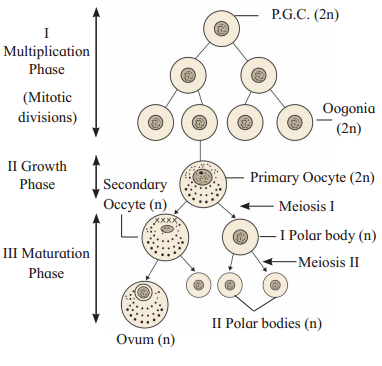
1. Oogenesis is the process of formation of the haploid female gamete, i.e. ovum.

2. The process of oogenesis takes place in the follicular cells inside the ovaries. The germinal epithelium cells undergo oogenesis.

3. They pass through three phases, viz. phase of multiplication, phase of growth and phase of maturation at the time of oogenesis.

  • Multiplication phase : Germinal cells undergo mitotic divisions and produce large number of diploid (2n) oogonia. Oogonia are present in the ovaries of female even before she is born.
  • Growth phase : During puberty changes, the FSH from pituitary makes one oogonium to develop at a time. The growth takes place as the follicle matures and larger primary oocyte (2n) is produced inside the Graafian follicle.
  • Maturation phase : The primary oocyte undergoes first meiotic division. There are equal nuclear divisions during meiosis but the cytoplasm is unequally divided.

4. By the end of first meiotic division, larger haploid secondary oocyte and smaller haploid polar body are produced. Since the embryo develops from the egg, there is provision for more food in the secondary oocyte.

(5) The second meiotic division takes place in the secondary oocyte and polar body. But this division is arrested during metaphase.

(6) The secondary oocyte is released from the ovary in the process of ovulation. Remaining division takes place if and only if ovum is fertilized.

(7) The division is unequal and form functional female gamete or ovum at the time of fertilization.

Need a full question paper?

Generate a complete, print-ready paper with questions like this in minutes — across 16+ boards, with answer keys.

Start Generating Free

Similar questions

What are biofertilizers? Explain what are the different types of biofertilizers with suitable examples.
Draw a labelled diagram of an anther lobe at microspore mother cell stage. Mention the role of different wall layers of anther.
Describe the stages during three trimesters of pregnancy. Explain the process of parturition. Add a note on location.

Describe Griffith’s transformation experiment.
OR
In the light of Griffith’s experiment, explain the action of two strains of streptococcus pneumoniae and give his conclusion.

Explain how Hershey – Chase experimentally proved that DNA is the genetic material.
  1. Write the scientific names (binomials) of the causative organisms of pneumonia.
  2. How does a healthy person acquire infection of this disease?
  3. Mention the characteristic symptoms of the disease.
Water is essential for growth in plants.
The relation between species richness and area for a wide variety of taxa turns out to be a rectangular hyperbola. Give a brief explanation.
Which of the following ecosystems will be more productive in terms of primary productivity? Justify your answer.
A young forest, a natural old forest, a shallow polluted lake, alpine meadow.
Naman entered into a quarrel with some farmers who were spraying DDT in their field. Many people gathered at the spot to see and enjoy the incident. The angry mob demanded that Naman should not interfere in the farmer's job. Naman tried to explain his point and finally succeeded in explaining the harmful effects of DDT.
  1. What is biomagnification? Explain with an example.
  2. Is biomagnification related with DDT only? Comment.
  3. What is the effect of DDT on birds?
  4. What values did Naman promote?