Bihar BoardEnglish MediumSTD 12 ScienceChemistrySolutions4 Marks
Question
What is Osmosis? What is Osmotic Pressure? Derive it's formula.
✓
Answer
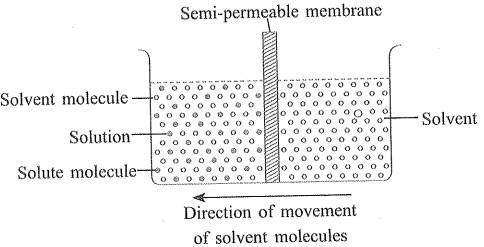
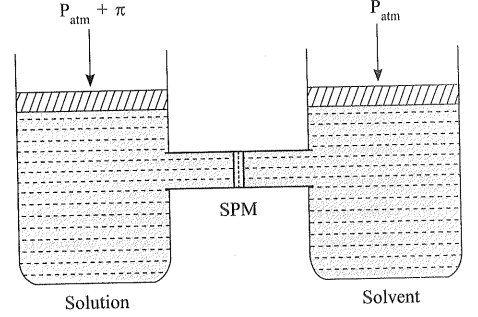
→ If semi permeable membrane is placed between the solvent and solution as shown fig. the solvent molecules will flow through the membrane from pure solvent to the solution. This process of flow of the solvent is called osmosis. → The flow will continue till the equilibrium is attained → The flow of the solvent from its side to solution side across a semipermeable membrane can be stopped if some extra pressure is applied on the solution. This pressure that just stops the flow of solvent is called osmotic pressure of the solution. → The osmotic pressure of a solution is the excess pressure that must be applied to a solution to prevent osmosis, → Osmotic pressure is a colligative property as it depends on the number of solute molecules and not on their identity. → osmotic pressure is proportional to the molarity, C of the solution at a given temperature T. $ \pi=\text { CRT } $ Where, $\pi=$ Osmotic pressure $ R =\text { gas constant } $ $\begin{aligned} \therefore \pi & =\frac{n_2 R T}{V} \quad\left(\because C=\frac{n_2}{V}\right) \\ \pi & =\frac{W_2 R T}{M_2 V}\end{aligned}$ $\begin{array}{l} W _2= Wt . \text { of Solute } \\ M _2=\text { Molar mass of Solute } \\ V =\text { Volume of Solution(L) } \\ T =\text { Temperature }\end{array}$
Need a full question paper?
Generate a complete, print-ready paper with questions like this in minutes — across 16+ boards, with answer keys.