Question
What is osmosis?

Answer

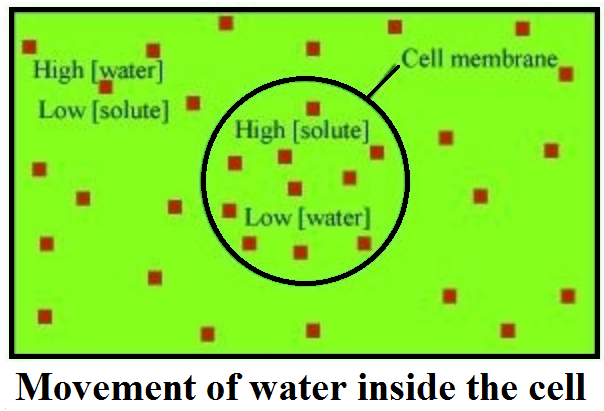
The movement of water molecules from a region of high concentration to a region of low concentration through a selectively permeable membrane is called osmosis. It is a special case of diffusion, where the medium is water. For example, if the medium surrounding the cell has a higher water concentration than the cell i.e., if the solution is a dilute solution, then the cell will gain water by osmosis.

Need a full question paper?

Generate a complete, print-ready paper with questions like this in minutes — across 16+ boards, with answer keys.
Start Generating Free

Similar questions

Write a short note on prevention of animal diseases.

State and explain Newton’s second law of motion.
Describe the method of separating a mixture containing common salt, sand and ammonium chloride.
How will you separate a mixture of common salt, sulphur powder and sand?
State the law of conservation of mass. Give one example to illustrate this law.
Name the following compounds. Also write the symbols/ formulae of the ions present in them:
  1. CuSO4
  2. (NH4)2SO4
  3. Na2O
  4. Na2CO3
  5. CaCl2
How many grams of magnesium will have the same number of atoms as 6 grams of carbon?
(Mg = 24u; C = 12u)
Explain the transformation of energy in the following cases:
  1. A ball thrown upwards.
  2. A stone dropped from the roof of a building.
How is green revolution different from white revolution?
A, B and C are all liquids. Liquid A has a comparatively low boiling point. On heating, liquid a vaporizes completely without leaving behind any residue. Liquid A is being used increasingly as a fuel in motor vehicles either alone or by mixing with petrol. Liquid B has a very high boiling point. It also vaporizes completely on heating, without leaving any residue. Liquid B is a conductor of electricity and used in making thermometers. Liquid c has a moderate boiling point. On heating, liquid C vaporises leaving behind a white solid D which is used in cooking vegetables. The condensation of vapours from C give a liquid E which turns anhydrous CuSO4 to blue.
  1. Which liquid could be an element? Name this element.
  2. Which liquid could be a mixture? Name this mixture.
  3. Which liquid could be a compound? Name this compound.
  4. What could the solid D be?
  5. What do you think is liquid E?