MCQ
What is relation between following molecules
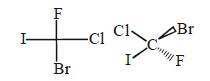
  • A
    Enantiomers
  • B
    Diastereomers
  • C
    Geometrical isomerism
  • Homomers

Answer

Correct option: D.
Homomers
d

Need a full question paper?

Generate a complete, print-ready paper with questions like this in minutes — across 16+ boards, with answer keys.

Start Generating Free

Similar questions

Fluorine has low electron affinity than chlorine because of
Aluminium oxide is not reduced by chemical reactions since
Primary alcohols can be obtained from the reaction of the $RMgX$  with
Which of the following linear combination of atomic orbitals will lead to formation of molecular orbitals in homonuclear diatomic molecules [internuclear axis in z-direction] ?
A. $2 p_{z}$ and $2 p_{x}$
B. 2 s and $2 \mathrm{p}_{\mathrm{x}}$
C. $3 d_{x y}$ and $3 d_{x^{2}-y^{2}}$
D. 2 s and $2 \mathrm{p}_{z}$
E. $2 p_{z}$ and $3 d_{x^{2}-y^{2}}$
In a first-order reaction $A \rightarrow B,$ if $ k$ is rate constant and initial concentration of the reactant $A$ is $0.5\, M,$ then the half-life is
The largest no. of molecules are in
The following concentrations were observed at $500 \mathrm{~K}$ for the formation of $\mathrm{NH}_3$ from $\mathrm{N}_2$ and $\mathrm{H}_2$. At equilibrium: $\left[\mathrm{N}_2\right\rfloor=2 \times 10^{-2}\ \mathrm{M},\left[\mathrm{H}_2\right\rfloor=3 \times 10^{-2}\  \mathrm{M}$ and $\left[\mathrm{NH}_3\right\rfloor=1.5 \times 10^{-2} \  \mathrm{M}$. Equilibrium constant for the reaction is________
The conductivity of a weak acid $HA$ of concentration $0.001\, \mathrm{~mol}\, \mathrm{~L}^{-1}$ is $2.0 \times 10^{-5}\, \mathrm{~S} \,\mathrm{~cm}^{-1} .$ If $\Lambda_{\mathrm{m}}^{\circ}$ $(\mathrm{HA})=190 \,\mathrm{~S} \,\mathrm{~cm}^{2} \mathrm{~mol}^{-1}$, the ionization constant $\left(\mathrm{K}_{\mathrm{a}}\right)$ of $\mathrm{HA}$ is equal to $....\,\times 10^{-6} .$ (Round off to the Nearest Integer)
Given that

$C(s) + {O_2}(g) \to C{O_2}(g),\Delta H = - 394\,kJ$

$2{H_2}(g) + {O_2}(g) \to 2{H_2}O(l),\,\Delta H = 568\,kJ$

$C{H_4}(g) + 2{O_2}(g)\,\, \to \,\,C{O_2}(g) + 2{H_2}O(l)$ $\Delta H = - 892\,kJ$ Heat of formation of $C{H_4}$ is.....$kJ$

General formula of paraffin is