Question
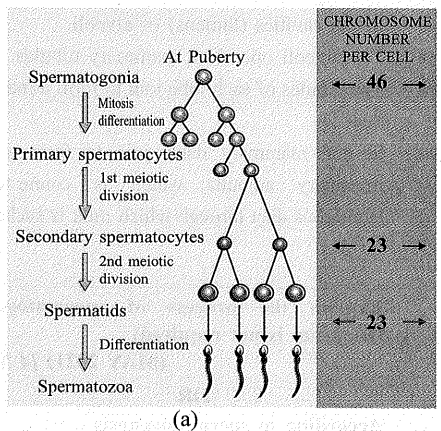
What is spermatogenesis? Briefly describe the process of spermatogenesis.###Explain the process of spermatogenesis. (Diagram is not required)###According to spermatogenesis (i) Development of sperm from primary spermatocytes. Explain it. (ii) Role of hormones which secreting from pituitary gland (iii) Structure of sperm (Diagram is not necessary)
Need a full question paper?

Generate a complete, print-ready paper with questions like this in minutes — across 16+ boards, with answer keys.

Start Generating Free

Similar questions

Explain pBR322 with its cloning sites, enzymes with well labeled diagram.###Explain: cloning sites. (Diagram is not necessary)
Read the following and answer any four questions from (i) to (v) given below: Siddharth is a chain smoker. He got into this habit in early adolescence due to peer pressure and gradually got addicted to this habit. Its now almost 20 years he is into the habit of smoking. Since few months he is experiencing pain in chest, shortness of breath, wheezing and chronic cough with phlegm. He seeked advice of a medical practitioner who diagnosed him with lung cancer. Based on the above information, answer the following questions.
  1. What do you think is the possible carcinogen responsible for Siddharth's lung cancer?
  1. Nitrosamines
  2. Benzo(a)pyrene
  3. Hydrazine
  4. All of these
  1. How is lung cancer diagnosed?
  1. Computerised tomography scan
  2. Sputum cytolog
  3. Biopsy of lung tissue
  4. All of these
  1. From which of the following type of cancer is Siddharth suffering from?
  1. Sarcoma
  2. Carcinoma
  3. Lymphoma
  4. Leukemia
  1. Select the correct statement.
  1. Surgery, radiotherapy and chemotherapy can be used to treat lung cancer.
  2. Chemotherapy involves the exposure of cancerous parts to X rays which destroy rapidly growing cancer cells.
  3. Surgical removal of lung cancer tissue is suggested at advanced stage 4.
  4. Monoclonal antibodies can effectively treat lung cancer and can cure it completely.
  1. Assertion: Lung cancer if not treated at an early stage can spread to other initial organs of the body.
Reason: Cancer cell have uncontrolled proliferation and ability to invade new sites (metastasis).
  1. Both assertion and reason are true and reason is the correct explanation of assertion.
  2. Both assertion and reason are true but reason is not the correct explanation of assertion.
  3. Assertion is true but reason is false.
  4. Both assertion and reason are false
Explain co-dominance in humans with the help of example.
Explain exponential growth equation with well labeled diagram.###Explain exponential growth.
Give an account of energy flow in an ecosystem.
Write a short note on embryo development.###With a labeled diagram discuss stages in embryo development in a dicot.
Read the following and answer any four questions from (i) to (v) given below:
Embryo develops at the micropylar end of the embryo sac, where the zygote is situated. Most zygotes divided only after certain amount of endosperm is formed. The early stages of embryo development are similar in both monocotyledons and dicotyledons. The zygote gives rise to the proembryo and subsequently to the globular heart-shaped and mature embryo. A typical dicotyledonous embryo consists of an embryonal axis and two cotyledons. Embryo of monocotyledons possess only one cotyledon.
  1. True embryo develops as a result of fusion of:
  1. Two polar nuclei of embryo sac.
  2. An egg cell and a male gamete.
  3. Synergid and male gamete.
  4. A male gamete and antipodals.
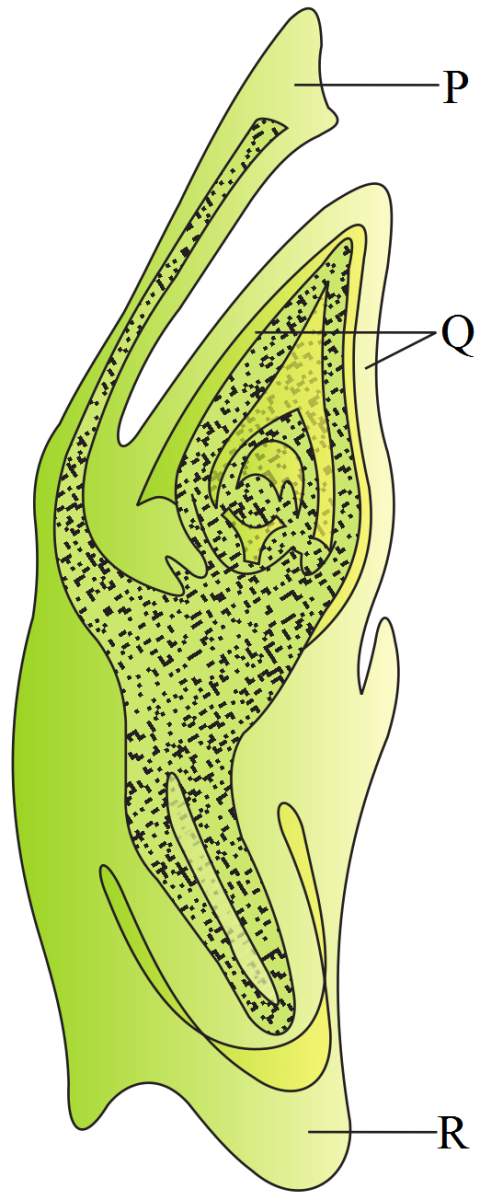
  1. Refer to the given diagram of the embryo of an angiospermous plant with parts labelled P, Q and R. Select the correct statement(s) regarding this.
  1. Part 'P' supplies nutrition to the developing embryo.
  2. Part 'Q' is the protective sheath of radicle and root cap.
  3. Part 'R' is the protective sheath of shoot apex and leaf primordia.
  4. The embryo shown in the diagram is present in members of Family Poaceae.
  1. (IV) only.
  2. (II) and (III) only.
  3. (I) and (IV) only.
  4. (I), (II), (III) and (IV).
  1. Which of the given statements are true?
  1. During the development of a dicot embryo, heart-shaped embryo is followed by globular embryo.
  2. The part of embryonal axis above the level of cotyledons is epicotyl, while the part below the level of cotyledons is hypocotyl.
  3. Monocot seeds possess a single cotyledon, represented by scutellum.
  1. (I) and (II).
  2. (II) and (III).
  3. (I) and (III).
  4. (I), (II) and (III).
  1. Consider the following parts of an embryonal axis of a dicot seed.
  1. Hypocotyl.
  2. Epicotyl.
  3. Radicle.
  4. Plumule.
In which of the following the above parts are correctly arranged from top to base?
  1. (III) → (I) → (II) → (IV).
  2. (II) → (I) → (III) → (IV).
  3. (IV) → (II) → (I) → (III).
  4. (III) → (IV) → (II) → (I).
  1. In grass family, the cotyledon, is called:
  1. Epiblast.
  2. Plumule.
  3. Scutellum.
  4. Perisperm.
Explain in situ approach for conservation of biodiversity.
Read the following and answer any four questions from (i) to (v) given below:
ln many species of fig trees, there is a tight one-to-one relationship with the pollinator species of wasp. It means that a given fig species can be pollinated only by its 'partner' wasp species and no other species. The wasp pollinates the fig inflorescence while looking for suitable egg-laying sites. ln return for the favour of pollination, the fig offers the wasp some of its developing seeds as food for the developing wasp larvae.
  1. The interaction between fig trees and wasp is an example of:
  1. Mutualism
  2. Commensalism
  3. Amensalism
  4. Parasitism
  1. AD the given interactions are similar to interaction between fig trees and wasp, except.
  1. Plant and animal relation for pollination.
  2. Association of algae and fungi in lichens.
  3. Association of cattle egret and grazing cattle.
  4. Association of fungi and roots of higher plants in mycorrhiza.
  1. In which of the following interactions both partners are adversely affected?
  1. Parasitism
  2. Mutualism
  3. Competition
  4. Predation
  1. ln relationship between fig and wasp:
  1. One benefitted other harmed.
  2. Both are benefitted.
  3. One benefitted other unaffected.
  4. One inhibited, other unaffected.
  1. Assertion: Fig and wasp cannot complete their life cycle without each other.
Reason: They show mutualistic relationship.
  1. Both assertion and reason are true and reason is the correct explanation of assertion.
  2. Both assertion and reason are true but reason is not the correct explanation of assertion.
  3. Assertion is true but reason is false.
  4. Both assertion and reason are false.
Read the following and answer any four questions from (i) to (v) given below:
Over population causes number of family problems. Strategies like birth control methods help to control population explosion. Natural methods of birth control do not involve medications or devices to prevent pregnancy, but rather rely on behavioural practices and/ or making observations about menstrual cycle.
  1. Which method helps in contraception by temporary absence of sex?
  1. Coitus interruptus.
  2. Withdrawal method.
  3. Rhythm method.
  4. Lactational amenorrhea method.
  1. Assertion: The effectiveness of coitus interruptus method is limited.
Reason: Some sperms may pass into vagina before ejaculation.
  1. Both assertion and reason are true, and reason is the correct explanation of assertion.
  2. Both assertion and reason are true, but reason is not the correct explanation of assertion.
  3. Assertion is true, but reason is false.
  4. Both assertion and reason are false.
  1. Why is lactational amenorrhea effective for about 4-5 months after parturition?
  1. Ovulation occurs on about the $14^{th}$ day of menstruation.
  2. Ovulation does not occur during intense lactation.
  3. This method inhibits mobility of sperms.
  4. Both (b) and (c).
  1. Which fact is not the basis of periodic absence method of birth control?
  1. Ovum remains alive for about 1-2 days.
  2. Ovulation occurs on about $14^{th}$  day of menstruation.
  3. Sperms survive for about 3 days.
  4. Alteration in uterine endometrium.
  1. On which days of menstrual cycle should coitus be avoided to prevent fertilisation?
  1. 10-17
  2. 6-13
  3. 1-5
  4. 15-28