Question
Write a short note on embryo development.###With a labeled diagram discuss stages in embryo development in a dicot.

Answer

Embryo develops at the micropylar end of the embryo sac where the zygote is situated. Image
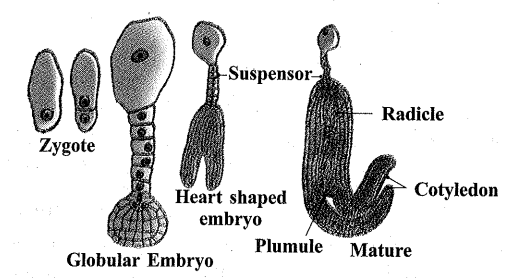
→ Most zygotes divide only after certain amount of endosperm is formed. This is an adaptation to provide assured nutrition to the developing embryo.
→ Though the seeds differ greatly, the early stages of embryo development (embryogeny) are similar in both monocotyledons and dicotyledons.
→ Figure depicts the stages of embryogeny in a dicotyledonous embryo. The zygote gives rise to the proembryo and subsequently to the globular, heart-shaped and mature embryo.
Dicotyledonous embryo:
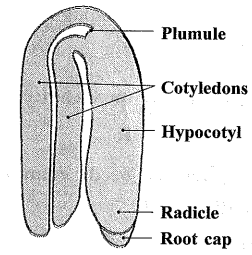
→ A typical dicotyledonous embryo, consists of an embryonal axis and two cotyledons.
Image
(i) Epicotyl: The portion of embryonal axis above
the level of cotyledons is the Epicotyl, which terminates with the plumule or stem tip.
(ii) Hypocotyl: The cylindrical portion below the level of cotyledons is Hypocotyl that terminates at its lower end in the radicle or root tip. The root tip is covered with a root cap.
Monocotyledonous embryo :
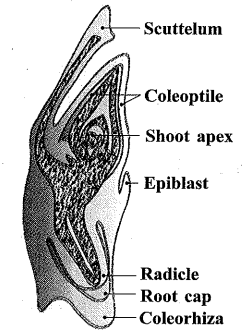
→ Embryos of monocotyledons possess only one cotyledon.
Image
(i) Scutellum: In the grass family the cotyledon is called scutellum that is situated towards one side (lateral) of the embryonal axis.
(ii) Coleorrhiza: At its lower end, the embryonal axis has the radical and root cap enclosed in an undifferentiated sheath called Coleorrhiza.
(iii) Coleoptile: The portion of the embryonal axis above the level of attachment of scutellum is the epicotyl. Epicotyl has a shoot apex and a few leaf primordia enclosed in a hollow foliar structure, the Coleoptile.
Need a full question paper?

Generate a complete, print-ready paper with questions like this in minutes — across 16+ boards, with answer keys.

Start Generating Free

Similar questions

Explain Mutualism as a population interaction with suitable examples.###Explain Mutualism with examples
Read the following and answer any four questions from (i) to (v) given below:
Non-native or alien species are often introduced in advertently for their economic and other uses. They often become invasive and drive away the local species. Exotic species have proved harmful to both aquatic and terrestrial ecosystems. For example, water hyacinth (Eichhornia crassipes) was introduced in Indian waters to reduce pollution. It was clogged water bodies including wetlands at many places resulting in death of several aquatic plants and animals.
  1. Island water ecosystem are the most vulnerable due to:
  1. Small size.
  2. Small number of species.
  3. Increases reproductive capacity.
  4. Both (a) and (b).
  1. Which of the following is not an alien species?
  1. Lantana camara.
  2. Periplaneta americana.
  3. Nile Perch.
  4. Yucca moth.
  1. Second major cause of species extinction is:
  1. Habitat loss and fragmentation.
  2. Over exploitation.
  3. Alien species invasion.
  4. Co-extinction.
  1. Assertion: Eichhomia crassipes drains off oxygen from water and can be seen growing in standing water.
Reason: Eichhornia crassipes is an indigenous species of India.
  1. Both assertion and reason are true and reason is the correct explanation of assertion.
  2. Both assertion and reason are true but reason is not the correct explanation of assertion.
  3. Assertion is true but reason is false.
  4. Both assertion and reason are false.
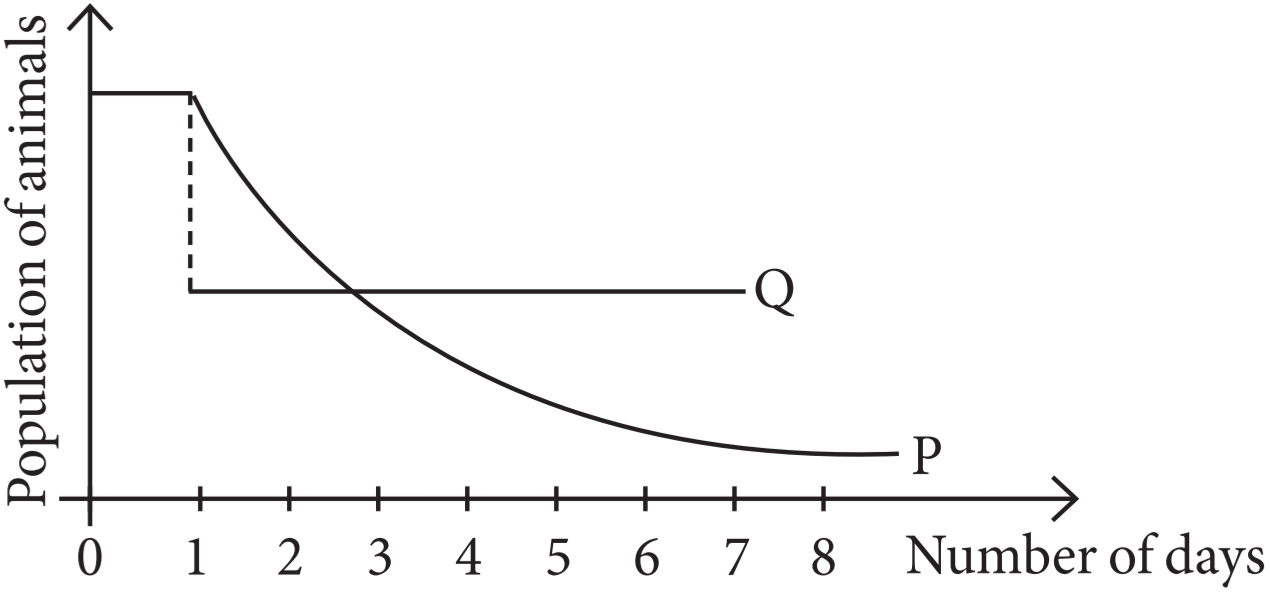
  1. The population of species Pin a certain conununity was constant until a population species Q from a distant land was subsequently introduced into that community. The interaction between the two populations is reflected in the graph below.


What could be the possible reason for the decrease in the population of species P over a number of days?
  1. Species Q is a predator of species P.
  2. Species Q is a prey species which wiped out the population of species P.
  3. Species P and Q compete for space but feeds on different food.
  4. None of these.
Explain parasitism as population interaction with examples.
Give information about primary and secondary lymphoid organ ### Explain lymphatic organs of human lymphatic system. (Diagram is not required)
Read the following text carefully and answer the questions that follow:
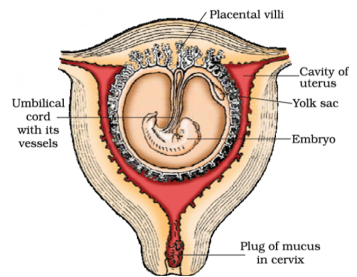
After implantation, finger-like projections appear on the trophoblast called chorionic villi which are surrounded by the uterine tissue and maternal blood. The chorionic villi and uterine tissue become interdigitated with each other and jointly form a structural and functional unit between the developing embryo (foetus) and the maternal body.
Image
i. Name the hormone crucial in parturition. Does the parturition signal originate from the mother or the fetus?(1)
ii. When and where do chorionic villi appear in humans? (1)
iii. Woman has conceived and implantation has occurred. Discuss the impact of progesterone and estrogen. (2)
OR
Fetal ejection reflex leads to parturition. Justify (2)
Read the following and answer any four questions from (i) to (v) given below:
Mutation explains the relationship between gene and DNA. The effects of large deletions and rearrangement in a segment of DNA results in loss or gain of gene and its function. Insertion or deletion of one or two bases changes the reading frame from the point of insertion or deletion. A classical example of point mutation is a change of single base pair in the gene for beta globin chain that results in change of amino acid residue glutamate to valine and results into a diseased condition called sickle cell anaemia.
  1. A mutation is a change produced by an alteration in the genetic mechanism and.
  1. May arise spontaneously.
  2. Is always induced by the environment.
  3. Is never advantageous.
  4. Is not inherited.
  1. The DNA code for glutamic acid is CTC or CTT. The code for valine is CAA or CAT. In sickle cell haemoglobin, valine is present instead of glutamic acid.
Assuming a single base pair substitution has occurred, what is the mRNA code in the affected mutant?
  1. CUU
  2. GAA
  3. GAG
  4. GUA
  1. A mutation involving the substitution of one nitrogenous base for another has altered the base sequence of a DNA molecule, coding for four amino acids, as shown below.
Normal A-G-C-A-T-G-G-A-T-C-C-T

Mutant A-G-C-A-T-G-C-A-T-C-C-T
The table shows six codons and the corresponding amino acids into which each is translated.
mRNA codon
Amino acid
AAG
Lysine
CUA
Leucine
GGA
Glycine
GUA
Valine
UAC
Tyrosine
UCG
Serine
The mutation has changed the amino acid.
  1. Leucine to valine.
  2. Lysine to glycine.
  3. Serine to leucine.
  4. Tyrosine to lysine.
  1. Assertion : Insertion or deletion of three or its multiple bases, insert or delete one or multiple codons and so one or multiple amino acids.
Reason: Reading frame remains unaltered with insertion or deletion of three or its multiple bases.
  1. Both assertion and reason are true, and reason is the correct explanation of assertion.
  2. Both assertion and reason are true, but reason is not the correct explanation of assertion.
  3. Assertion is true, but reason is false.
  4. Both assertion and reason are false.
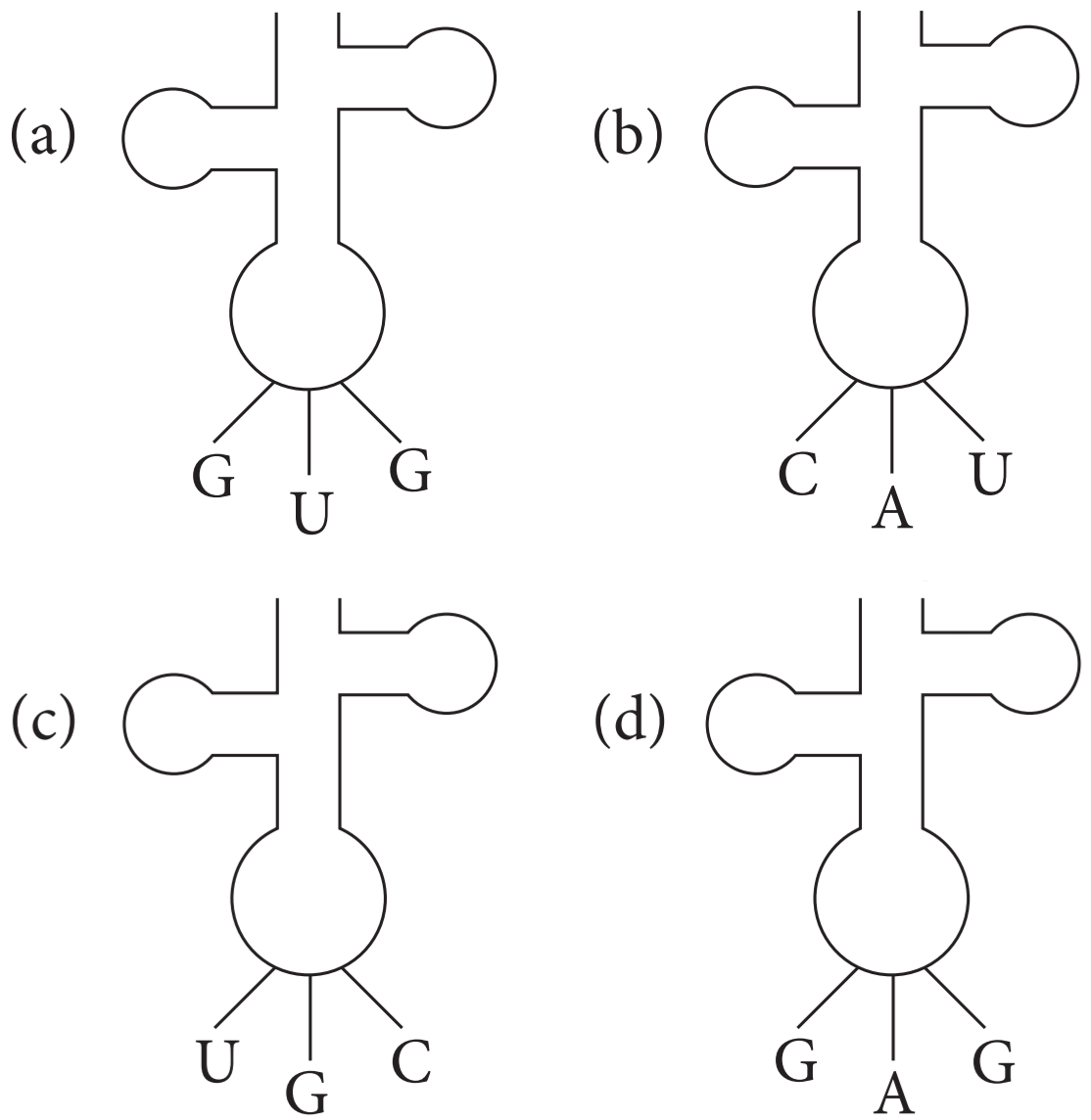
  1. Part of the amino acid sequences in normal and sickle cell haemoglobin are shown.
Normal haemoglobin Sickle cell haemoglobin
Thr-Pro-Glu-Glu Thr-Pro-Val-Glu
mRNA codons for these amino acids are
Glutamine (Glu) GAA GAG
Praline (Pro) CCU CCC
Threonine (Thr) ACU ACC
Valine (Val) GUA GUG
Which transfer RNA molecule is involved in the formation of this part of the sickle cell haemoglobin?
Write a short note on pollination by wind.
Polymerase chain reaction:
Read the following and answer any four questions from (i) to (v) given below:
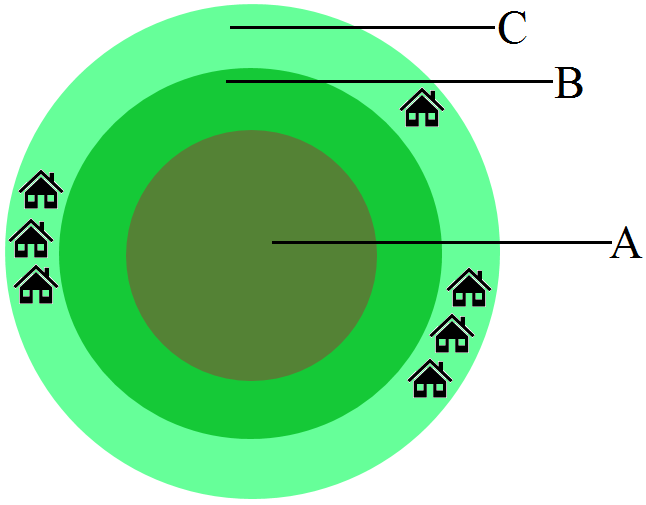
Biosphere reserves are multipurpose protected areas which are meant for preserving genetic diversity in representative ecosystems of various natural biomes and unique biological communities by protecting wild populations, traditional life style of tribals and domesticated plant/animal genetic resources. Each biosphere reserve has three zones-core, buffer and transition zone.
  1. Which of the following is similar to biosphere reserve in terms of conservation?
  1. Gene banks.
  2. Offsite collection.
  3. Orchards.
  4. Hotspots.
  1. Refer to the given figure representing different zones of a biosphere reserve and select the correct option regarding it.
  1. A-Limited human activity is allowed such as for research and education.
  2. B-An active co-operation occurs between reserve management and local people for activities like cropping, settlements, etc.
  3. C-No human activity is allowed.
  4. None of these.
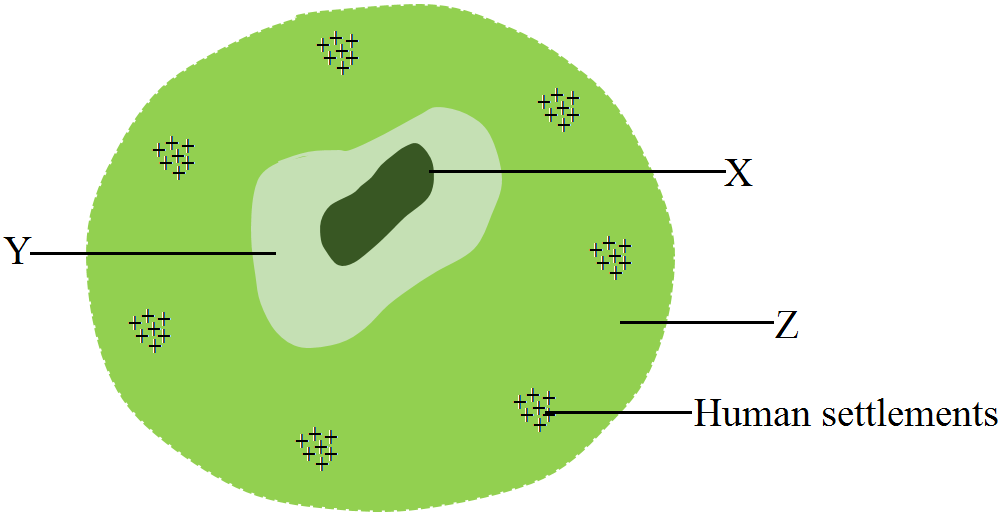
  1. Refer to the given diagrammatic representation of a biosphere reserve.


Select the incorrect statement regarding X, Y and Z.
  1. X is devoted to strict protection of wildlife and no human activity is allowed in this zone.
  2. In Y, only limited human activity (compatible with conservation) is allowed.
  3. In Z, commercial exploitation of natural resources is allowed.
  4. Tourism is allowed in Z zone only.
  5. Zone Y helps to maintain the lifestyle of the tribal people living in the area.
  1. (iii), (iv) and (v) only
  2. (ii), (iii) and (v) only
  3. (i), (iii) and (iv) only
  4. (ii), (iii) and (iv) only
  1. Biosphere reserves differ from national parks and wildlife sanctuaries because in the former.
  1. Human beings are not allowed to enter
  2. People are an integral part of the system
  3. Plants are paid greater attention than the animals
  4. Living organisms are brought from all over the world and preserved for posterity.
  1. MAB Programme means.
  1. Man and biosphere programme.
  2. Man and biodiversity conservation programme.
  3. Manually aided biosphere conservation programme.
  4. None of these.
Explain co-dominance in humans with the help of example.