Question
What is the Bulk modulus for a perfect rigid body?

Answer

Bulk Modulus $=\frac{-\text{p(V)}}{\Delta\text{V}}$ as the perfect rigid body does not change it's shape even at infinite (deforming a stretching) force. Hence, $\Delta\text{V}=0$ $\Rightarrow\ \text{B}=\frac{\text{pV}}{\Delta\text{V}}=\frac{\text{pV}}{0}=\propto$ So the bulk modulus is infinity.

Need a full question paper?

Generate a complete, print-ready paper with questions like this in minutes — across 16+ boards, with answer keys.
Start Generating Free

Similar questions

The torque of a force $\overrightarrow{\text{F}}$ about a point is defined as $\overrightarrow{\text{r}}=\overrightarrow{\text{r}}\times\overrightarrow{\text{F}}.$ Suppose $\overrightarrow{\text{r}}, \overrightarrow{\text{F}}$and $\overrightarrow{\text{r}}$ are all nonzero. Is $\text{r}\times\overrightarrow{\text{r}}\Bigg|\Bigg|\overrightarrow{\text{F}}$ always true? Is it ever true?
A block of mass 250g slides down an incline of inclination 37° with a uniform speed. Find the work done against the friction as the block slides through 1.0m.
For what condition, an object could be considered as a point object? Describe in brief.
Prove the Kepler's law, that the line joining the sun and the planet sweeps equal areas in equal time, using the angular momentum conservation with the planet.
A projectile is fired from the top of a 40m high cliff with an initial speed of 50m/s at an unknown angle. Find its speed when it hits the ground.
There are two containers of equal volume. One is filled with oxygen gas and the other is filled with hydrogen gas. If both the gases are at the same temperature then what will be the ratio of their pressures? If the ratio of their square root velocities is $1: 4$.
A car travelling at a speed of 10m/s due North, turns to its left and travels with same speed. Find the change in velocity associated.
Show that if the room temperature changes by a small amount from T to $\text{T}+\triangle\text{T},$ the fundamental frequency of an organ pipe changes from v to $\text{v}+\triangle\text{v},$ where-$\frac{\triangle\text{v}}{\text{v}}=\frac{1}{2}\frac{\triangle\text{T}}{\text{T}}.$
Find the dimensions of :
  1. Electric dipole moment $p$.
  2. Magnetic dipole moment $M$.
The defining equations are $p = q.d$ and $M = IA$, where $d$ is distance, $A$ is area, $q$ is charge and $I$ is current.
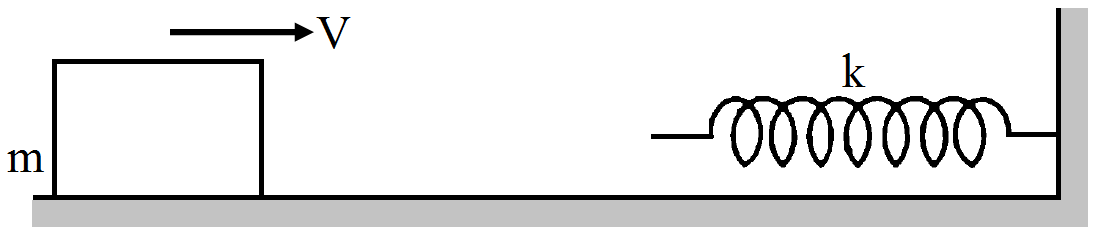
A block of massip, sliding on a smooth horizontal surface with a velocity $\vec{\text{v}}$ meets a long horizontal spring fixed at one end and having spring constant k as shown in figure. Find the maximum compression of tin spring. Will the velocity of the block be the same $\vec{\text{v}}$ when it comes back to the original position shown?