Question
What is the difference between a theorem and an axiom?

Answer

Axiom: An axiom is a basic fact that is taken for granted without proof.
Examples:
  1. Halves of equals are equal.
  2. The whole is greater than each of its parts.
Theorem: A statement that requires proof is called theorem.
Examples:
  1. The sum of all the angles around a point is 360°.
  2. The sum of all the angles of triangle is 180°.

Need a full question paper?

Generate a complete, print-ready paper with questions like this in minutes — across 16+ boards, with answer keys.
Start Generating Free

Similar questions

ABCD is such a quadrilateral that A is the centre of the circle passing through B, C and D. Prove that $\angle\text{CBD}+\angle\text{CDB}=\frac{1}{2}\angle\text{BAD}$
Draw the graph of the following linear equations in two variables:
y = 2x
If two circles intersect at two points, prove that their centres lie on the perpendicular bisector of the common chord.
Prove that:
$\frac{1}{1+\sqrt{2}}+\frac{1}{\sqrt{2}+\sqrt{3}}+\frac{1}{\sqrt{3}+\sqrt{4}}+\frac{1}{\sqrt{4}+\sqrt{5}}\\+\frac{1}{\sqrt{5}+\sqrt{6}}+\frac{1}{\sqrt{6}+\sqrt{7}}+\frac{1}{\sqrt{7}+\sqrt{8}}+\frac{1}{\sqrt{8}+\sqrt{9}}=2$
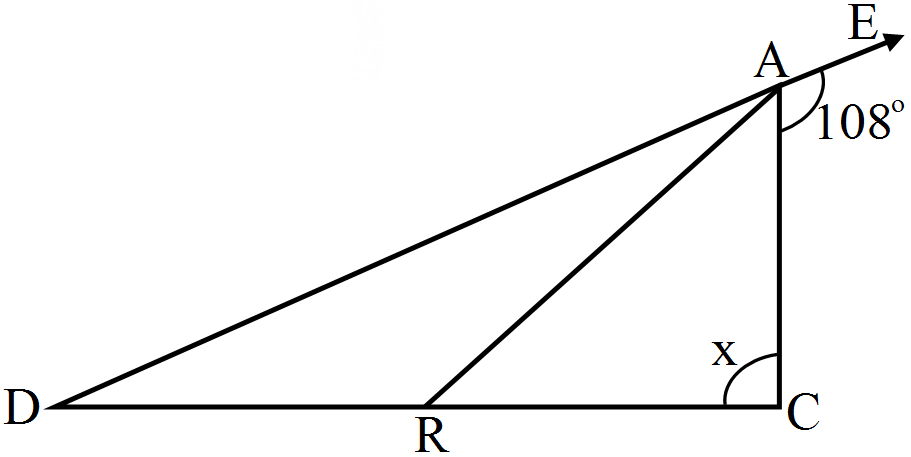
In figure AB divides $\angle\text{DAC}$ in the ratio 1 : 3 and AB = DB. Determine the value of x.

Find rational numbers a and b such that:
$\frac{5+2\sqrt{3}}{7+4\sqrt{3}}=\text{a}+\text{b}\sqrt{3}$
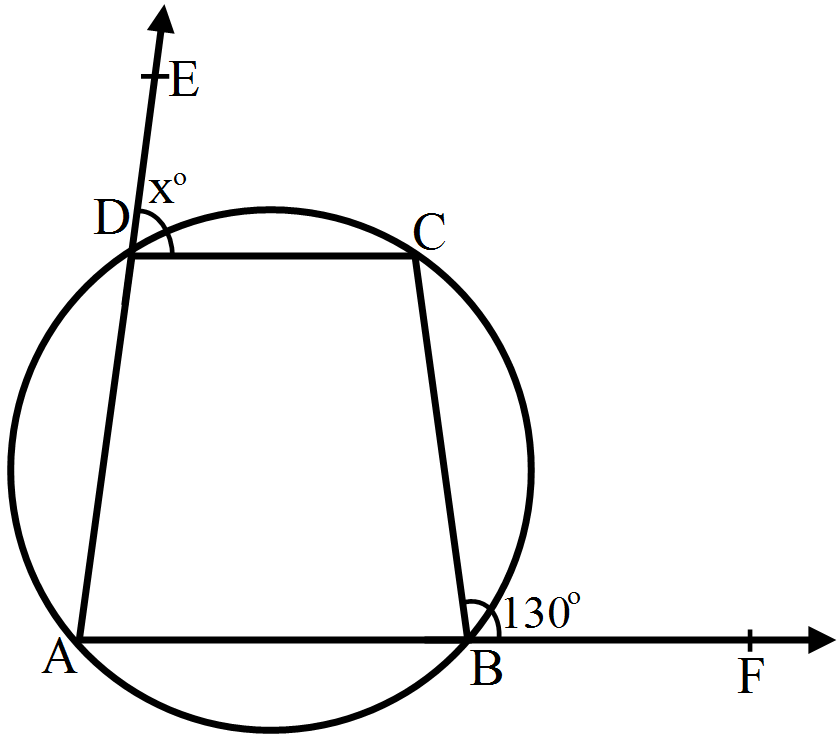
In the given figure, sides AD and AB of cyclic quadrilateral ABCD are produced to E and Frespectively. If $\angle\text{CBF}=130^\circ$ and $\angle\text{CDE}=\text{x}^\circ,$ find the value of x.

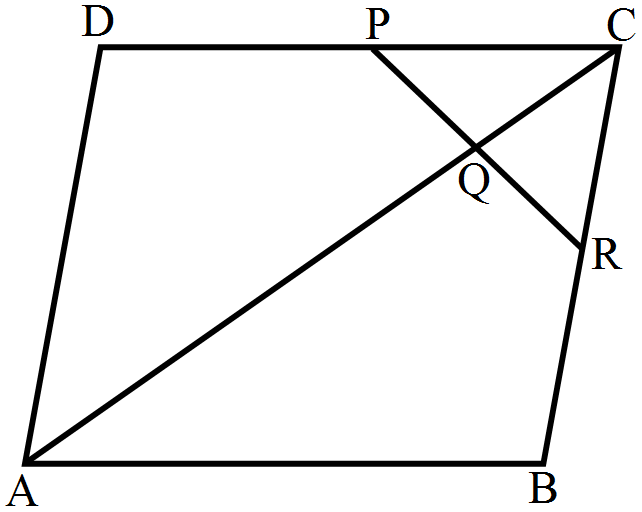
In ABCD is a parallelogram in which P is the mid-points of DC and Q is a point on AC such that $\text{CQ}=\frac{1}{4}\text{AC}.$ if PQ produced meets BC at E, prove R is a mid-points of BC.

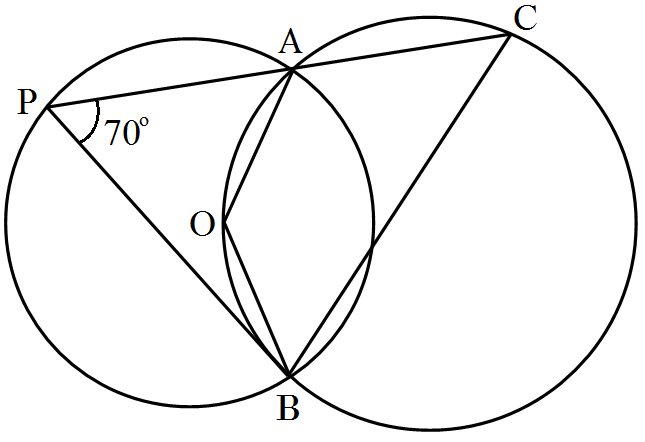
In the given figure, two circles intersect at A and B. The centre of the smaller circle is O and it lies on the circumference of the larger circle. If $\angle\text{APB} = 70^\circ,$ find $\angle\text{ACB.}$