Question
What is the impact parameter? Explain the trajectory of $\alpha$-particle from it.

Answer

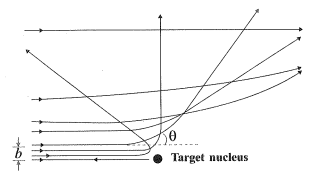
→Impact parameter (b) : "The perpendicular distance of the initial velocity vector of the $\alpha$-particle from the centre of the nucleus is called the impact parameter."
The path (trajectory) of an $\alpha$-particle depends on impact parameter of the collision with the nucleus.
Image
As shown in the figure, the impact parameters (b) of $\alpha$-particles are different so that they scattered in various directions with different probabilities.
An $\alpha$-particle which is close to the nucleus suffers large scattering.
In case of head-on collision, the impact parameter is minimum and the $\alpha$-particle rebounds back. (For head-on collision $b \approx 0, \theta \approx 180^{\circ}$ )
For a large impact parameter, the $\alpha$-particle goes nearly undeviated and has a small deflection.
The fact that only a small fraction of the number of incident particles of the number of incident particles rebound back indicates that the number of $\alpha$-particles undergoing head on collision is small. This implies that the mass and positive charge of the atom is concentrated in a small volume.
Therefore, Rutherford scattering experiment is a powerful way to determine the size of the nucleus.

Need a full question paper?

Generate a complete, print-ready paper with questions like this in minutes — across 16+ boards, with answer keys.
Start Generating Free

Similar questions

The following figure shows the variation of intensity of magnetisation versus the applied magnetic field intensity, H, for two magnetic materials A and B:
  1. Identify the materials A and B.
  2. Why does the material B, have a larger susceptibility than A, for a given field at constant temperature?
Explain the formation of potential barrier and depletion region in a p-n junction diode. What is effect of applying forward bias on the width of depletion region?
A cell of emf $ 'E\ ’$ and internal resistance $\ 'r\ ’$ is connected across a variable resistor $' R\ ’.$ Plot a graph showing variation of terminal voltage $' V\ ’$ of the cell versus the current $' I\ ’.$ Using the plot, show how the emf of the cell and its internal resistance can be determined.
Find the number of molecules in $1\ cm^3$ of an ideal gas at $0^\circ C$ and at a pressure of $10^{-5} \ mm $ of mercury.
Write down the difference between forward bias and reverse bias of $p-n$ junction diode.
A proton and an a-particle have the same de-Broglie wavelength. Determine the ratio of (i) Their accelerating potentials and (ii) Their speeds.
Two capacitors of capacitance 6 μF an 12 μF are connected in series with a battery. The voltage across the 6 capacitor is 2 V. Compute the total battery voltage.
Write down the equation of displacement current and derive the Ampere$-$Maxwell's law.
A spherical surface of radius 30cm separates two transparent media A and B with refractive indices 1.33 and 1.48 respectively. The medium A is on the convex side of the surface. Where should a point object be placed in medium A so that the paraxial rays become parallel after refraction at the surface?
Estimate the number of collisions per second suffered by a molecule in a sample of hydrogen at $\text{STP}.$ The mean free path $($average distance covered by a molecule between successive collisions$) = 1.38 \times 10^{-5}cm.$