MCQ
What is the main reason of diagonal relationship between lithium and magnesium?
  • A
    Electronegativity remains constant the same on moving parallel.
  • Electronegativity remains constant the same on moving horizontally.
  • C
    Electronegativity remains constant the same on moving diagonally.
  • D
    Electronegativity remains constant the same on moving vertically.

Answer

Correct option: B.
Electronegativity remains constant the same on moving horizontally.
The diagonally opposite elements possess almost similar electronegativities and there fore almost similar electropositive character.

Need a full question paper?

Generate a complete, print-ready paper with questions like this in minutes — across 16+ boards, with answer keys.

Start Generating Free

Similar questions

From the following $0.1\, M$ solution of compound, will be basic in nature
The shapes of nitrite and nitrile respectively are
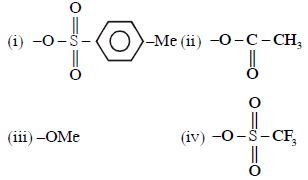
Rank the group in order of decreasing leaving group ability
The prefix ${10^{18}}$ is
The electronic configuration of four elements are

$(i)\, [Xe]\,6s^1$
$(ii)\, [Xe]\,4f^{14}5d^16s^2$
$(iii)\, [Ne]\,3s^23p^5$
$(iv)\, [Ar]\,3d^74s^2$

Which one of the following statements about these elements is not true ?

The correct sequence of polarity of the following molecule
$(1)$ Benzene           $(2)$ Inorganic Benzene
$(3)\, PCl_3F_2$        $(4)\, PCl_2F_3$

$1\,\,\,$-$\,\,\,2\,\,\,$-$\,\,\,3\,\,\,$-$\,\,\,4$

(Where. $P =$ polar, $NP =$ non-polar)

Which of the following is correct option for free expansion of an ideal gas under adiabatic condition?
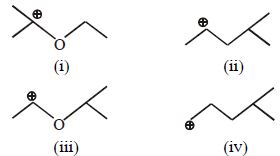
Correct order of stability for following carbocations
Compound $(X)$ will be

Compound $(X)$ $\xrightarrow[{Pt}]{{5{H_2}}}$ 

Compound $(X)$ $\xrightarrow{{AgN{O_3}}}$ Precipitate

Compound $(X)$ $\xrightarrow[{M{e_2}S}]{{{O_3}}}$ $\begin{array}{*{20}{c}}
  {\,\,\,\,\,\,\,O\,\,\,\,\,\,\,\,\,\,\,\,\,\,\,\,\,\,\,\,\,\,\,\,\,\,\,\,\,\,\,\,\,\,\,\,\,\,\,\,\,\,\,O\,\,\,\,\,\,\,\,\,\,O\,\,\,\,} \\ 
  {\,\,\,\,\,\,\,\,\,\,\,\,\,\,\,\,\,\,\,||\,\,\,\,\,\,\,\,\,\,\,\,\,\,\,\,\,\,\,\,\,\,\,\,\,\,\,\,\,\,\,\,\,\,\,\,\,\,\,\,\,\,\,\,\,||\,\,\,\,\,\,\,\,\,\,||\,\,\,\,\,\,\,\,\,\,\,\,\,\,\,\,\,\,} \\ 
  {H - C - C{H_2} - C{H_2} - C - C - H} 
\end{array}$ $\begin{array}{*{20}{c}}
  {\,\,O\,\,\,\,\,\,O\,\,\,\,\,\,\,\,\,\,} \\ 
  {||\,\,\,\,\,\,\,\,||\,\,\,\,\,\,\,\,\,} \\ 
  {H - C - C - O - H} 
\end{array}$ $ + \begin{array}{*{20}{c}}
  {O\,\,\,\,\,\,\,} \\ 
  {||\,\,\,\,\,\,\,\,} \\ 
  {H - C - O - H} 
\end{array}$ $ + \begin{array}{*{20}{c}}
  {CHO} \\ 
  {|\,\,\,\,\,\,\,\,} \\ 
  {CHO} 
\end{array}$

The hydrogen ion concentration of a $0.006\,M$ benzoic acid solution is $({K_a} = 6 \times {10^{ - 5}})$