MCQ
What is the maximum number of rectangular components into which a vector can be split in space?
  • A
    $2$
  • $3$
  • C
    $4$
  • D
    Infinite

Answer

Correct option: B.
$3$
b
The number of rectangular components into which a vector can be splitted in space is three as our space is three-dimensional.

Need a full question paper?

Generate a complete, print-ready paper with questions like this in minutes — across 16+ boards, with answer keys.
Start Generating Free

Similar questions

How many wavelength of Kr86 are there in 1m?
A metal wire of length $0.5 m$ and cross-sectional area $10^{-4}\; m ^{2}$ has breaking stress $5 \times 10^{8}\; Nm ^{-2}$. A block of $10\; kg$ is attached at one end of the string and is rotating in a horizontal circle. The maximum linear velocity of block will be $ms ^{-1}$.
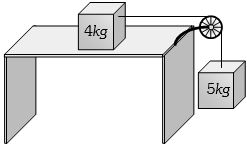
Two masses of $4\, kg$ and $5 \,kg$ are connected by a string passing through a frictionless pulley and are kept on a frictionless table as shown in the figure. The acceleration of $5\, kg$ mass is  ........... $m/s^2$
The height of water rising in a capillary will be:
You measure two quantities as $\text{A} = 1.0 \text{m}\pm 0.2 \text{m},\ \text{B} = 2.0 \text{m}\pm 0.2 \text{m}.$ We should report correct value for $\sqrt{\text{AB}}$ as:

  1. $1.4 \text{m}\pm 0.4\text{m.}$

  2. $1.41\text{m} \pm 0.15 \text{m}.$

  3. $1.4\text{m} \pm 0.3 \text{m}.$

  4. $1.4\text{m} \pm 0.2 \text{m}.$

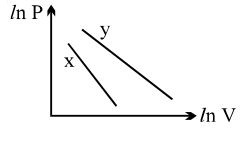
For two different gases $X$ and $Y$, having degrees of freedom $f_1$ and $f_2$ and molar heat capacities at constant volume $C_{V1}$ and $C_{V2}$ respectively, the ln $P$ versus ln $V$ graph is plotted for adiabatic process, as shown
A body is falling freely under the action of gravity alone in vacuum. Which of the following quantities remain constant during the fall?
  1. Kinetic energy.
  2. Potential energy.
  3. Total mechanical energy.
  4. Total linear momentum.
Every planet revolves around the sun in an elliptical orbit :

$A.$ The force acting on a planet is inversely proportional to square of distance from sun.

$B.$ Force acting on planet is inversely proportional to product of the masses of the planet and the sun

$C.$ The centripetal force acting on the planet is directed away from the sun.

$D.$ The square of time period of revolution of planet around sun is directly proportional to cube of semi-major axis of elliptical orbit.

Choose the correct answer from the options given below :

The maximum energy in thermal radiation from a source occurs at the wavelength $4000Å$ . The effective temperature of the source is ....... $K$
$Assertion$ : When a particle moves in a circle with a uniform speed, its velocity and acceleration both changes.

$Reason$ : The centripetal acceleration in circular motion is dependent on angular velocity of the body.