Question
What is the phase difference between electric and magnetic fields in an electromagnetic wave?
Answer

  1. $\pi$
Explanation: 
The phase difference between electric and magnetic fields in an electromagnetic wave is$\pi$.

Need a full question paper?

Generate a complete, print-ready paper with questions like this in minutes — across 16+ boards, with answer keys.

Start Generating Free

Similar questions

The layered lens is made of two kinds of glass. A point source of light is placed on its principal axis. If the reflections from the boundaries between layers are ignored, the lens will form
A parallel plate condenser with oil between the plates $($dielectric constant of oil $K = 2)$ has a capacitance $C$. If the oil is removed, then capacitance of the capacitor becomes
What is the C.G.S. unit of charge?
Which of the following are polar molecules:
A bar magnet has coercivity $4 \times 10^3 Am^{-1}.$ It is desired to demagnetise it by inserting it inside a solenoid $12 \ cm$ long and having $60$ turns. The current that should be sent through the solenoid is
The number of turns of primary and secondary coils of a transformer are 5 and 10 respectively and the mutual inductance of the transformer is 25 henry. Now the number of turns in the primary and secondary of the transformer are made 10 and 5 respectively. The mutual inductance of the transformer in henry will be(a) 6.25(b) 12.5(c) 25       (d) 50
       
Two photons, each of energy 2.5 eV are simultaneously incident on the metal surface. If the work function of the metal is 4.5 eV, then from the surface of the metal:
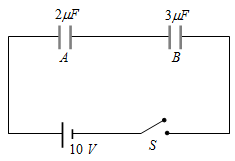
Two capacitors $A$ and $B$ are connected in series with a battery as shown in the figure. When the switch $S$ is closed and the two capacitors get charged fully, then
Resistance of a voltameter is 2Ω, it is connected in series to a battery of 10 V through a resistance of 3Ω. In a certain time mass deposited on cathode is 1 gm. Now the voltameter and the 3Ω resistance are connected in parallel with the battery. Increase in the deposited mass on cathode in the same time will be(a) 0 (b) 1.5 gm(c) 2.5 gm(d) 2 gm
       
A thin lens is made with a material having refractive index $\mu=1.5.$ Both the sides are convex. It is dipped in water $(\mu=1.33).$ It will behave like: