Question
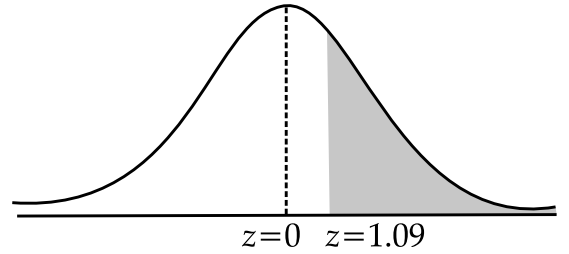
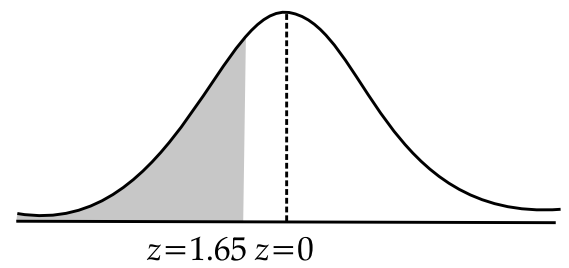
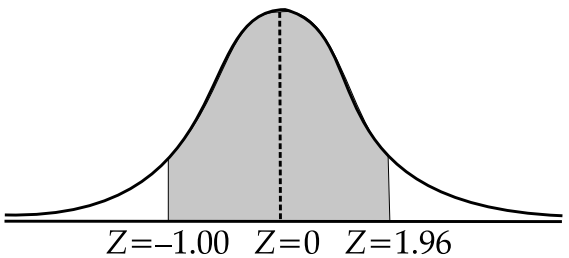
What is the probability that a standard normal variate Z will be
(i) greater than 1.09
(ii) less than - 1.65
(iii) lying between - 1.00 and 1.96

Need a full question paper?

Generate a complete, print-ready paper with questions like this in minutes — across 16+ boards, with answer keys.

Start Generating Free

Similar questions

If $A=\left(\begin{array}{ccc}1 & 3 & 2 \\ 2 & 0 & -1 \\ 1 & 2 & 3\end{array}\right)$, then show that $A^3-4 A^2-3 A+$ $11 I=0$.
The quarterly profits of a small-scale industry (₹ in thousands) are as follows.
YearQuarter 1Quarter 2Quarter 3Quarter 4
202039472056
202168596672
202288606067
Calculate 4-quarterly moving averages.
Two cards are drawn simultaneously (without replacement) from a well-shuffled pack of 52 cards. Find the mean and variance of the number of red cards.
Two cards are drawn successively without replacement from a well-shuffled deck of 52 cards. Compute the variance of the number of aces.
Prove that the following inequality holds true:
$
\sqrt{5}+\sqrt{3}>\sqrt{6}+\sqrt{2}
$
The sum of three numbers is 6. If we multiply the third number by 2 and add the first number to the result, we get 7. By adding second and third numbers to three times the first number, we get 12. Using matrices find the numbers.
Two numbers are selected at random (without replacement) from the first six positive integers. Let x denote the larger of the two numbers obtained. Find the probability distribution of random variable x and hence find the mean of the distribution.
Two numbers are selected at random (without replacement) from first 7 natural numbers. If X denotes the smaller of the two numbers obtained, find the probability distribution of X. Also, find mean of the distribution.
The cost of a TV depreciates by ₹ 800 during the second year and by ₹ 700 during the third year. Calculate:
(i) the rate of depreciation per annum.
(ii) the original cost of the machine.
(ii) the value of the TV at the end of third year.
Two tailors P and Q earn ₹ 150 and ₹ 200 per day respectively. P can stitch 6 shirts and 4 trousers a day, while Q can stitch 10 shirts and 4 trousers per day. How many days should each work to produce at least 60 shirts and 32 trousers at minimum labour cost?