Questions

5 Marks Questions

🎯

Test yourself on this topic

17 questions · timed · auto-graded

Question 15 Marks
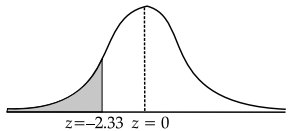
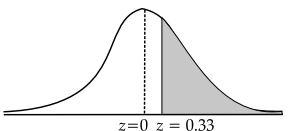
A sample of 125 dry battery cells tested to find the length of life produced the following results with mean 12 and SD 3 hours. Assuming that the data to be normal distributed, what percentage of battery cells are expected to have life
(i) more than 13 hours
(ii) less than 5 hours
(iii) between 9 and 14 hours
View full question & answer
Question 25 Marks
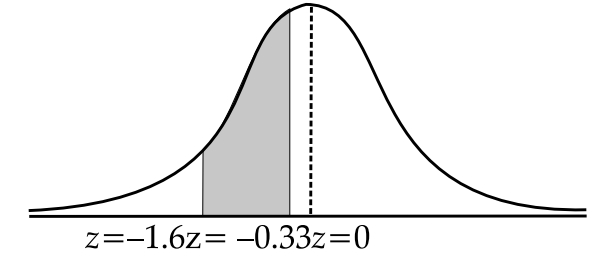
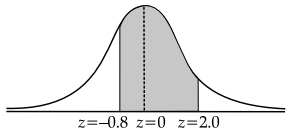
The average daily sale of 550 branch offices was ₹ 150 thousand and standard deviation is ₹ 15 thousand. Assuming the distribution to be normal, indicate how many branches have sales between
(i) ₹ 1,25,000 and ₹ 1,45,000
(ii) ₹ 1,40,000 and ₹ 1,60,000
View full question & answer
Question 35 Marks
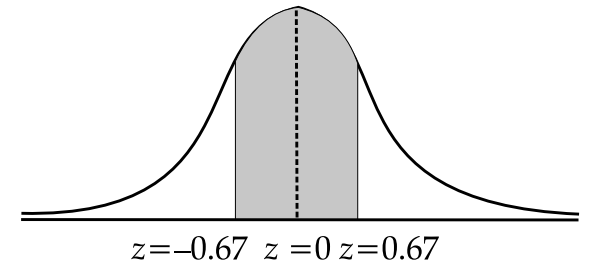
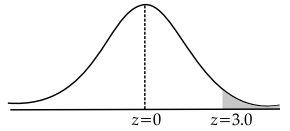
If X is a normal variate with mean $30$ and SD $5.$ Find the probabilities that $\text{(i) } 26\leq X\leq40 \text{ (ii) }X>45.$
View full question & answer
Question 45 Marks
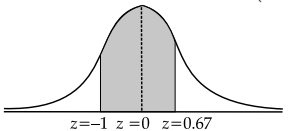
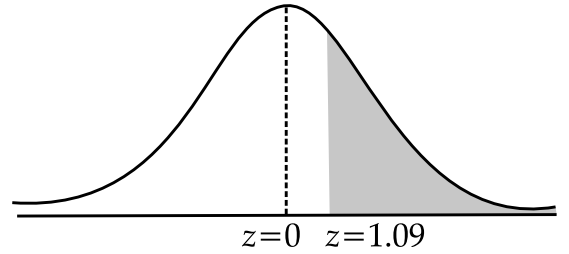
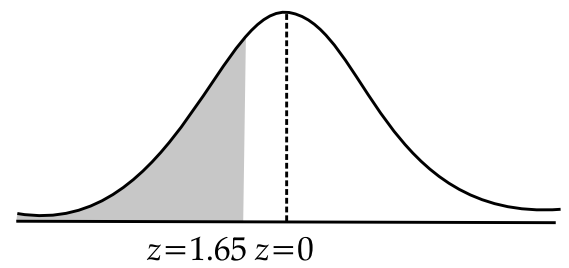
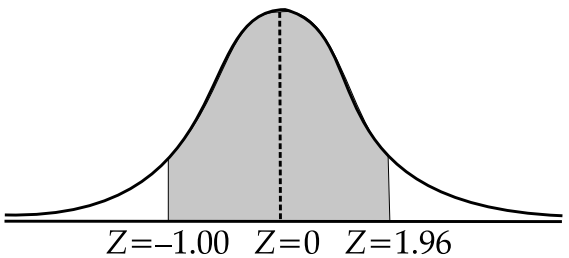
What is the probability that a standard normal variate Z will be
(i) greater than 1.09
(ii) less than - 1.65
(iii) lying between - 1.00 and 1.96
View full question & answer
Question 55 Marks
In the proportion of defective in a bulk is 4%. Find the probability of not more than 2 defective in a sample of 10. It is known that $e^{-4}=0.6703.$
Answer
Proportion of defective units
$p=\frac{4}{100}=0.4$
$m=n p=0.04 \times 10=0.4$
Probability of not more than 2 defective means the sum of probabilities of 0, 1 and 2 defectives:
No. of defective UnitsProbability
0$e^{-4}=0.6703$
1$e^{-4} \times \frac{4}{1}=0.6703 \times 4=0.2681$
2$e^{-4} \times \frac{(0.4)^2}{2!}=\frac{0.6703 \times 0.4 \times 0.4}{2 \times 1}$
$= 0.0536$
Probability of defective upto 2 terms$= 0.9920$
Hence the probability of not more than 2 defectives $= 0.9920$ or $99.2\%$
View full question & answer
Question 65 Marks
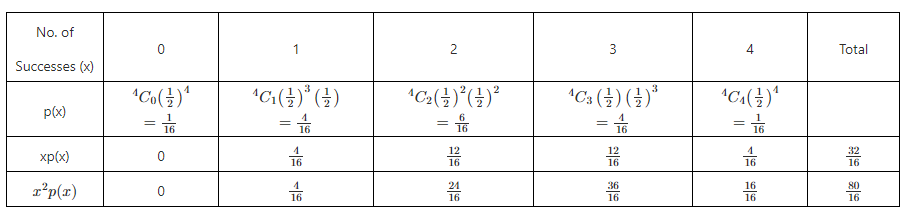
An unbiased coin is tossed 4 times. Find the mean and variance of number of heads obtained.
Answer
Given $n = 4$
Getting $p = \frac{1}{2}$ and $q=\frac{1}{2}$
Image$\begin{aligned} \text { Mean } & =\Sigma x ~p(x)=\frac{32}{16}=2 \\ \text { Variance } & =\Sigma x^2 p(x)-\{\Sigma x p(x)\}^2 \\ & =\frac{80}{16}-(2)^2=5-4=1\end{aligned}$
View full question & answer
Question 75 Marks
A box has 20 pens of which 2 are defective. Calculate the probability that out of 5 pens drawn one by one with replacement, at most 2 are defective.
Answer
Let $X$ be a random variable that denotes the number of defective pens is a draw of 5 pens.
Then, $X$ can take values $0, 1, 2, 3, 4$ and $5.$
Here, $p =$ probability of getting a defective pen in a single draw $=\frac{2}{20}=\frac{1}{10}$ and $q=$ probability of getting a defective pen in a single draw $=1-p=1-\frac{1}{10}=\frac{9}{10}$
Clearly, $X$ follows binomial distribution with parameters $n = 5,$ $p=\frac{1}{10}$ and $q=\frac{9}{10}.$
$\therefore P( X =r)={ }^5 C_r\left(\frac{1}{10}\right)^r\left(\frac{9}{10}\right)^{5-r}$
$r = 0, 1, 2, 3, 4$ and $5$
Now, $P$(getting at most 2 defective pen)
$\begin{array}{l}=P(x \leq 2) \\ =P(X=0)+P(X=1)+(X=2)\end{array}$
$={ }^5 C_0\left(\frac{1}{10}\right)^0\left(\frac{9}{10}\right)^5+{ }^5 C_1\left(\frac{1}{10}\right)\left(\frac{9}{10}\right)^4$$+{ }^5 C_2\left(\frac{1}{10}\right)^2\left(\frac{9}{10}\right)^3 $
$=\frac{9^3}{10^5}\left[9^2+5 \times 9+10\right]=\frac{729}{100000}[81+45+10]$
$=\frac{729 \times 136}{100000}=\frac{99144}{100000}=0.99144$
View full question & answer
Question 85 Marks
An experiment succeeds thrice as often as it fails. Find the probability that in the next 5 trials, there will be atleast 3 successes.
Answer
Let probability of success be $p$ and that of failure be $q$
$\begin{array}{l}\therefore p=3 q, \text { and } p+q=1 \\\therefore p=\frac{3}{4} \text { and } q=\frac{1}{4}\end{array}$
$P$(atleast 3 successes)
$=P(r \geq 3)=P(3)+P(4)+P(5)$
$={ }^5 C_3\left(\frac{1}{4}\right)^2 \cdot\left(\frac{3}{4}\right)^3+{ }^5 C_4\left(\frac{1}{4}\right)^1 \cdot\left(\frac{3}{4}\right)^4+{ }^5 C_5\left(\frac{3}{4}\right)^5$
$=\frac{270}{1024}+\frac{405}{1024}+\frac{243}{1024}=\frac{918}{1024}=\frac{459}{512}$
View full question & answer
Question 95 Marks
Five bad oranges are accidently mixed with 20 good ones. If four oranges are drawn one by one successively with replacement, then find the probability distribution of number of bad oranges drawn. Hence, find the mean and variance of the distribution.
View full question & answer
Question 105 Marks
If $f(x)$ is defined by $f(x)=k e^{-2 x}, 0 \leq x<\infty$ is a density function. Determine the constant $k$ and also find mean.
Answer
We know that
$\int_{-\infty}^{\infty} f(x) d x=1$ since $f(x)$ is a density function.
$\begin{array}{l}\int_0^{\infty} k e^{-2 x} d x=1 \\ k \int_0^{\infty} e^{-2 x} d x=1 \\ k\left[\frac{e^{-2 x}}{-2}\right]_0^{\infty}=1\end{array}$
$\Rightarrow \quad k=2$
$E(X)=\int_{-\infty}^{\infty} x f(x) d x$
$\begin{array}{l}=\int_0^{\infty} x k e^{-2 x} d x=2 \int_0^{\infty} x e^{-2 x} d x \end{array}$
$=2\left\{\left[\frac{x e^{-2 x}}{-2}\right]_0^{\infty}-\int_0^{\infty} \frac{e^{-2 x}}{-2} d x\right\}\quad\quad$$\left(\because \int u d v=u v-\int v d u\right)$
$=\int_0^{\infty} e^{-2 x} d x=\frac{1}{2}$
View full question & answer
Question 115 Marks
A random variable X has the following probability function
Value of $X$$p(x)$
$0$$0$
$1$$a$
$2$$2a$
$3$$2a$
$4$$3a$
$5$$a^2$
$6$$2 a^2$
$7$$7 a^2+a$
(i) Find $a,$ Evaluate (ii) $P(X< 3),$ (iii) $P(X > 2)$ and (iv) $P(2 < x \leq 5).$
Answer
(i) Since the condition of probability mass function is $\sum_{i=1}^{\infty} p\left(x_i\right)=1$
$\therefore \sum_{i=0}^7 p\left(x_i\right)=1$
$0+a+2 a+2 a+3 a+a^2+2 a^2+7 a^2+a=1$
$10 a^2+9 a-1=0$
$(10a - 1)(a + 1) = 0$
$a=\frac{1}{10}$ and $-1$
Since p(x) cannot be negative, $a = - 1$ is not applicable.
Hence, $a=\frac{1}{10}$
(ii) $P(X<3)=P(X=0)+P(X=1)+P(X=2)$
$= 0 + a + 2a$
$= 3a$
$=\frac{3}{10}$ $\left(\because a=\frac{1}{10}\right)$
(iii) $P(X>2)=1-P(X \leq 2)$
$= 1 - [P(X = 0) + P(X = 1) + P(X = 2)]$
$=1-\frac{3}{10}$
$=\frac{7}{10}$
(iv) $P(2 < X \leq 5)=P(X=2)+P(X=4)+P(X=5)$
$=2 a+3 a+a^2$
$=5 a+a^2$
$=\frac{5}{10}+\frac{1}{100}=\frac{51}{100}$
View full question & answer
Question 125 Marks
Two numbers are selected at random (without replacement) from the first six positive integers. Let x denote the larger of the two numbers obtained. Find the probability distribution of random variable x and hence find the mean of the distribution.
Answer
First 6 positive integers $= (1, 2, 3, 4, 5, 6)$
Random Variable = X = larger of 2 numbers
Sample space S = {(1, 2), (1, 3), (1, 4), (1, 5), (1, 6), (2, 1), (3, 1), (4, 1), (5, 1), (6, 1), (2, 3), (2, 4), (2, 5), (2,6), (3, 2), (4, 2), (5, 2), (6, 2), (3, 4), (3, 5), (3, 6), (4, 3), (5, 3), (6, 3), (4, 5), (4, 6), (5, 4), (6, 4), (5, 6), (6, 5)}
$X$$P(X)$$X_i P_i$$X_i^2 P_i$
$2$$\frac{2}{30}=\frac{1}{15}$$\frac{2}{15}$$\frac{4}{15}$
$3$$\frac{4}{30}=\frac{2}{15}$$\frac{6}{15}$$\frac{18}{15}$
$4$$\frac{6}{30}=\frac{3}{15}$$\frac{12}{15}$$\frac{48}{15}$
$5$$\frac{8}{30}=\frac{4}{15}$$\frac{20}{15}$$\frac{100}{15}$
$6$$\frac{10}{30}=\frac{5}{15}$$\frac{30}{15}$$\frac{180}{15}$
$\Sigma X_i P_i=\frac{70}{15} \quad \Sigma X_i^2 P_i=\frac{350}{15}$
Mean $=\Sigma X_i P_i=\frac{14}{3}=4.66$
Variance $=\Sigma X_i^2 P_i-(\mu)^2$
$\begin{array}{l}=\frac{350}{15}-\frac{70}{15} \times \frac{70}{15} \\ =\frac{70}{15}\left[5-\frac{70}{15}\right] \\ =\frac{70}{15}\left[\frac{75-70}{15}\right] \\ =\frac{70}{15} \times \frac{5}{15}=\frac{14}{9} \\ =1.55\end{array}$
Variance $=1.55$
View full question & answer
Question 135 Marks
Two cards are drawn simultaneously (or successively without replacement) from a well shuffled pack of 52 cards. Find the mean and variance of the number of kings.
Answer
$X =$ no. of kings $= 0, 1, 2$
$P(X=0) = P$(one king) $=\frac{48}{52} \times \frac{47}{51}=\frac{188}{221}$
$P(X = 1) = P$(one king and one non-king)
$=\frac{4}{52} \times \frac{48}{51} \times 2=\frac{32}{221}$
$P(X=2) = P$(two kings) $=\frac{4}{52} \times \frac{3}{51}=\frac{1}{221}$
Probability distribution is given by
$X$$0$$1$$2$
$P(X)$$\frac{188}{221}$$\frac{32}{221}$$\frac{1}{221}$
Now, Mean $=\Sigma X \cdot P(X)$
$=\frac{34}{221}$ or $\frac{2}{13}$
and $\operatorname{Var}( X )=\Sigma X^2 \cdot P(X)-[\Sigma X \cdot P(X)]^2$
$=\frac{36}{221}-\left(\frac{34}{221}\right)^2$
$=\frac{6800}{48841}$ or $\frac{400}{2873}$
View full question & answer
Question 145 Marks
Three numbers are selected at random (without replacement) from first six positive integers. Let X denote the largest of the three numbers obtained. Find the probability distribution of X. Also, find the mean and variance of the distribution.
Answer
The variance $X$ takes values $3, 4,5$ and $6$
$P(X=3)=\frac{1}{20} ; P(X=4)=\frac{3}{20} ;$
$P(X=5)=\frac{6}{20} ; P(X=6)=\frac{10}{20} ;$
$X$$3$$4$$5$$6$
$P(X)$$\frac{1}{20}$$\frac{3}{20}$$\frac{6}{20}$$\frac{10}{20}$
$XP(X)$$\frac{3}{20}$$\frac{12}{20}$$\frac{30}{20}$$\frac{60}{20}$
$X^2 P(X)$$\frac{9}{20}$$\frac{48}{20}$$\frac{150}{20}$$\frac{360}{20}$
Mean $=\Sigma X P(X)=\frac{105}{20}=\frac{21}{4}$
Variance $=\Sigma X^2 P(X)-\{\Sigma X P(X)\}^2$
$\frac{567}{20}-\frac{441}{16}=\frac{63}{80}$
View full question & answer
Question 155 Marks
Two numbers are selected at random (without replacement) from first 7 natural numbers. If X denotes the smaller of the two numbers obtained, find the probability distribution of X. Also, find mean of the distribution.
Answer
Let $X$ denotes the smaller of the two numbers obtained
So $X$ can take values 1, 2, 3, 4, 5, 6
$P(X = 1$ is smaller number)
$P(X=1)=\frac{6}{{ }^7 C_2}=\frac{6}{21}=\frac{2}{7}$
(Total cases when two numbers can be selected from first 7 numbers are ${ }^7 C_2$)
$\begin{array}{l}P(X=2)=\frac{5}{{ }^7 C_2}=\frac{5}{21} \\ P(X=3)=\frac{4}{{ }^7 C_2}=\frac{4}{21} \\ P(X=4)=\frac{3}{{ }^7 C_2}=\frac{3}{21}=\frac{1}{7} \\ P(X=5)=\frac{2}{{ }^7 C_2}=\frac{2}{21} \\ P(X=6)=\frac{1}{{ }^7 C_2}=\frac{1}{21}\end{array}$
$x_i$$p_i$$p_i x_i$
$1$$\frac{6}{21}$$\frac{6}{21}$
$2$$\frac{5}{21}$$\frac{10}{21}$
$3$$\frac{4}{21}$$\frac{12}{21}$
$4$$\frac{3}{21}$$\frac{12}{21}$
$5$$\frac{2}{21}$$\frac{10}{21}$
$6$$\frac{1}{21}$$\frac{6}{21}$
Mean = $\Sigma p_i x_i=\frac{6}{21}+\frac{10}{21}+\frac{12}{21}+\frac{12}{21}+\frac{10}{21}+\frac{6}{21}$
$\begin{array}{l}=\frac{56}{21} \\ =\frac{8}{3}\end{array}$
View full question & answer
Question 165 Marks
Two cards are drawn simultaneously (without replacement) from a well-shuffled pack of 52 cards. Find the mean and variance of the number of red cards.
Answer
Number of red cards = 26
Let X be a random variable which can take values 0, 1, 2, where X is the no. of red cards selected
$\therefore \quad X=0$ means $0$ red cards
$P(X=0)=\frac{{ }^{26} C_2}{{ }^{52} C_2}=\frac{26 \times 25}{52 \times 51}=\frac{25}{102}$
$P(X=1)=\frac{{ }^{26} C _1 \times{ }^{26} C _1}{{ }^{52} C _2}=\frac{26 \times 26 \times 2}{52 \times 51}=\frac{52}{102}$
$P(X=2)=\frac{{ }^{26} C_2}{{ }^{52} C_2}=\frac{26 \times 25}{52 \times 51}=\frac{25}{102}$
Probability distribution of random variable X is
$X$$0$$1$$2$
$P(X)$$\frac{25}{102}$$\frac{52}{102}$$\frac{25}{102}$
Mean $=\Sigma x P(X)=\frac{52+50}{102}=1$
Variance $=\Sigma x^2 P(X)-\{x P(X)\}^2$
$=\frac{152}{102}-1$
$=\frac{50}{102}$ or $\frac{25}{51}$
View full question & answer
Question 175 Marks
Suppose that two cards are drawn at random from a deck of cards. Let $X$ be the number of aces obtained. Then the value of $E(X).$
Answer
Let X denotes the number of aces obtained. Therefore, X can take any of the values of 0, 1, or 2. In a deck of 52 cards, 4 cards are aces. Therefore, there are 48 non-ace cards.
$\therefore P(X=0)=P(0$ ace and $2$ non-ace cards$)$
$=\frac{{ }^4 C_0 \times{ }^{48} C_2}{{ }^{52} C_2}=\frac{1128}{1326}$
$P(X = 1) =P$$(1$ ace and $1$ non-ace cards$)$
$=\frac{{ }^4 C_1 \times{ }^{68} C_1}{{ }^{52} C_2}=\frac{192}{1326}$
$P(X = 2) = P(2$ ace and $0$ non-ace cards$)$
$=\frac{{ }^4 C_2 \times{ }^{48} C_0}{{ }^{52} C_2}=\frac{6}{1326}$
Thus, the probability distribution is as follows:
$X$$0$$1$$2$
$P(X)$$1128/1326$$192/1326$$6/1326$
Then, $E(X)=\sum p_i x_i$
$=0 \times \frac{1128}{1326}+1 \times \frac{192}{1326}+2 \times \frac{6}{1326}$
$=\frac{204}{1326}=\frac{2}{13}$
View full question & answer
5 Marks Questions - Applied Maths STD 12 Science Questions - Vidyadip