MCQ
What is the relative decrease in focal length of a lens for an increase in optical power by 0.1 D from 2.5 D? ['D' stands for dioptre]
  • 0.04
  • B
    0.40
  • C
    0.1
  • D
    0.01

Answer

Correct option: A.
0.04
(A)
Sol. When $\mathrm{P}=2.5 \mathrm{D}$
$
\mathrm{F}=\frac{1}{\mathrm{P}}=\frac{1}{2.5}
$
When $\mathrm{P}^{\prime}=2.6 \mathrm{D}$
$\mathrm{F}^{\prime}=\frac{1}{\mathrm{P}^{\prime}}=\frac{1}{2.6}$
Relative decrease in focal length
$
\frac{\mathrm{F}-\mathrm{F}^{\prime}}{\mathrm{F}}=\frac{\frac{2}{5}-\frac{5}{13}}{\frac{2}{5}}=1-\frac{25}{26}=\frac{1}{26}=0.04
$

Need a full question paper?

Generate a complete, print-ready paper with questions like this in minutes — across 16+ boards, with answer keys.
Start Generating Free

Similar questions

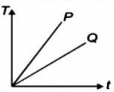
Heat energy at constant rate is given to two substances $P$ and $Q$. If variation of temperature $(T)$ of substances with time $(t)$ is as shown in figure, then select the correct statement.
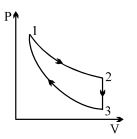
Three processes form a thermodynamic cycle as shown on $P-V$ diagram for an ideal gas. Process $1 \rightarrow 2$ takes place at constant temperature $(300K$). Process $2 \rightarrow 3$ takes place at constant volume. During this process $40J$ of heat leaves the system. Process $3 \rightarrow 1$ is adiabatic and temperature $T_3$ is $275K$. Work done by the gas during the process $3 \rightarrow 1$ is ..... $J$
If the distance between the earth and the sun becomes half its present value, the number of days in a year would have been
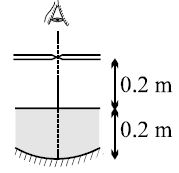
When a pin is moved along the principal axis of a small concave mirror, the image position coincides with the object at a point $0.5\, m$ from the mirror, refer figure. If the mirror is placed at a depth of $0.2\, m$ in a transparent liquid, the same phenomenon occurs when the pin is placed $0.4\, m$ from the mirror. The refractive index of the liquid is
The grease deposited on a glass plate can be easily removed by cleaning the glass with hot water containing detergent powder, because the detergent powder 
A particle of mass $M$ at rest decays into two particles of masses $m_1$ and $m_2$, having non-zero velocities. The ratio of the de-Broglie wavelengths of the particles, ${\lambda _1}/{\lambda _2}$ is
A body is dropped on ground from a height $h_1$ and after hitting the ground, it rebounds to a height $h _2$ If the ratio of velocities of the body just before and after hitting ground is $4$, then percentage loss in kinetic energy of the body is $\frac{x}{4}$. The value of $x$ is $.......$
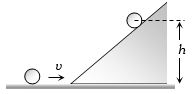
A disc of mass $M$ and radius $R$ rolls in a horizontal surface and then rolls up an inclined plane as shown in the fig. If the velocity of the disc is $v$, the height to which the disc will rise will be..
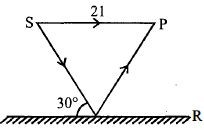
Interference pattern is observed at $'P'$ due to superimposition of two rays coming out from a source $'S'$ as shown in the figure. The value of $'I'$ for which maxima is obtained at $'P'$ is: ( $R$ is perfect reflecting surface)
Every gas (real gas) behaves as an ideal gas