MCQ
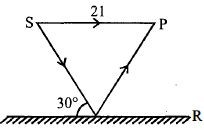
Interference pattern is observed at $'P'$ due to superimposition of two rays coming out from a source $'S'$ as shown in the figure. The value of $'I'$ for which maxima is obtained at $'P'$ is: ( $R$ is perfect reflecting surface)
  • A
    $I\, = \,\frac{{2n\lambda }}{{\sqrt 3  - 1}}$
  • B
    $I\, = \,\frac{{(2n - 1)\lambda }}{{2(\sqrt 3  - 1)}}$
  • $I\, = \,\frac{{(2n - 1\,\lambda )\sqrt 3 }}{{4(2 - \sqrt 3 )}}$
  • D
    $I\, = \,\frac{{(2n - 1)\lambda }}{{\sqrt 3  - 1}}$
Answer

Correct option: C.
$I\, = \,\frac{{(2n - 1\,\lambda )\sqrt 3 }}{{4(2 - \sqrt 3 )}}$
c
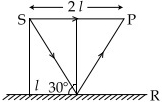
From the figure straight path $\mathrm{SP}=2 l$

Reflected path $\mathrm{SP}=2 l$ sec $30^{\circ}$

So path difference is $2 l\left(\sec 30^{\circ}-1\right)$

Also the ray, when reflected by the mirror, suffers a phase change of $\pi$

So the total difference in phase is $2 l\left(\sec 30^{\circ}-1\right) \times \frac{2 \pi}{\lambda}+\pi$

For constructive interference

$2 l\left(\sec 30^{\circ}-1\right) \times \frac{2 \pi}{\lambda}+\pi=2 n \pi$

Solving this, we get $l=\frac{(2 n-1) \lambda \sqrt{3}}{4(2-\sqrt{3})}$

Need a full question paper?

Generate a complete, print-ready paper with questions like this in minutes — across 16+ boards, with answer keys.

Start Generating Free

Similar questions

In optical bench experiment index error is $+1\ cm$ and $-1\ cm$ , between object needle and lens, lens and image needle respectively. Observed values of $u$ and $v$ are $9\ cm$ and $17\ cm$ . Focal length of lens is .....$cm$
A body starts from rest from the origin with an acceleration of $6 \;m / s^2$ along the $x$-axis and $8\; m / s^2$ along the $y$-axis. Its distance from the origin after $4\; seconds$ will be
Electric current is due to drift of electrons in
The displacement-time graph for two particles $A$ and $B$ are straight lines inclined at angles of ${30^o}$ and ${60^o}$ with the time axis. The ratio of velocities of ${V_A}:{V_B}$ is
Car $B$ overtakes another car $A$ at a relative speed of $40\, ms^{-1}$. How fast will the image of car ${B}$ appear to move in the mirror of focal length $10\, cm$ fitted in car ${A}$, when the car ${B}$ is $1.9\, m$ away from the car ${A}$ ? (In $ms^{-1}$)
When subjected to a transverse electric field, cathode rays move
A plano convex lens is made of glass of refractive index $1.5$. The radius of curvature of its convex surface is $R$. Its focal length is
If a carrier wave $C\left( t \right) = A\,\sin \,{\omega _c}t$ is amplitude modulated by a modulator signal $m\left( t \right) = A\,\sin \,{\omega _m}t$ then the equation of modulated signal $[C_m(t)]$ and its modulation index are respectively
Equal potentials are applied on an iron and copper wire of same length. In order to have the same current flow in the two wires, the ratio $r$ (iron)/$r$ (copper) of their radii must be (Given that specific resistance of iron = $1.0 \times {10^{ - 7}}$ $ ohm-m$ and specific resistance of copper = $1.7 \times {10^{ - 8}}\,ohm-m$)
A cyclic process $ABCD$ is shown in the $p-V$ diagram. Which of the following curves represents the same process if $BC \& DA$ are isothermal processes