Question
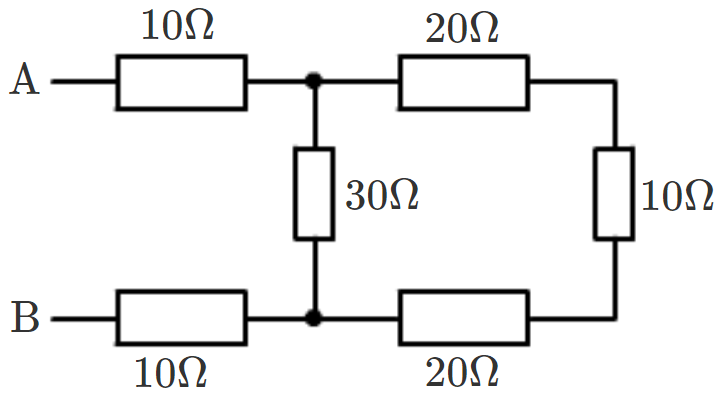
What is the resistance between A and B in the figure given below?

Answer

The three resistance of 20 ohm, 10 ohm and 20 ohm on the extreme right side are in series. So, the resultant of these three resistance = 20 + 20 + 10 = 50 ohms. This 50 ohms is in parallel with 30 ohms. so resultant of these two will be$\frac{1}{\text{R}}=\frac{1}{30}+\frac{1}{50}$
$\frac{1}{\text{R}}=\frac{80}{1500}$
R = 18.75 ohms Now, the resistance 10 ohms, 18.75 ohms and 10 ohms are in series. Therefore, resultant resistance = 18.75 + 10 + 10 = 38.75 ohms.

Need a full question paper?

Generate a complete, print-ready paper with questions like this in minutes — across 16+ boards, with answer keys.
Start Generating Free

Similar questions

“Damage to the ozone layer is a cause for concern.” Justify this statement. Suggest any two steps to limit this damage
A 2.0cm tall object is placed 40 cm from a diverging lens of focal length 15cm. Find the position and size of the image.
The farmers have been cultivating a food plant X for over two thousand years and have produced as many as five entirely different looking vegetables A, B, C, D and E from it.
  1. What could the plant X be?
  2. What are A, B, C, D and E?
  3. What is the process of evolution involved in this example known as?
A pencil when dipped in water in a glass tumbler appears to be bent at the interface of air and water. Will the pencil to be bent to the same extent, if instead of water we use liquids like, kerosene or turpentine? Support your answer with reasons.
Bio-gas is an excellent fuel. Justify the statement by giving two reasons. Mention the mass constituent of bio-gas along with its percentage.
A solution of $CuSO_4$ was kept in an iron pot. After few days the iron pot was found to have a number of holes in it. Explain the reason in terms of reactivity. Write the equation of the reaction involved.
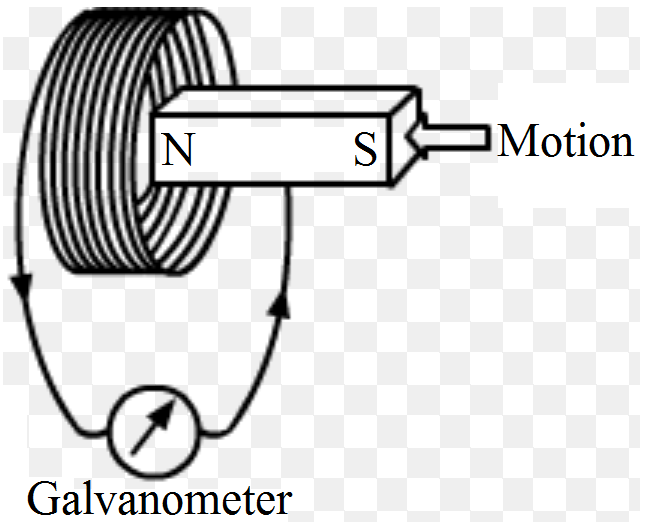
When the magnet shown in the diagram below is moving towards the coil, the galvanometer gives a reading to the right.
  1. What is the name of the effect being produced by the moving magnet?
  2. State what happens to the reading shown on the galvanometer when the magnet is moving away from the coil.
  3. The original experiment is repeated. This time the magnet is moved towards the coil at a great speed. State two changes you would notice in the reading on the galvanometer.
Ferrous sulphate decomposes with the evolution of a gas having a characteristic odour of burning sulphur. Write the chemical reaction involved and identify the type of reaction.
Explain how the blood system carries waste products from liver to the kidneys?
What is a ‘food web’? Show its formation.