MCQ
What is the resistivity of a pure semiconductor at absolute zero?
  • A
    Zero.
  • Infinity.
  • C
    Same as that of conductors at room temperature.
  • D
    Same as that of insulators at room temperature.

Answer

Correct option: B.
Infinity.

Need a full question paper?

Generate a complete, print-ready paper with questions like this in minutes — across 16+ boards, with answer keys.
Start Generating Free

Similar questions

If eight identical drops are joined to form a bigger drop, the potential on bigger as compared to that on smaller drop will be
A lens which has focal length of $4 \;cm$ and refractive index of $1.4$ is immersed in a liquid of refractive index $1.6,$ then the focal length will be.......$cm$
A rod of length l rotates with a small but uniform angular velocity $\omega$ about its perpendicular bisector. A uniform magnetic field $B$ exists parallel to the axis of rotation. The potential difference between the centre of the rod and an end is:
The following cannot be explained by wave nature of light:
A particle moves in a region having a uniform magnetic field and a parallel, uniform electric field. At some instant, the velocity of the particle is perpendicular to the field direction. The path of the particle will be:
A photon collides with a stationary hydrogen atom in ground state inelastically. Energy of the colliding photon is 10.2 eV. After a time interval of the order of micro second another photon collides with same hydrogen atom inelastically with an energy of 15 eV. What will be observed by the detector
Unpolarised light is incident from air on a plane surface of a material of refractive index $\mu .$ At a particular angle of incidence $i,$ it is found that the reflected and refracted rays are perpendicular to each other. Which of the following options is correct for this situation? 
Calculate the dispersive power for crown glass from the given data if $μ_v = 1.5230$ and $μ_r = 1.5145$ .
When a dielectric slab is introduced between the two plates of condenser then its capacity $......$
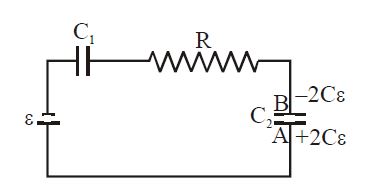
The capacitance of $C_1$ and $C_2$ shown in the diagram is $C$. $C_1$ is initially uncharged and $C_2$ is given a charge $2C_\varepsilon$  as shown. Which of the following graph represents charge on plate $B$ of capacitor $C_2$ as a function of time ?