Question
What is weak electrolyte? Explain relation between concentration of weak electrolyte and molar conductivity.

Answer

→ "Electrolyte which is incompletely ionized in its aqueous solution are known as weak electrolyte.
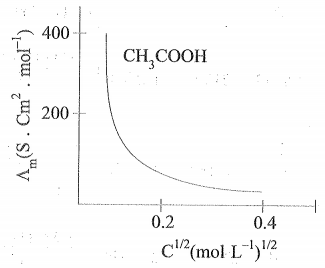
→" Weak electrolytes like acetic acid have lower degree of dissociation at higher concentrations and hence for such electrolytes, the change in $\hat{m}_{ m }$ with dilution is due to increase in the degree of dissociation and consequently the number of ions in total volume of solution that contains 1 mol of electrolyte.
→ In such cases $\wedge_{ m }$ increases steeply on dilution especially near lower concentrations. Therefor $\wedge_{ m }^0$ cannot be obtained by extra polation of $\wedge_{ m }^0$ zero concentration.
→ At infinite dilution (i.e. concentration $c \rightarrow$ zero electrolyte dissociates completely $(\alpha=1)$, but such low concentration the conductivity of the solution is so low that it cannot be measured accurately.
→ Therefore, $\wedge_{ m }^0$ for weak electrolytes is obtained by using Kohlrausch law of independent migration of ions.
Image
→ At any concentration c , if a is the degree of dissociation then it can be approximated to the ratio of molar conductivity $\wedge_{ m }$ at the concentration c to limiting molar conductivity, $\wedge_{ m }^0$ Thus we have :
$\begin{aligned} \alpha & =\frac{\Lambda_{ m }}{\Lambda_{ m }^0} \\ k _{ a } & =\frac{ c \alpha^2}{1-\alpha}=\frac{ c \Lambda_{ m }^2}{\Lambda_{ m }^{02}\left(1-\frac{\Lambda_{ m }}{\Lambda_{ m }^0}\right)}=\frac{ c \Lambda_{ m }^2}{\Lambda_{ m }^0 \Lambda_{ m }^0-\Lambda_{ m }}\end{aligned}$

Need a full question paper?

Generate a complete, print-ready paper with questions like this in minutes — across 16+ boards, with answer keys.
Start Generating Free

Similar questions

  1. Which one of the following is a disaccharide: starch, maltose, fructose, glucose
  2. What is the difference between acidic amino acid and basic amino acid?
  3. Write the name of the linkage joining two nucleotides.
Give reasons for the following:
  1. Acetylation of aniline reduces its activation effect.
  2. $\ce{CH_3NH_2}$ is more basic than $\ce{C_6H_5NH_2}.$
  3. Although $-\ce{NH_2}$ is $o/p$ directing group, yet aniline on nitration gives a significant amount of $m-$nitroaniline.
What are ambident nucleophilies? Explain with an example.
An element 'X' (At mass = 40 g $ mol^{-1} $) having fcc structure has unit cell edge length of 400 pm. Calculate the density of 'X' and the number of unit cell in 4 g of 'X'. $ (N_{A}=6.022\times10^{23}mol^{-1}) $.
Although $Cr^{3+}$ and $Co^{2+}$ ions have same number of unpaired electrons but the magnetic moment of $Cr^{3+}$ is $3.87 \ \text{B.M}.$ and that of $Co^{2+}$ is $4.87 \ \text{B.M}.$ Why?
$^{238}_{92}\text{U}$ Change to $^{206}_{92}\text{Pb}$ by successive radioactive decay. A sample of urenium ore was anlaysed and found to contain $1.0 g$ of $^{238}\text{U}$ and $0.1 g$ of $^{206}\text{Pb}$ had accumulated due to decay of $^{238}\text{U}$, find out the age of ore. $($Half$-$ life of $^{238}\text{U}$$= 4.5\times10^9$ years$).$
How would you account for the following$: \ce{Cr^{2+}}$ is reducing in nature while with the same $d-$orbital configuration $\ce{(d^4) Mn^{3+}}$ is an oxidising agent.
An aqueous solution of 2% non-volatile solute exerts a pressure of 1.004 bar at the normal boiling point of the solvent. What is the molar mass of the solute?
An organic compound $(A) ($molecular formula $C_8H_{16}0_2)$ was hydrolysed with dilute sulphuric acid to give a carboxylic acid $(B)$ and an alcohol $(C).$ Oxidation of $(C)$ with chromic acid produced $(B).\ (C)$ on dehydration gives but$-1-$ene. Write equations for the reactions involved.
What is meant by hydroboration oxidation reaction? Illustrate with an example.