MCQ
What parameter is used to measure the stability of a nucleus?
  • Average binding energy
  • B
    No. of protons
  • C
    No. of neutrons
  • D
    No. of electrons

Answer

Correct option: A.
Average binding energy

Stability of nucleus is based on average binding energy i.e. binding energy per nucleon. This much energy will be needed for nucleon to break free.

Need a full question paper?

Generate a complete, print-ready paper with questions like this in minutes — across 16+ boards, with answer keys.

Start Generating Free

Similar questions

A glass hemisphere of radius $0.04\, m$ and $R.I.$ of the material $1.6$ is placed centrally over a cross mark on a paper

$(i)$ with the flat face;

$(ii)$ with the curved face in contact with the paper.

In each case the cross mark is viewed directly from above. The position of the images will be

The distance between the two charges 25μC and 36μC is 11 cm At what point on the line joining the two, the intensity will be zero
An achromatic convergent doublet of two lens in contact has a power of $+ 2\, D$. The convex lens is power $+ 5\, D$. What is the ratio of the dispersive powers of the convergent and divergent lenses?
An object is placed in front of a spherical mirror whose $2\, times$ magnified image is formed on screen. Then choose $CORRECT$ option
Two heaters $A$ and $B$ have power rating of $1 \mathrm{~kW}$ and $2 \mathrm{~kW}$, respectively. Those two are first connected in series and then in parallel to a fixed power source. The ratio of power outputs for these two cases is:
Magnetic dipole moment is a
In a transformer, number of turns in the primary are $140$ and that in the secondary are $280$. If current in primary is $4\,A$ then that in the secondary is.....$A$
A proton of energy 200 MeV enters the magnetic field of 5 T. If direction of field is from south to north and motion is upward, the force acting on it will be
What equal length of an iron wire and a copper-nickel alloy wire, each of $2 \; {mm}$ diameter connected parallel to give an equivalent resistance of $3 \Omega ?$

(Given resistivities of iron and copper-nickel alloy wire are $12 \;\mu \Omega {cm}$ and $51\; \mu \Omega {cm}$ respectively) (in ${m}$)
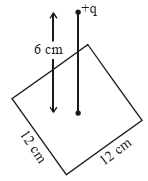
A point charge of $+\,12 \,\mu C$ is at a distance $6 \,cm$ vertically above the centre of a square of side $12\, cm$ as shown in figure. The magnitude of the electric flux through the square will be ....... $\times 10^{3} \,Nm ^{2} / C$