MCQ
What volume of decimolar solution should be mixed in a solution of same solute $(0.5 \,M,\,200\, ml)$ to make it $0.25\,molar$ ........ $ml$.
  • $333.33$
  • B
    $500$
  • C
    $233.33$
  • D
    $133.33$

Answer

Correct option: A.
$333.33$
a
${{\text{M}}_1}{{\text{V}}_1} + {{\text{M}}_2}{{\text{V}}_2}$ $ = {{\text{M}}_3}\left( {{{\text{V}}_1} + {{\text{V}}_1}} \right)$

$0.1\, \mathrm{V}+0.5 \times 200=0.25(200+\mathrm{V})$

$\mathrm{V}=333.33\,\mathrm{ml}$

Need a full question paper?

Generate a complete, print-ready paper with questions like this in minutes — across 16+ boards, with answer keys.

Start Generating Free

Similar questions

$EN$ of element $A$ is $E_1$ and $IP$ is $E_2$ hence $EA$ will be
The total number of gm-molecules of $S{O_2}C{l_2}$ in $13.5\,g$ of sulphuryl chloride is
Which of the following represent correct reactivity order for $SN^1$ as well as $SN^2$
mechanism -
In the reaction  $C{H_3}COOH\xrightarrow{{PC{l_5}}}(A)\xrightarrow{{N{H_3}}}(B)\xrightarrow{{NaBrO}}(C).$ 

the final product $(C)$ is

A $5\%$ solution of canesugar (mol. wt. $ =342$) is isotonic with $1\%$ solution of a substance $X$. The molecular weight of $X$ is
The $IUPAC$ name of $\begin{matrix}
   \,\,\,\,\,\,\,\,\,\,\,\,\,\,\,\,\,\,\,\,\,\,\,\,\,\,\,\,\,\,\,\,\,\,\,\,\,\,\,\,\,\,\,\,\,\,\,\,\,\,\,\,\,\,\,\,\,C{{H}_{3}}\,  \\
   \,\,\,\,\,\,\,\,\,\,\,\,\,\,\,\,\,\,\,\,\,\,\,\,\,\,\,\,\,\,\,\,\,\,\,\,\,\,\,\,\,\,\,\,\,\,\,\,\,\,|  \\
   C{{H}_{3}}-C{{H}_{2}}-CH-CH-C-C{{H}_{3}}  \\
   \,\,\,\,\,\,\,\,\,\,\,\,\,\,\,\,\,\,\,\,\,|\,\,\,\,\,\,\,\,\,\,\,\,\,|\,\,\,\,\,\,\,\,\,\,\,\,|\,  \\
   \,\,\,\,\,\,\,\,\,\,\,\,\,\,\,\,\,\,\,\,\,\,\,Cl\,\,\,\,\,\,\,\,C{{H}_{3}}\,\,\,OH  \\
\end{matrix}$ is
At standard conditions, if the change in the enthalpy for the following reaction is $-109 \;kJ mol ^{-1}$

$H _{2( g )}+ Br _{2( g )} \rightarrow 2 HBr _{( g )}$

Given that bond energy of $H _{2}$ and $Br _{2}$ is $435 \;kJ mol ^{-1}$ and $192 \;kJ mol^{-1}$, respectively, what is the bond energy (in $kJ mol ^{-1}$ ) of $HBr?$
The $IUPAC$ name of the compound is $\begin{array}{*{20}{c}}
  {\,\,\,\,\,\,\,\,\,\,Ph} \\ 
  {\,\,\,\,\,\,\,\,|} \\ 
  {C{H_3} - CH - CH - N{H_2}} \\ 
  {\,|\,\,\,\,\,\,\,\,\,\,\,\,\,\,\,\,\,\,} \\ 
  {C{H_3}\,\,\,\,\,\,\,\,\,\,} 
\end{array}$
The standard electrode potential of $M ^{+} / M$ in aqueous solution does not depend on
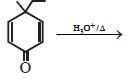
What will be major product of given reaction ?