What will be the most suitable combination of three resistors $A =2\, \Omega, B =4\, \Omega, C =6\, \Omega$ so that $\left(\frac{22}{3}\right)\Omega$ is equivalent resistance of combination$?$
JEE MAIN 2022, Medium
Download our app for free and get started
$\Rightarrow \frac{4}{3}+6=\frac{22}{3}$

Download our appand get started for free
Experience the future of education. Simply download our apps or reach out to us for more information. Let's shape the future of learning together!No signup needed.*
Similar Questions
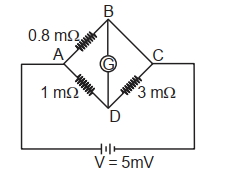
- 1To measure the temperature coefficient of resistivity $\alpha$ of a semiconductor, an electrical arrangement shown in the figure is prepared. The arm BC is made up of the semiconductor. The experiment is being conducted at $25^{\circ} \mathrm{C}$ and resistance of the semiconductor arm is $3 \mathrm{~m} \Omega$. Arm BC is cooled at a constant rate of $2^{\circ} \mathrm{C} / \mathrm{s}$. If the galvanometer $\mathrm{G}$ shows no deflection after $10 \mathrm{~s}$, then $\alpha$ is :View Solution
- 2Two electric bulbs marked $40\,W,$ $220\,V$ and $60\,W,\,\,220\,V$ when connected in series across same voltage supply of $220\,V,$ the effective power is $P_1$ and when connected in parallel, the effective power is $P_2.$ Then $\frac {P_1}{P_2}$ isView Solution
- 3If ${R_1}$ and ${R_2}$ are respectively the filament resistances of a $200$ $watt$ bulb and $100$ $watt$ bulb designed to operate on the same voltage, thenView Solution
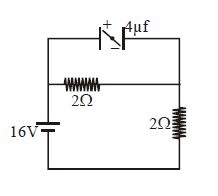
- 4What is net force on the small dipole placed inside the capacitor at steady state if the plates are separated by $1\ cm$ ?......$N$View Solution
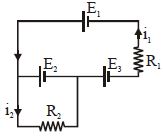
- 5The current $i_1$ and $i_2$ through the resistor $R_1 (= 10\,\Omega )$ and $R_2 (=30 \,\Omega )$ in the circuit diagram with $E_1 = 3\,V, E_2 = 3\,V$ and $E_3 = 2\,V$ are respectively:View Solution
- 6A wire of resistance $R$ is divided in $10$ equal parts. These parts are connected in parallel, the equivalent resistance of such connection will beView Solution
- 7A potentiometer wire of length $1\,m$ and resistance $10\,\Omega$ is connected in series with a cell of $emf$ $2\,V$ with internal resistance $1 \,\Omega$ and a resistance box including a resistance $R$. If potential difference between the ends of the wire is $1\, mV$, the value of $R$ is ............. $\Omega $View Solution
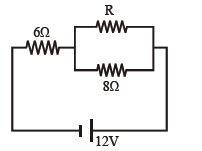
- 8In the circuit shown in figure, the power which is dissipated as heat in the $6\,\Omega$ resistor is $6\,W$. What is the value of resistance $R$ in the circuit?................... $\Omega$View Solution
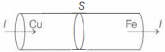
- 9Two rods of copper and iron with the same cross-sectional area are joined at $S$ and a steady current $I$ flows through the rods as shown in the figure. Choose the most appropriate representation of charges accumulated near the junction $S$.View Solution
- 10When a resistor of $11 \,\Omega$ is connected in series with an electric cell, the current flowing in it is $0.5\, A$. Instead, when a resistor of $5 \,\Omega$ is connected to the same electric cell in series, the current increases by $0.4\, A$. The internal resistance of the cell is ................ $\Omega$View Solution