Question
What would be an effect on equilibrium price and equilibrium quantity if demand and supply both fall at the same rate?
OR
Market for a good is in equilibrium. There is simultaneous "decrease" both in demand and supply but there is no change in market price. Explain with the help of a schedule how is it possible.
Answer

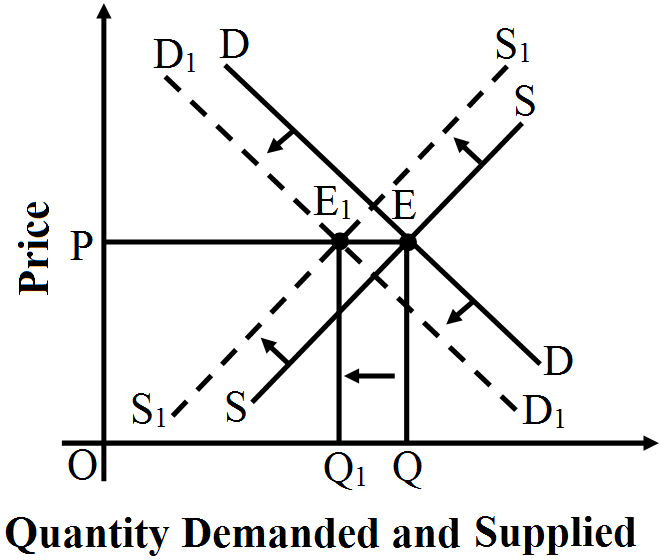
When demand and supply both decrease at the same rate, equilibrium price remains constant and equilibrium quantity falls. It can be shown with the help of the following diagram.

In the given diagram price is measured on vertical axis and quantity demanded and supplied is measured on horizontal axis. Initially, the equilibrium price is $OP$ and equilibrium quantity is $OQ$. But as given in the examination problem, "demand and supply both decrease at the same rate”, then,
  1. Equilibrium price remains constant Beat $OP$.
  2. quilibrium quantity falls from $OQ$ to $OQ_1$.

Need a full question paper?

Generate a complete, print-ready paper with questions like this in minutes — across 16+ boards, with answer keys.

Start Generating Free

Similar questions

A consumer has 10, and both goods X and Y are priced at ₹ 2 and are available in integer units. (a) give the bundles that this consumer can afford to buy (b) give the bundles that cost exactly ₹ 10 (C) give two bundles that this consumer cannot afford to buy.
Give any three points of difference between monopoly and monopolistic competition.
From the following schedule find out the level of output at which the producer is in equilibrium. Give reasons for your answer.
Output

(Units)
Price

(Rs.)
Total Cost

(Rs.)
1 24 26
2 24 50
3 24 72
4 24 92
5 24 115
6 24 139
7 24 165
Explain the distinction between change in demand and change in quantity demanded of a commodity.
OR
Explain the distinction between a shift in demand curve and a movement along the demand curve. Use diagram.
Explain producer’s equilibrium using a schedule. Use total cost and total revenue approach.
The price elasticity of supply of good X is half the price elasticity of supply of Good Y. A 10% rise in the price of good Y results in a rise in its supply from 400 units to 520 units. Calculate the percentage change in quantity supplied of good X when its price falls from ₹ 10 to 8 per unit.
Calculate Total Variable Cost and Total Cost from the following cost schedule of a firm whose Fixed Costs are 10:
Output (unit) 1 2 3 4
Marginal Cost (MC) (₹) 6 5 4 6
State three features of monopolistic competition.
Price Elasticity of Demand of a good is $(-) 3$. If the price rises from ? $10$ per unit to ? $12$ per unit, what is the percentage change in demand?
Define cost. Distinguish between fixed and variable costs. Give one example of each.