Questions · Page 1 of 2

4 Marks Question

🎯

Test yourself on this topic

50 questions · timed · auto-graded

Question 14 Marks
What would be an effect on equilibrium price and quantity when demand and supply both increase at the same rate?
OR
Explain with the help of a diagram a situation when demand and supply curves shift to the right but equilibrium price remains the same.
OR
Market for a good is in equilibrium. What is the effect on equilibrium price and quantity if both the market demand and the market supply of the goods increase in the same proportion? Use diagram.
Answer
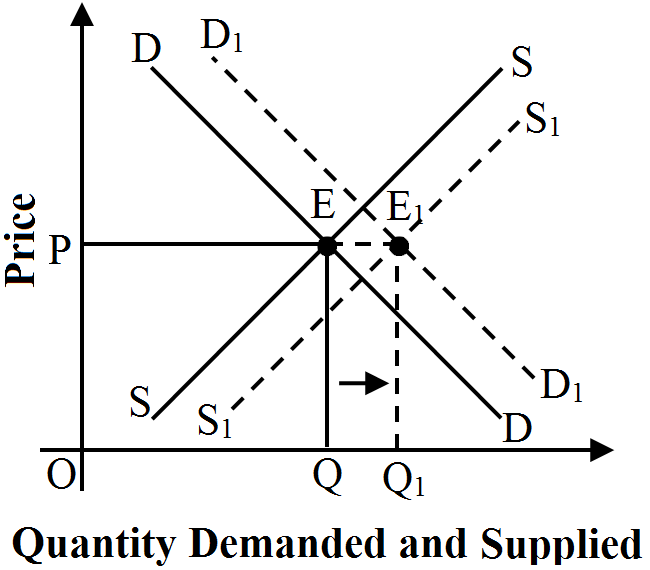
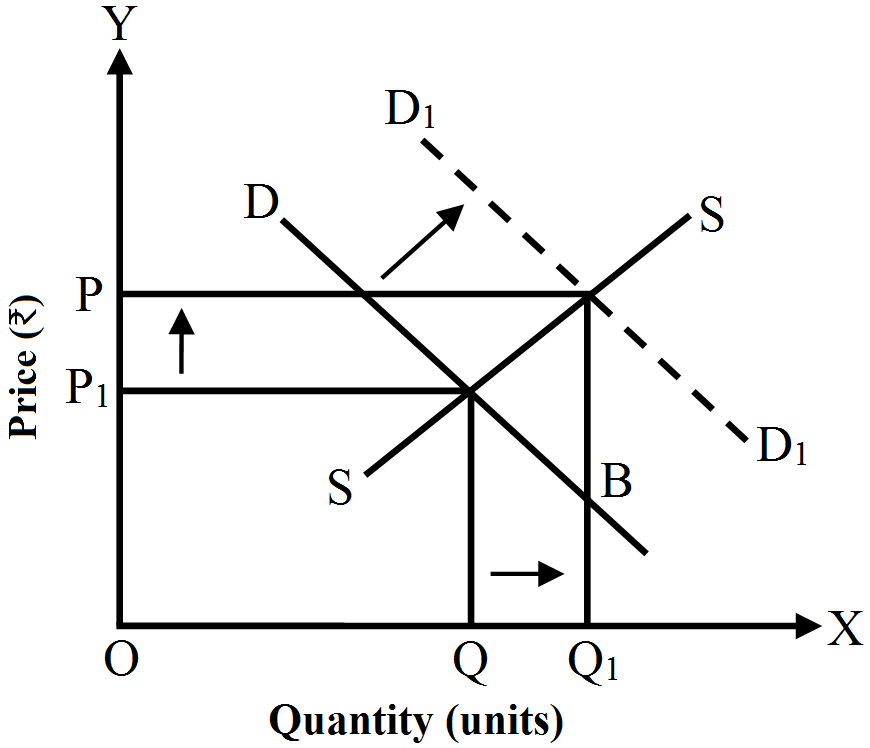
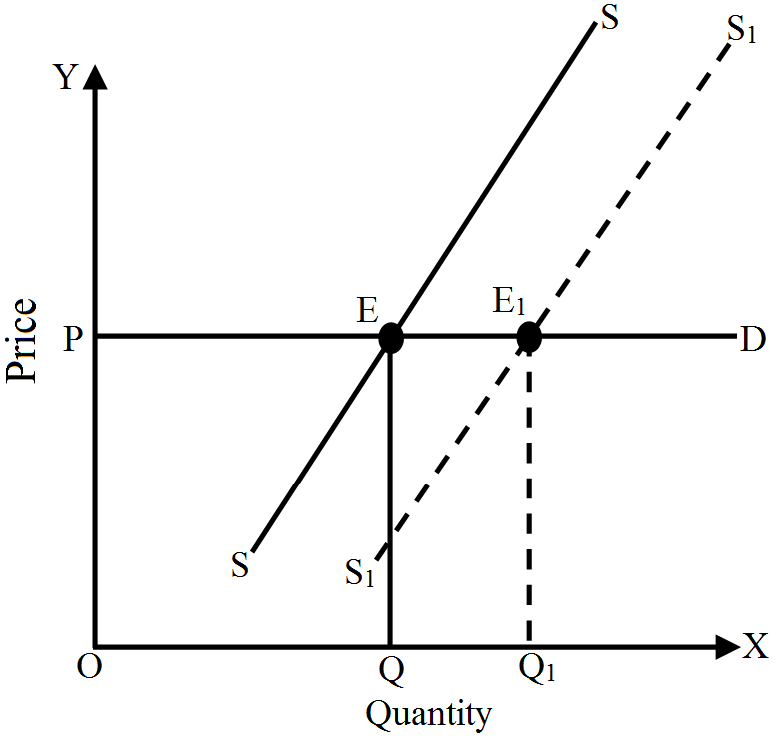
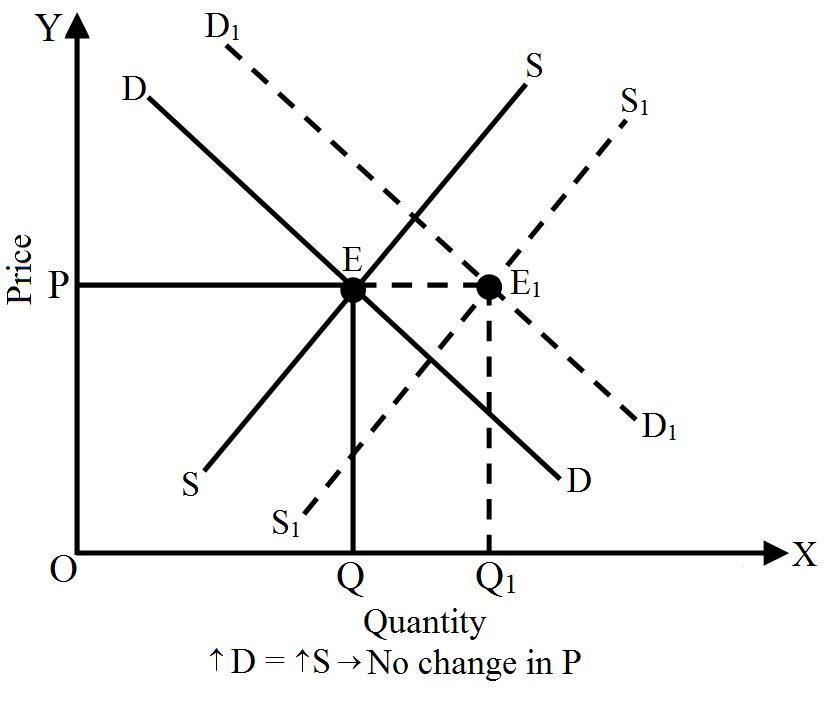
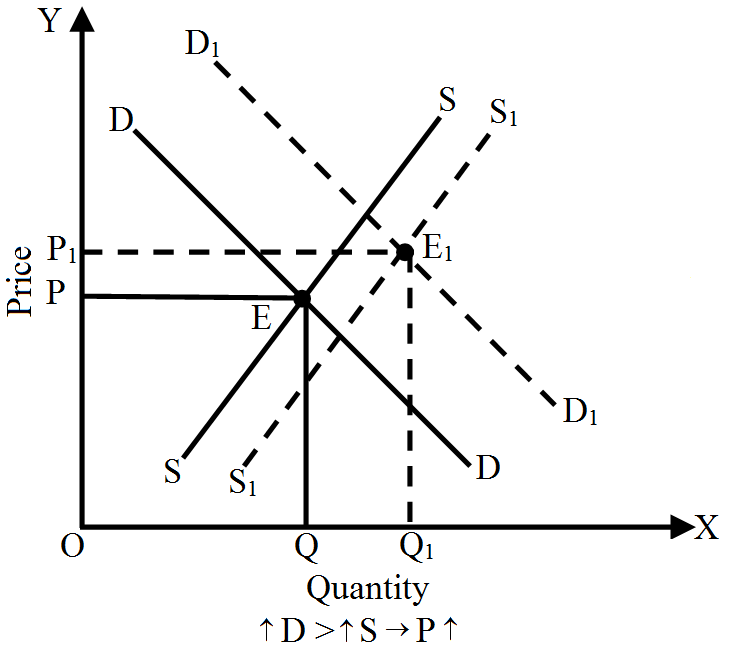
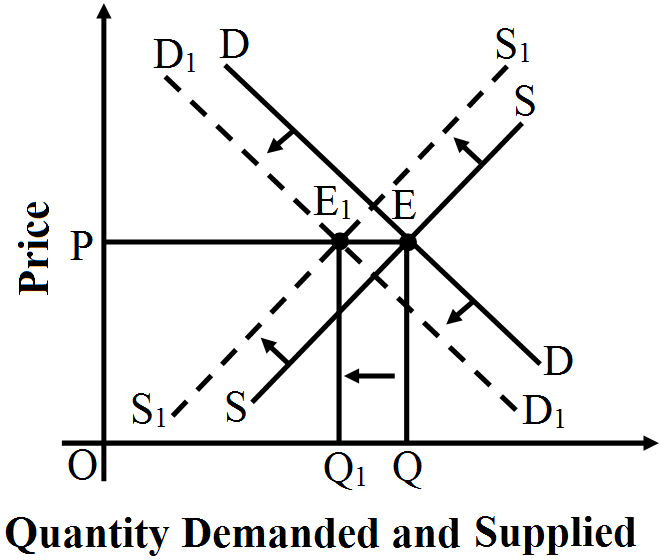
When demand and supply both increase at the same rate, equilibrium price remains constant and equilibrium quantity rises. It can be shown with the help of the following diagram.
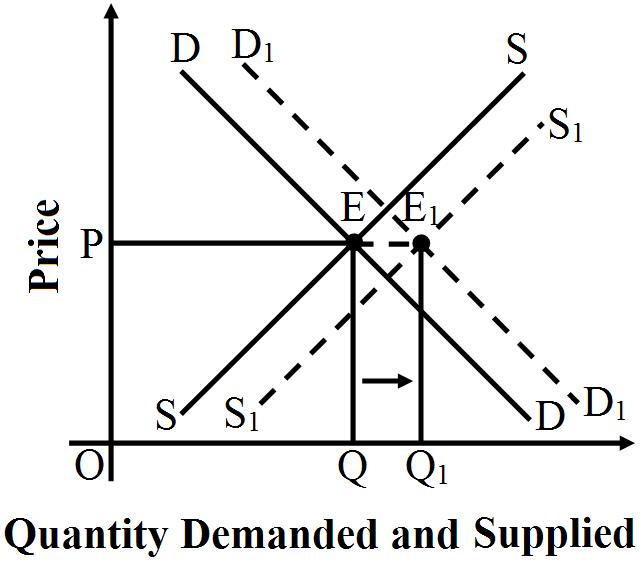
In the above diagram price is measured on vertical axis and quantity demanded and supplied is measured on horizontal axis. Initially, the equilibrium price is $OP$ and equilibrium quantity is $OQ$. But as given in the examination problem, "demand and supply both increase at the same rate", then,
  1. Equilibrium price remains constant at $OP$.
  2. Equilibrium quantity rises from $OQ$ to $OQ_1$
View full question & answer
Question 24 Marks
How does an increase in the input price affect equilibrium price and quantity exchanged of a commodity? Use diagram.
Answer
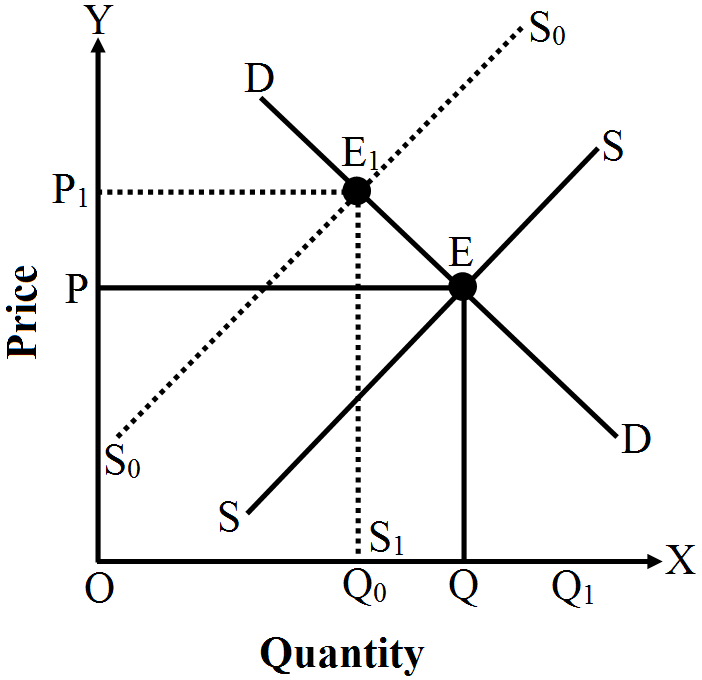
An increase in the price of an input used in the production of a commodity increases the unit cost of production of the commodity. This will cause a decrease in the supply of a commodity and leads to a leftward shift of the supply curve as shown in the diagram given below. The demand curve of the commodity remaining the same, this will cause the market price of the commodity to rise and quantity exchanged to fall.


It is clear from the diagram that as a result of a decrease in supply, the supply curve shifts leftward. As a result, the equilibrium price rises from $OP$ to $OP_1$ and the equilibrium quantity falls from $OQ$ to $OQ_0$.
View full question & answer
Question 34 Marks
What is monopolistic competition? Can a seller in such a market influence the price? Explain.
Answer
It is a form of market in which there are many sellers of the product, but the product of each seller is somewhat different from that of the other, e.g. firms producing different brands of toothpastes, viz colgate, closeup, pepsodent, etc.
In such a market, a seller has a partial control over price due to product differentiation. However, full control over price is not possible because of the fact that there are a large number of close substitutes available in the market.
View full question & answer
Question 44 Marks
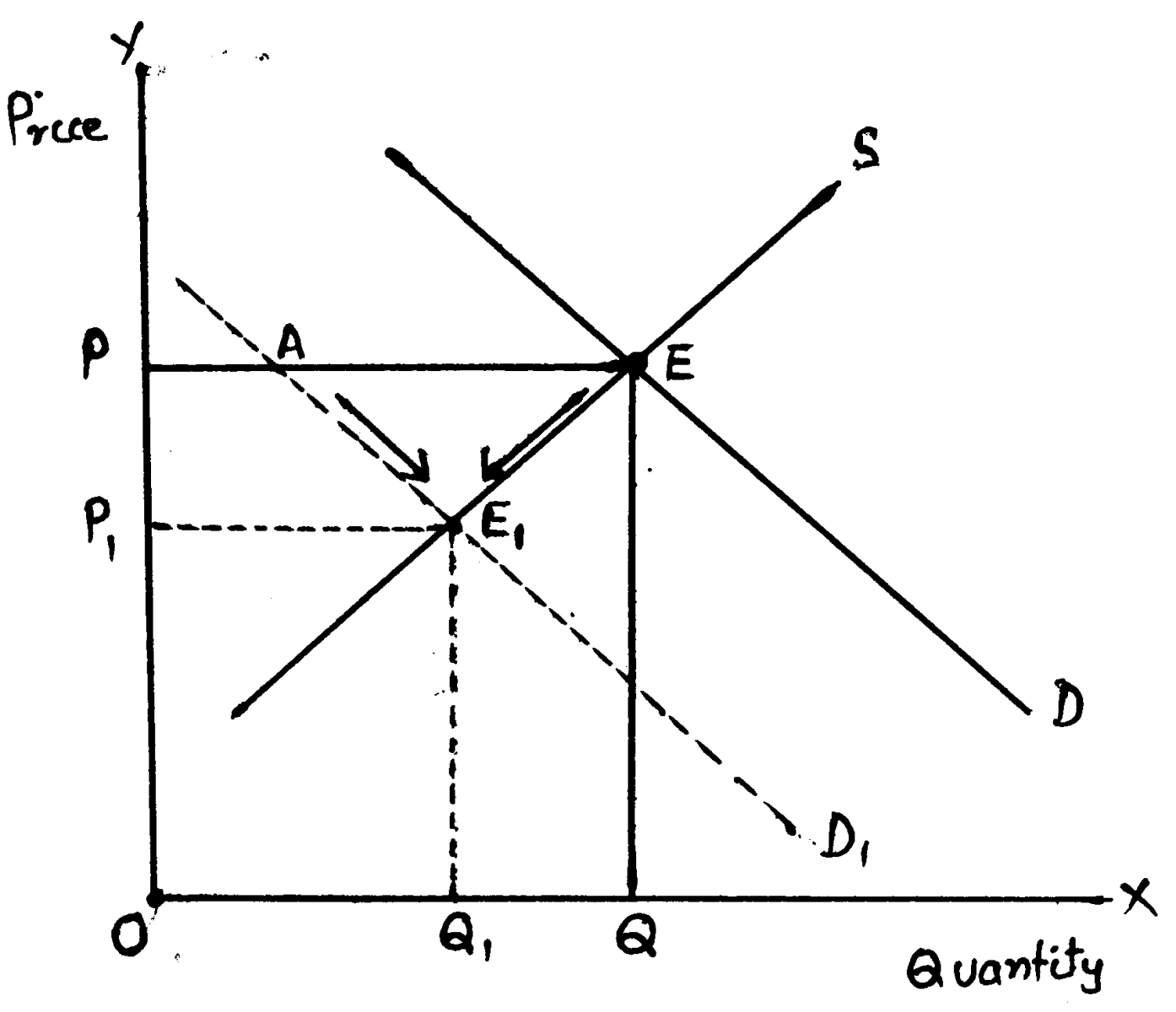
How is the equilibrium price of a commodity affected by a leftward shift of the demand curve? Explain with the help of a diagram.
Answer

When demand curve shifts to the left, this leads to excess supply $(A E)$ at price $OP$. The producers unable to sell all they produce, lower the price. The lower price leads to fall in supply and rise in demand. These changes continue till the price reaches $OP_1$ where the market is once again in equilibrium with both demand and supply equal to $OQ_1$.
View full question & answer
Question 54 Marks
Explain with the help of a diagram, the effect of a decrease in the supply of a commodity on its equilibrium price and quantity.
OR
Explain the chain of effects of decrease in supply of a good on its price, supply and demand. Use diagram.
Answer
The diagram shows that the original demand curve DD and original supply curve SS of the commodity intersect each other at point E. OP is the original equilibrium price and OQ is the original equilibrium quantity. Now due to decrease in supply of a good, the supply curve SS shifts to the left $(S_0S_{­0})$, demand curve remaining unchanged. At the original price OP, the quantity demanded is $OQ$ which is greater than supply by $QQ_0 / AE$. The excess demand equal to $AE/QQ_0$​​​​​​​ emerges. This excess demand results in competition among the buyers leading to a rise in the price. A rise in price results in a fall in quantity demanded (an upward movement along the demand curve) and a rise in quantity supplied (an upward movement along the new supply curve). These changes continue till we reach price $OP_1​​​​​​​$​​​​​​​. This is new equilibrium price at which quantity demanded and quantity supplied are equal. Hence, equilibrium price rises from $OP$ to $OP_1​​​​​​​$​​​​​​​ and equilibrium quantity falls from $OQ$ to $OQ_1​​​​​​​$​​​​​​​.
View full question & answer
Question 64 Marks
Equilibrium price of an essential medicine is too high. Explain what possible steps can be taken to bring down the equilibrium price but only through the market forces. Also, explain the series of changes that will occur in the market.
Answer
One possible step can be to reduce tax on medicine (or alternatively give subsidy). This will bring down cost and in turn ‘increase’ supply. Demand remaining unchanged, a situation of ‘excess supply’ will emerge which will lead to competition between sellers. This will lead to fall in price of the medicine.
View full question & answer
Question 74 Marks
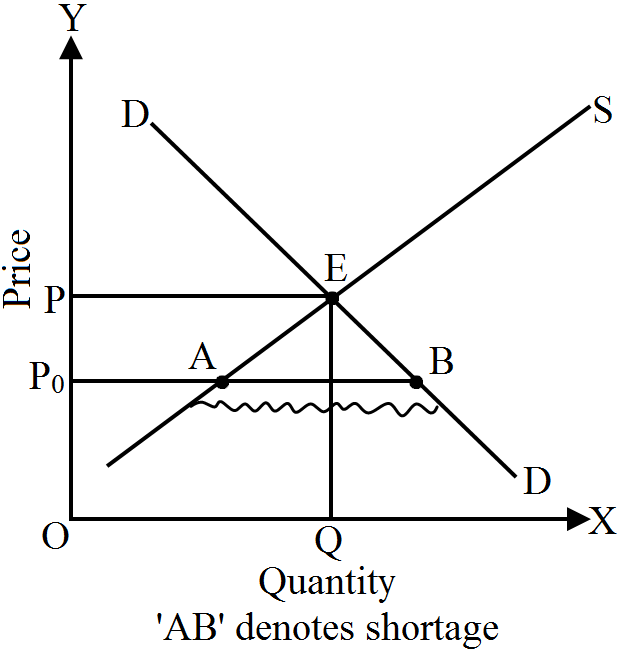
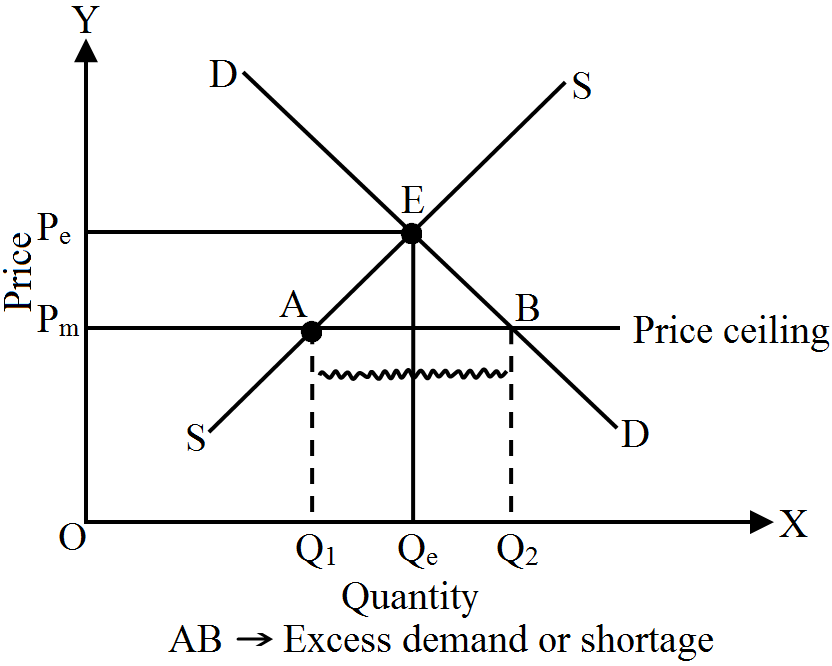
What is maximum price ceiling? On what type of goods is it normally imposed? Use diagram.
Answer
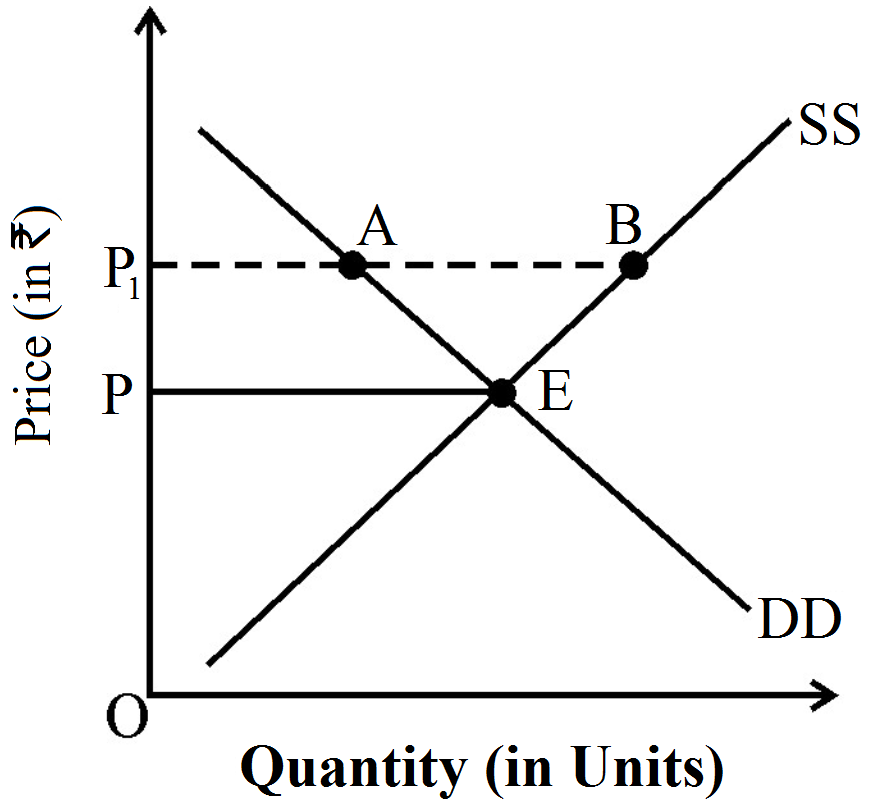
Maximum price ceiling refers to the imposed upper limit on the price of a good charged by the government. Since price ceiling is lower than the equilibrium price OP, it leads to excess demand or shortage to the tune of AB as shown in the diagram.
Maximum price ceiling is normally imposed on essential items needed by the masses like food grains, medicines, wheat, sugar, rice etc.
View full question & answer
Question 84 Marks
What is meant by a product being perfectly homogeneous? What is its implication for the price charged by producers in the market?
Answer
A product being perfectly homogeneous implies that the products are identical in size, quality and quantity. Perfectly homogeneous product is sold in the market at a uniform price.
If even an individual firm tries to charge a higher price, it would lose all its buyers to a large number of other sellers. Hence, they sell homogeneous product at the prevailing market price as decided by the market forces of demand and supply.
View full question & answer
Question 94 Marks
Suppose the demand and supply curve of commodity X in a perfectly competitive market are given by:$\text{q}^\text{D}=700-\text{p}$
$\text{q}^\text{s}=500+3\text{p for p}\geq15$
$=0\text{ for }0\leq\text{p}<15$
Assume that the market consists of identical firms. Identify the reason behind the market supply of commodity X being zero at any price less than $Rs. 15$. What will be the equilibrium price for this commodity? At equilibrium, what mquantity of X will be produced?
Answer
Is given that;$\text{q}^\text{D}=700-\text{p}$
$\text{q}^\text{s}=500+3\text{p for p}\geq\text{Rs}.15$
$=0\text{ for }0\leq\text{p}<15$
The market supply is zero for any price from $Rs. 0$ to $Rs. 15$, this is because, for price between $0$ to $15$, no individual firm will produce any positive level of output (as the price is less than the minimum of AVC). Consequently, the market supply curve will be zero.
At equilibrium $q^d_= q^s 700 - p $
$= 500 + 3p -p - 3p$
$ = 500 - 700 -4p $
$= -200 p = 50$
Equilibrium price is $Rs. 50$. Quantity
$= q^s = 500 + 3p $
$= 500 + 3 (50) $
$= 500 + 150 = 650$
Therefore, the equilibrium quantity is $650$ units.
View full question & answer
Question 104 Marks
Explain, how in the long-run, equilibrium with free entry and exit, firms under perfect competition earn zero abnormal profits.
Answer
A perfectly competitive firm in the long-run can earn normal profits only. In case an industry is showing supernormal profits (TR > TC or AR > AC) in short-run, new firms will join the industry leading to increase in supply and will shift market supply curve to the right. Accordingly market price will be reduced and supernormal profits will be wiped out.
In case of negative abnormal profits (losses) in the short-run when (TRCTC or AR < AC) some of the existing firms will leave the industry. Accordingly, supply will fall and market supply curve will shift to the left forcing the price to move up till the situation of zero normal profit is reached.
View full question & answer
Question 114 Marks
Explain how market price of a good is determined using diagram.
OR
How is price determined under perfect competition? Explain briefly.

OR
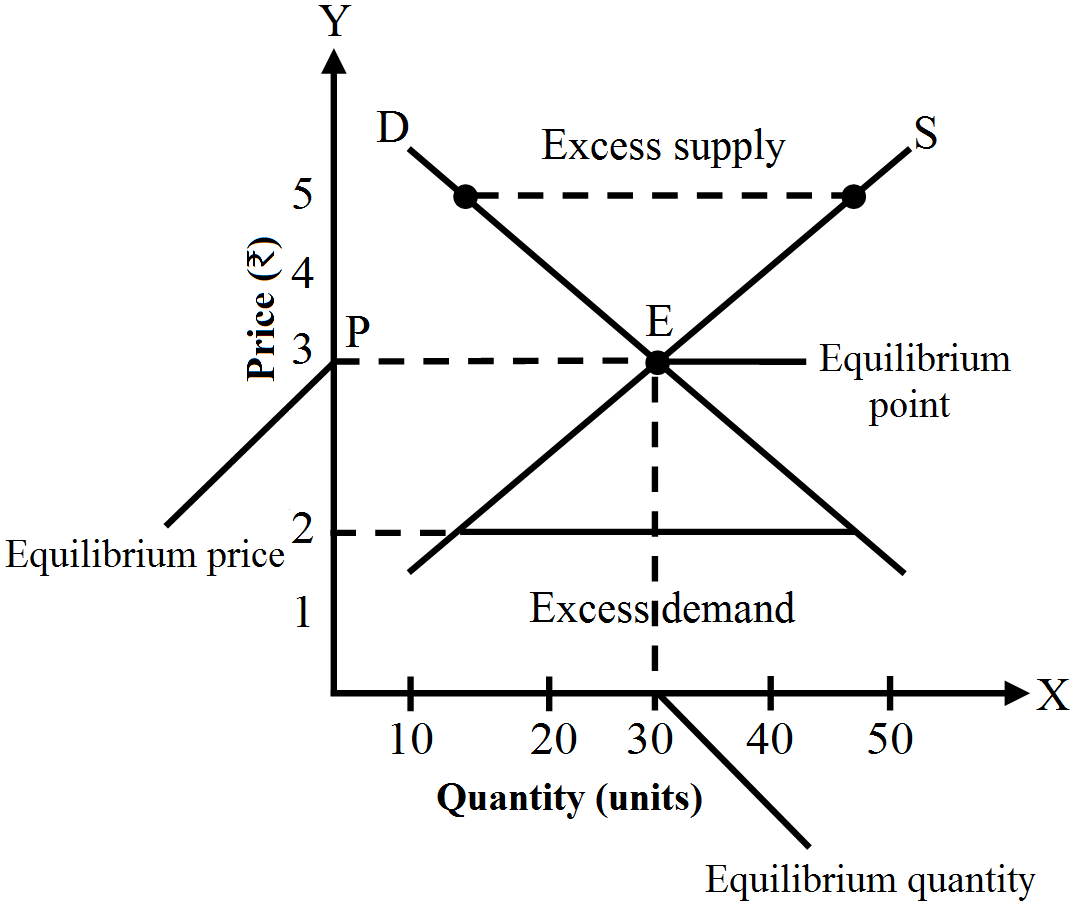
How is equilibrium price of a commodity determined? Explain with the help of demand and supply schedule.
Answer
Market price or equilibrium price is determined by the forces of market demand and market supply. Considering market demand schedule on one hand and market supply schedule on the other, we identify equilibrium price as the one where market demand is equal to market supply or where market demand curve and market supply curve intersect each other.
S. No Pdce of commdity X (₹) Quantity supplied of a commodity X (Dozen) Quantily demanded lor a commodity X (Dozen)
1. 5 50 10 Excess supply
2. 4 40 20
3. 3 30 30 (Equilibrium)
4. 2 20 40 Excess demand
5. 1 10 50

In the above schedule and diagram, demand and supply become equal only at the price of 3.00, so it will be our equilibrium price. Also, it is clear that equilibrium price is determined at the point, where demand and supply curves intersect each other at 30 units of commodity 'X'.
View full question & answer
Question 124 Marks
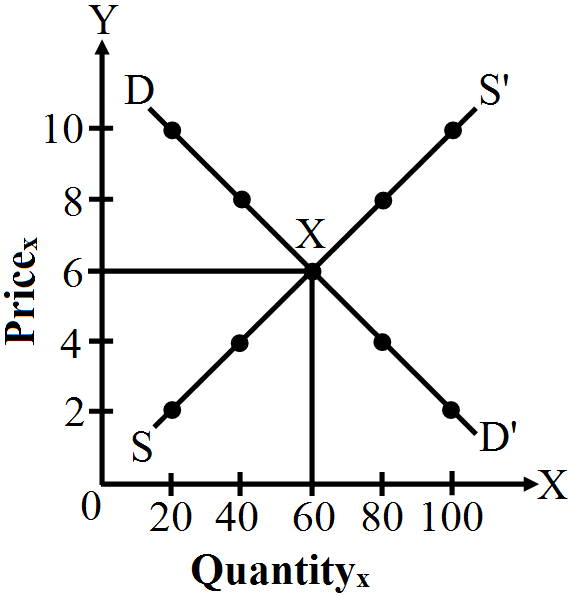
Consider a hypothetical demand and supply schedule of a commodity as given below:
Price of X (₹)
Demand (Units)
Supply (Units)
2 100 20
4 80 40
6 60 60
8 40 80
10 20 100
Draw a diagram and find the equilibrium price and equilibrium quantity.
Answer

On the basis of the diagram drawn above Equilibrium Price = ₹ 6 and Equilibrium Quantity = 60kg.
View full question & answer
Question 134 Marks
Explain the effect of increase in income of buyers of a ‘normal’ commodity on its equilibrium price.
Answer
  • Increase in income increases demands at the given price.
  • This leads to excess demand.
  • Leads to competition among buyers. As a result, price starts rising.
  • Rise in price leads to rise in supply and fall in demand.
  • These changes continue till supply and demand become equal at a new equilibrium price.
  • Equilibrium price rises.
View full question & answer
Question 144 Marks
Under what condition increase in demand would not make any effect $N$ on equilibrium price?
Answer
Case I: When supply also increase at the same rate as the demand increases: In the given diagram price is measured on vertical axis and quantity demanded and supplied is measured on horizontal axis. Initially, the equilibrium price is $OP$ and equilibrium quantity is $OQ$. But when "demand and supply both increase at the same rate" then,
  1. Equilibrium price remains constant at $OP$.
  2. Equilibrium quantity rises from $OQ$ to $OQ_1$.

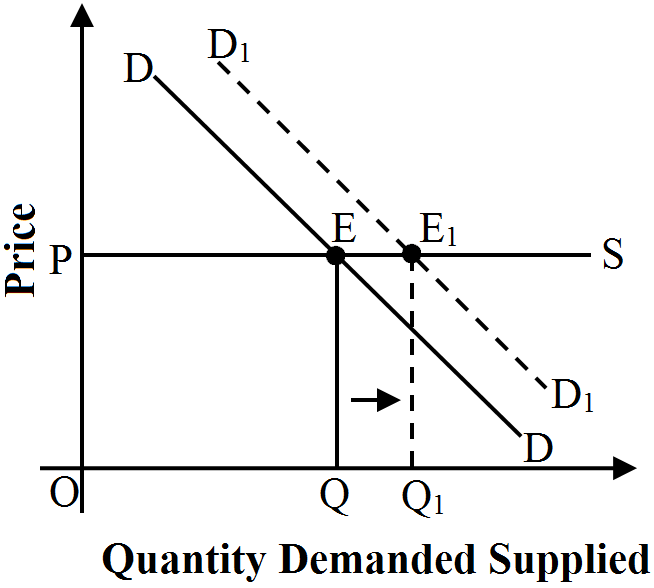
Case II: When supply becomes perfectly elastic: In the given diagram price is measured on vertical axis and quantity demanded and supplied is measured on horizontal axis. Initially, the equilibrium price is $OP$ and equilibrium quantity is $OQ$. But when "supply becomes perfectly elastic and demand increases then.
  1. Equilibrium price remains constant at $OP$.
  2. Equilibrium quantity rises from $OQ$ to $OQ_1$.
View full question & answer
Question 154 Marks
Equilibrium price of an essential medicine is too high. Explain what possible steps can be taken to bring down the equilibrium price, but only through the market forces. Also explain the series of changes that will occur in the market.
Answer
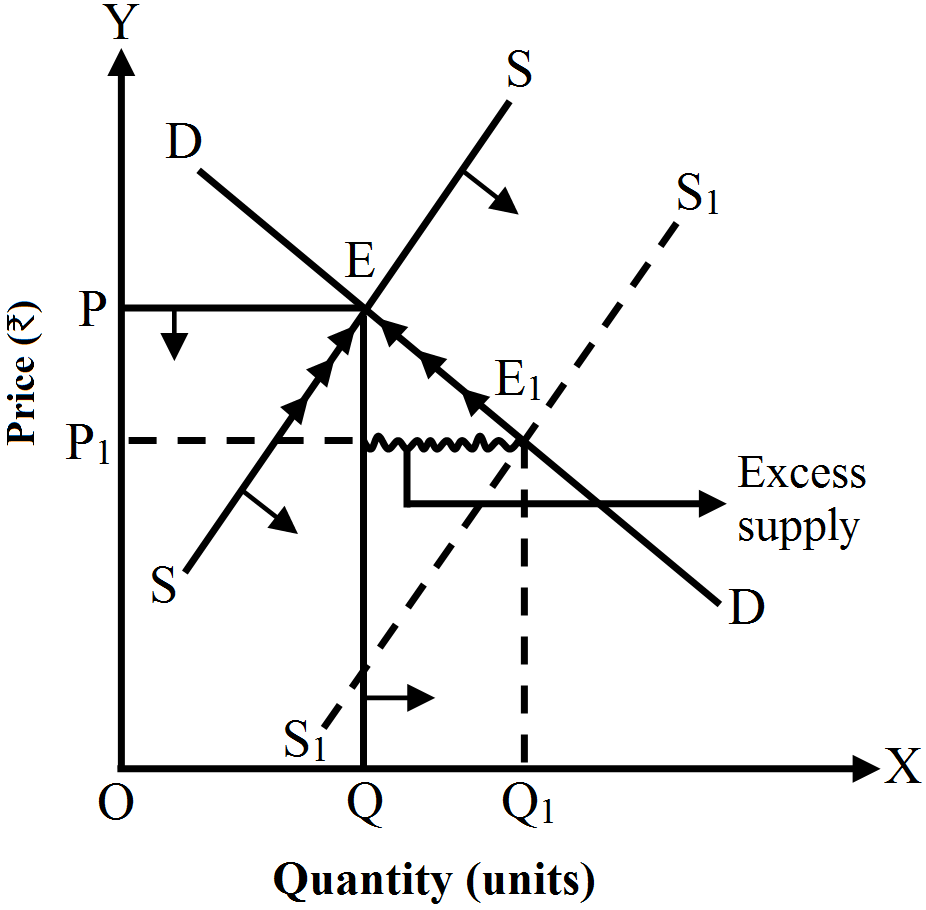
If the equilibrium price of an essential medicine is too high, then its price can be reduced by opting two ways,
  1. Increase the supply of the commodity.
  2. Government should provide such essential medicines on subsidised rates.
But as per the question, option (i) would be most appropriate. Changes that will occur in the market are mentioned below

In the given figure, it is clearly depicted that due to increase in supply, the supply curve shifts to the right from $\mathrm{SS}$ to $\mathrm{S}_1 \mathrm{~S}_1$. The new supply curve $\mathrm{S}_1 \mathrm{~S}_1$ intersects the demand curve at point $\mathrm{E}_1$. The equilibrium price decreases from $\mathrm{OP}$ to $\mathrm{OP}_1$, and quantity increases from $\mathrm{OQ}$ to $\mathrm{OQ}_1$. Thus, it is clear that by increasing the supply of the medicines, its equilibrium price can be brought down as by doing so, competition will be increased among the producers and consequently, they would be forced to sell their output at lower cost.
View full question & answer
Question 164 Marks
Using supply and demand curves, show how an increase in the price of shoes affects the price of a pair of socks and the number of pairs of socks bought and sold.
Answer
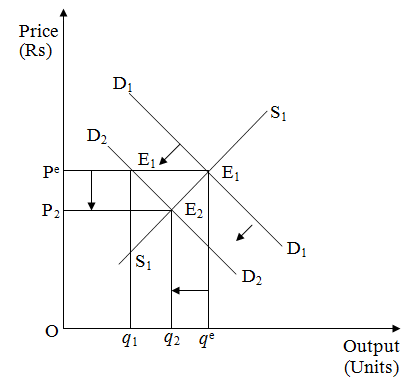
Shoes and socks both are complementary to each other and are used together. Therefore, the increase in shoe price will discourage the demand for socks. Therefore, due to the decrease in demand for socks, the demand curve for socks will shift leftwards parallelly from $D_1 D_1$ to $D_2 D_2$. The supply remaining unchanged, at the equilibrium price $P^2$, there exists excess supply of socks, which reduces the price of socks and the new equilibrium will be at $E _2$, with equilibrium price $P_2$ and equilibrium quantity $q_2$. Price decreases from $P_1$ to $P_2$ Demand decreases from $q^e$ to $q^2$ equilibrium point shifts from $E_1$ to $E_2$
View full question & answer
Question 174 Marks
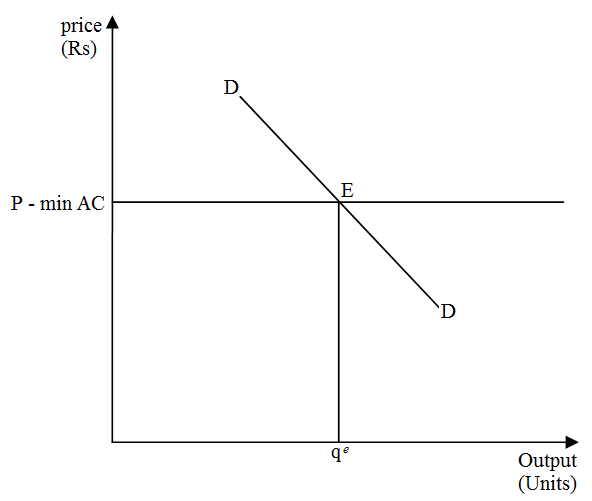
Suppose the price at which equilibrium is attained in exercise 5 is above the minimum average cost of the firms constituting the market. Now if we allow for free entry and exit of firms, how will the market price adjust to it?
Answer
If the equilibrium price (Rs. 8) in the above figure (of Q-5) is above the minimum of average cost, then it implies that the firm is earning supernormal profits. This situation will attract new firms in the market. As the new firms enter, the industry supply of output will also increase. New firms will continue to enter the industry that will lead the price to fall until it becomes equal to the minimum of the average cost. Thus, the supernormal profits are wiped out and all the firms earn normal profits
When the free entry and exit of firms is allowed, the equilibrium is determined by the intersection of demand curve and the 'P = min AC' line.
View full question & answer
Question 184 Marks
What is Elasticity of Demand under perfect competition and monopolistic competition?
Answer
Under perfect competition, Elasticity of Demand is perfectly elastic, i.e. $(\text{E})_{\text{d}}\text{a}=\infty$ This indicates that unlimited quantity can be sold at the prevailing price. On the other hand, under monopolistic competition, the Ed is greater than one, i.e. $E_d > 1$. This means that the responsiveness of demand is high with change in price. A small change in price will bring greater change in demand due to existence of many firms in the market, selling close substitute goods.
View full question & answer
Question 194 Marks
What happens when the government fixes the maximum price (or price ceiling) lower than the market equilibrium price for the commodity? Explain with the help of a diagram.
OR
Explain the effects of a 'Price Ceiling'.
Answer
When the government fixes the maximum price (or price ceiling) lower than the market equilibrium price for the commodity, it gives rise to "Excess demand". That is at the ceiling price, demand is more than supply, causing shortage of the commodity.
The given figure illustrates it. In the figure, E is the equilibrium point attained by the interaction of demand and supply curves, $D D$ and $S S$ respectively. $O P_e$ is the equilibrium price and $O Q_m$ is the equilibrium quantity. $O P_e$ is the maximum price fixed by the government. It is necessarily below the equilibrium price $OP _{ e }$. It is the maximum legal price. At this price $O P_m$, supply is $O Q_1$ units of good and the demand is $O Q_2$ units. $A B$ shows excess demand or shortage of the commodity at this price.
View full question & answer
Question 204 Marks
Under perfect competition, firms can sell any quantity at the existing price, then why firms are reluctant to reduce the price in order to capture the entire market?
Answer
It is true that firms under perfect competition can sell any quantity at the existing market price. They cannot increase the price of their commodity as it will lead to zero supply because each firm is selling homogeneous goods. On the other hand, firms are reluctant to reduce the price because of the following two reasons.
  1. They are earning only normal profits in the long-run. Selling before the prevailing price will result in abnormal losses.
  2. There is no logic in lowering the price, as unlimited quantity can be sold at the prevailing price.
View full question & answer
Question 214 Marks
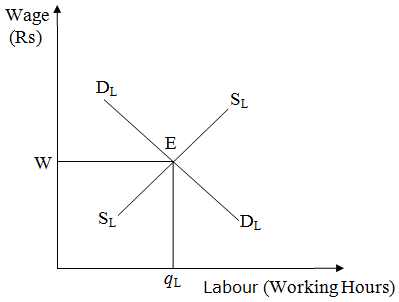
How is the optimal amount of labour determined in a perfectly competitive market?
Answer
A profit maximising firm will employ labour up to the point where the extra cost incurred by employing the last unit of labour (wage) equals the additional benefit it earns by employing that unit of labour. That is, Marginal cost of labour $=$ Marginal benefit by labour. Wage rate $=$ Marginal Revenue Product or $W = MRPL$ or $W = MR \times MPL$ (as $M R P_L=M R \times M P_L$ ) or $W = P \times M P_{ L }$ (in Perfect Competition Price $= MR$ ) or $W = VMP _{ L }$ (because $VMP _{ L }= P \times M P_{ L }$ ) The demand for labour is derived from $VMP _{ L }$ and the supply of labour is positively sloped. The equilibrium exists at E , where the demand for labour and the supply of labour intersect each other. The equilibrium wage rate is $w$ and optimal amount of labour is qL.
View full question & answer
Question 224 Marks
How is the equilibrium number of firms determined in a market where entry and exit is permitted?
Answer
The characteristic of free entry and exit of firms ensures that all the firms in a perfect competitive market earn normal profit, i.e. the market price is always equal to the minimum of LAC. No new firm will be attracted to enter the market or no existing firm will leave, if the price is equal to the minimum of LAC. Thus, the number of firms is determined by the equality of price and the minimum of LAC. The market equilibrium is determined by the intersection of market demand curve $\left(D_1 D_1\right)$ and the price line. The equilibrium price is $P _1$ and the equilibrium output is $q _1$. At this equilibrium price, each firm supplies the same output $q _1 f$, as it is assumed that all the firms are identical. Therefore, at the equilibrium, the number of firms in the market is equal to the number of firms required to supply output $q_1$ at price $P_1$, and each in turn supplying $q_1 f$ amount at this price. That is. $n=\frac{q_1}{q_1 f}$
Where, $n =$ number of firms at market equilibrium. $q _1=$ the equilibrium quantity demanded. $q _1 f =$ the quantity of output supplied by each firm.
View full question & answer
Question 234 Marks
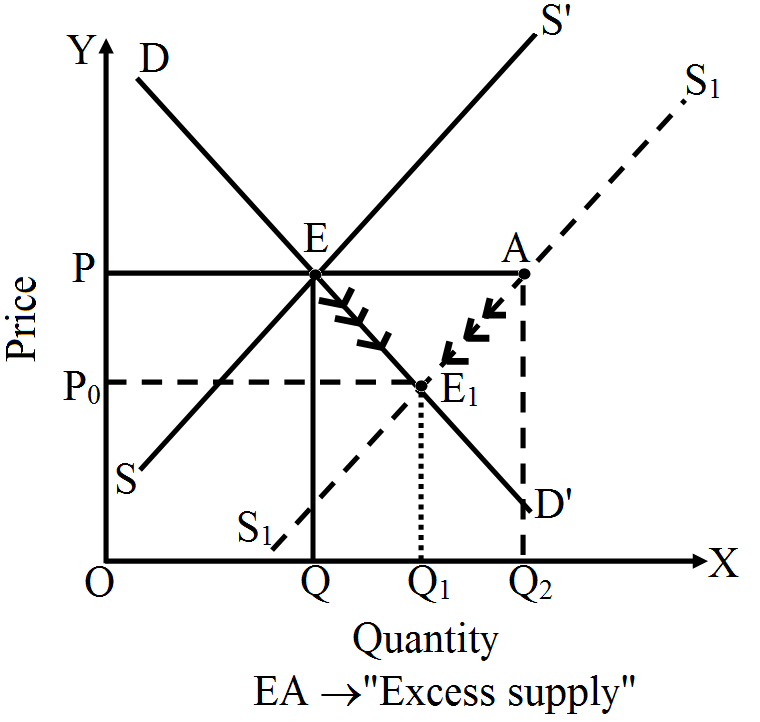
Explain with the help of a diagram, the effect of an increase in supply of a commodity on its equilibrium price and quantity.
OR
Explain the chain of effects of increase in the supply of a good on its price, supply and demand. Use diagram.
Answer

In the diagram, DD' and SS' denote the demand curve and supply curve of the given commodity, Point E denotes the point of equilibrium, where $DD ^{\prime}= SS$. . OP is the given equilibrium price and OQ is the given equilibrium quantity. With increase in supply of good, the supply curve shifts to right. When SS curve shifts to right then at OP price new quantity supplied is $O Q_2$, which is greater than quantity demanded $O Q_1$ by $Q Q_2$. The excess supply equal to $Q Q_2$ or EA emerges.
This excess supply results in competition among the sellers leading to a fall in the price. A fall in the price results in a rise in quantity demanded (a downward movement along the demand curve) and fall in quantity supplied (a downward movement along new supply curve). These changes continue till we reach price $O P_0$ which is the new equilibrium price at which quantity demanded and quantity supplied are equal $\left(=O Q_1\right)$. Hence equilibrium price falls from OP to $OP _0$ and equilibrium quantity increases from OQ to $OQ _1$.
View full question & answer
Question 244 Marks
What will happen if the price prevailing in the market is:
  1. above the equilibrium price?
  2. below the equilibrium price?
Answer
  1. If the market price is above the equilibrium price, there occurs the situation of excess supply (where market supply > market demand)

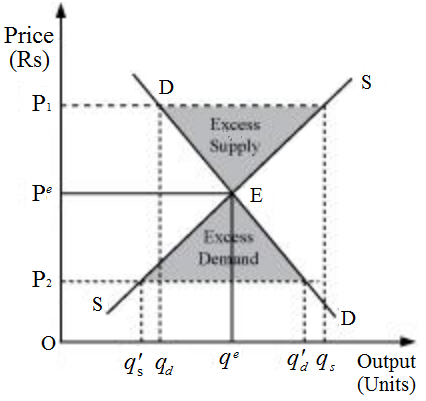
In the given figure, the equilibrium price and quantity is demoted by $P^e$ and $q^e$​​​​​​​.
Let us assume that the market price $(P_1)$ is above the equilibrium price $P^e$. Now, according to the demand curve, the quantity demanded is $q_d$. Whereas, according to the supply curve, the quantity supplied is $q_S$​​​​​​​. Thus, there exists a situation of excess supply equivalent to $(q_S- q_d)$.
  1. If the market price is below the equilibrium price, there occurs the situation of excess demand (where market demand > market supply)
Let us assume that the market price $P_2$​​​​​​​ is below the equilibrium price $P^e$​​​​​​. According to the demand curve, quantity demanded is $q’_d$. Whereas, according to the supply curve, the quantity supplied is $q’_S$​​​​​​​. So, it can be seen that there emerges the situation of excess supply equivalent to $(q’_d. - q’_S)$.
View full question & answer
Question 254 Marks
Economists say in consistent things, as price falls, demand rises, but as demand rises, price rises. Defend or refute.
Answer
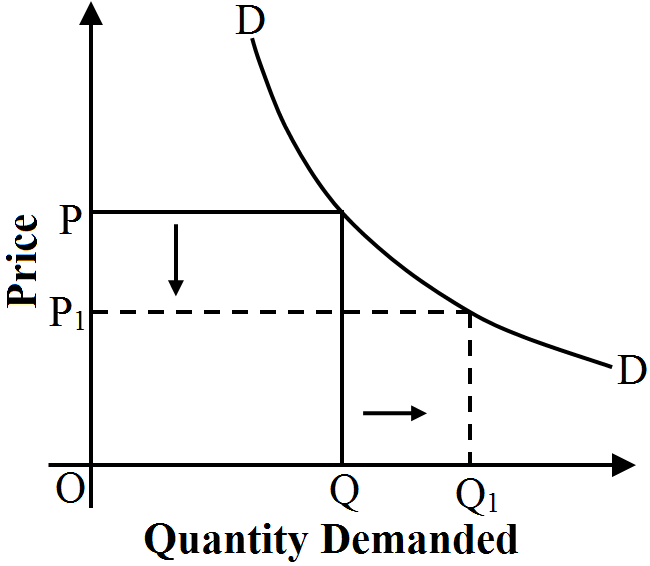
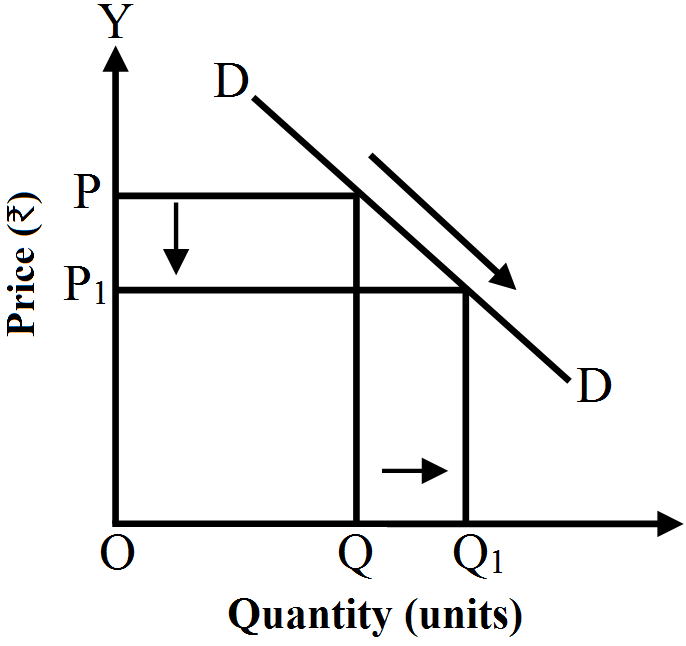
The statement that as price falls, demand rises, but as demand rises, price rises, can be defended. The first part of the statement, i.e. as price falls, demand rises shows the general behaviour of the consumer in the market. This is simply a forward movement along a demand curve.


But, there may also be a situation when increase in demand leads to increase in price. When the supply of a commodity remains unchanged and demand increases due to factors others than price such as increase in income of the consumer or change in taste and preference of the consumer, the demand curve shifts upward and it raises the market price as shown in figure B. Figure A shows when price falls from $OP$ to $OP_1$,demand rises to $OQ_1$ . This is extension of demand. Figure B shows when there is increase in demand and demand curve shifts upward to $D_1D_1$, price rises to $OP_1$.
View full question & answer
Question 264 Marks
China is a big manufacturer of telephone instruments. It has recently become a member of $WTO$, which means that it can sell its product in other member countries like India. Suppose that it does export a large number of telephone instruments to India.
  1. How will it affect the price and quantity sold of telephone instruments in India?
  2. Suppose that the demand for telephone instruments is relatively elastic. How will it affect India's total expenditure on telephone instruments?
Answer
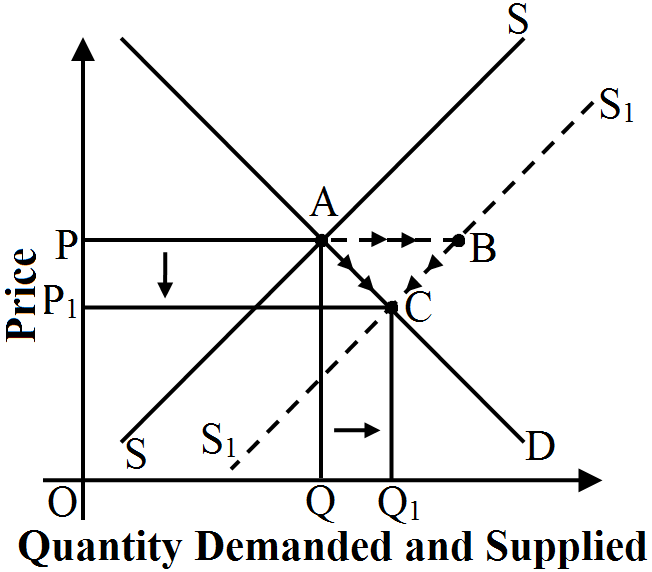
  1. The supply of telephone instruments in India will increase. An increase in supply of telephone instruments will result in a rightward shift of the supply curve from $SS$ to $S_1S_1$ as shown below:
The supply curve shifts rightward from $SS$ to $S_1S_1$. With new supply curve $S_1S_1$ there is excess supply at initial price $OP$ because at price $OP$ supply is $PB$ and demand is $PA$; so there is excess supply of $AB$ at price $OP$.
Due to this excess supply, competition among the producer will fall the price. Due to this fall in price there is downward movement along the supply curve (Contraction in supply) from $B$ to $C$ and similarly there is downward movement along the demand curve (Expansion in demand) from A to C. So, finally, equilibrium price falls from $OP$ to $OP_1$, and equilibrium quantity rises from $OQ$ to $OQ_1$.

Conclusion:
Due to increase in number of firms,
  1. Equilibrium price of telephones falls from $OP$ to $OP_1$.
  2. Equilibrium quantity of telephones rises from $OQ$ to $OQ_1$.
  1. For a product with relatively elastic demand a fall in the price of a commodity results in a relatively larger expenditure by the consumers. Thus, the total expenditure on telephones will increase.
View full question & answer
Question 274 Marks
Show with the help of a diagram, the effect on equilibrium price and quantity of a commodity when.
  1. Demand is perfectly elastic and supply decreases.
  2. Supply is perfectly inelastic and demand increases.
  3. The demand curve perfectly elastic and the supply curve shifts out.
Answer
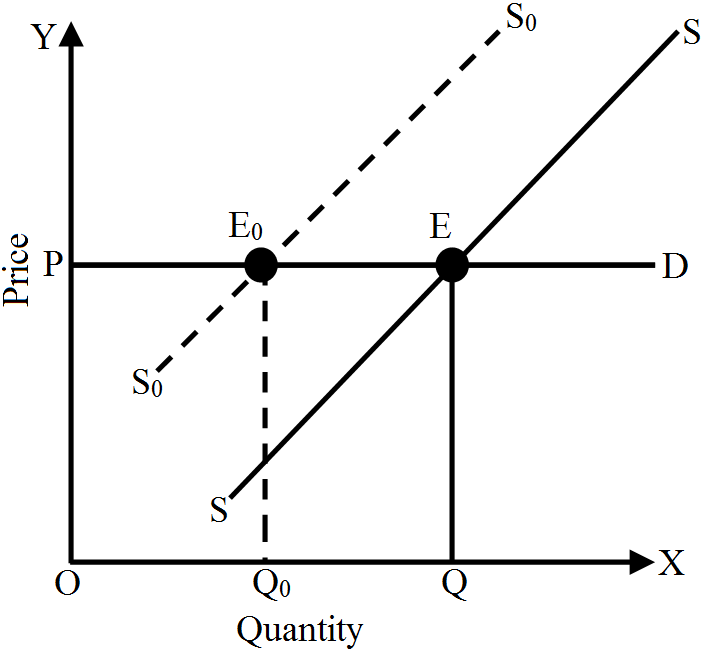
  1. When demand curve is perfectly elastic and supply decreases there will be no change in the equilibrium price but the equilibrium quantity decreases from OQ to $OQ_0.$

In the diagram, when supply decreases, it is shown by the leftward shift of the supply curve from SS to $S_0S_0$​​​​​​​, equilibrium price remains constant at OP, but equilibrium quantity decreases from OQ to $OQ_0.​​​​​​​$​​​​​​​
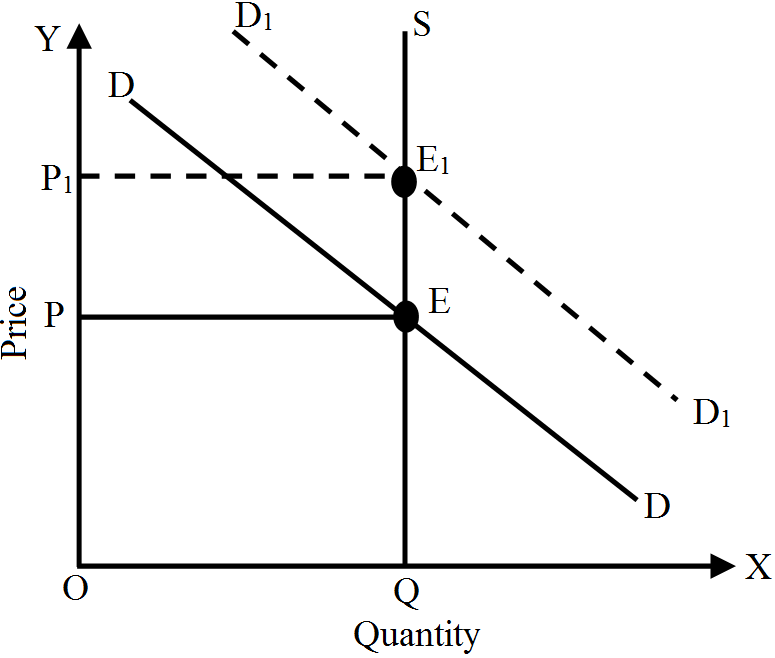
  1. When supply curve is perfectly inelastic and demand increases, the equilibrium price of the commodity will increase but the equilibrium quantity remains constant.

In the diagram, when demand increases, shown by rightward shift of the demand curve from DD to $D_1D_1​​​​​​​$​​​​​​​, the equilibrium price increases from OP to $OP_1​​​​​​​$​​​​​​​ but equilibrium quantity remains the same at $OQ.$​​​​​​​
  1. When demand curve is perfectly elastic and supply curve shifts to right, there will be no change in equilibrium price but equilibrium quantity increases

In the diagram, when supply increases shown by the rightward shift of supply curve from SS to $S_1S_1​​​​​​​$​​​​​​​ equilibrium price remains constant at OP, but the equilibrium quantity increases from $OQ$ to $OQ_1.$
View full question & answer
Question 284 Marks
Why a firm's demand curve indeterminates under oligopoly?
Answer
A firm's demand curve is indeterminates under oligopoly because there is high degree of interdependence between the firms. Price and output policy of one firm has a significant impact on the price and output policy of the rival firms in the market. When one firm lowers its price, the rival firms may also lower the price. Contrarily, when one firm raises the price, the rival firms may not do it. Accordingly, it becomes very difficult to estimate change in firm's sale caused by a change in price. So, a precise relationship between price and sales cannot be established or the firm's demand curve cannot be drawn.
View full question & answer
Question 294 Marks
Market for a good is in equilibrium. What is the effect on equilibrium price and quantity if increase in market demand is less than increase in market supply? Use diagram.
Answer
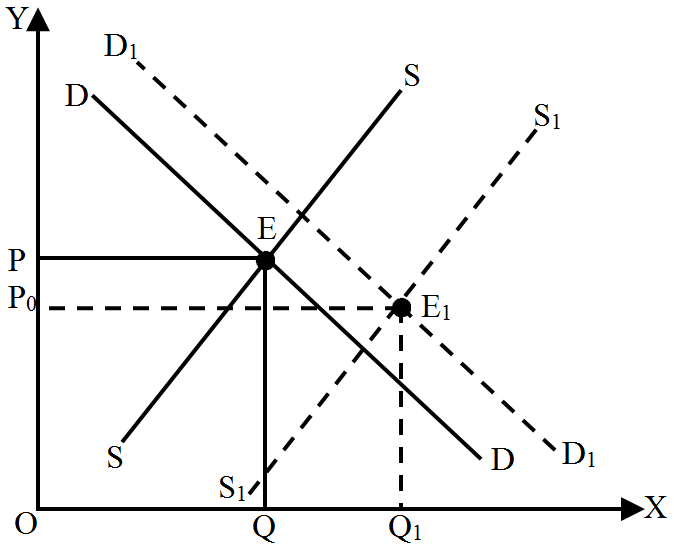
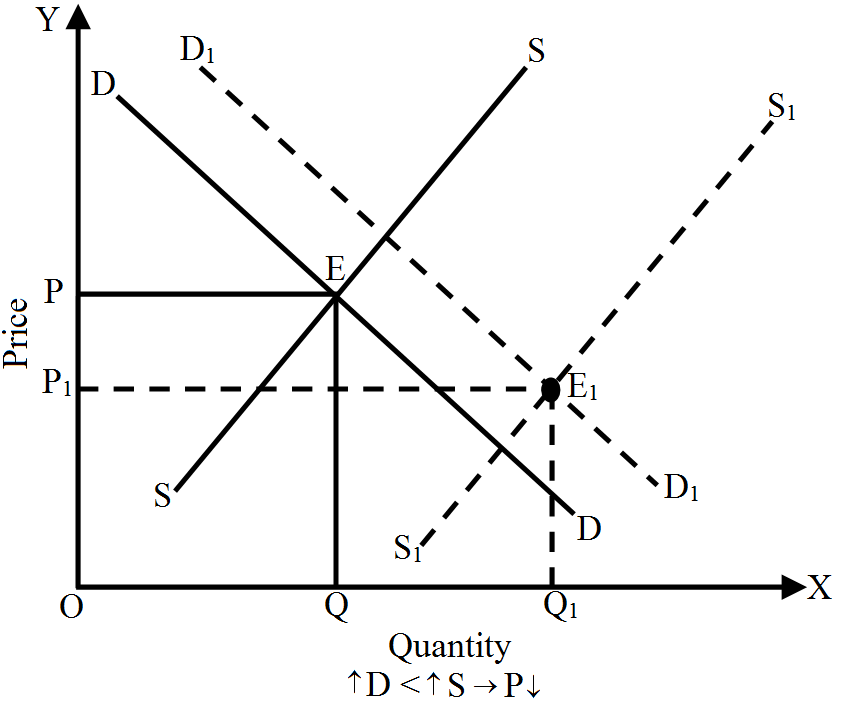
When increase in market demand is less than increase in market supply, then due to excess supply in the market, equilibrium price will fall but the equilibrium quantity will rise. The diagram illustrates the point.

In the diagram, when the supply curve shifts to the right from $SS$ to $S_1S_1$ and demand curve shifts to the right from $DD$ to $D_1D_1$ the equilibrium price falls from $OP$ to $OP_0$ but the equilibrium quantity rises from $OQ$ to $OQ_1$.
View full question & answer
Question 304 Marks
In the given diagram, $OP$ is the market determined price and $OP_1 $is the price fixed by the government.
  1. Identify if the diagram represents, price ceiling or price flooring.
  2. Discuss the likely behaviour of the market in the given condition.
Answer
a. The diagram represents price flooring.
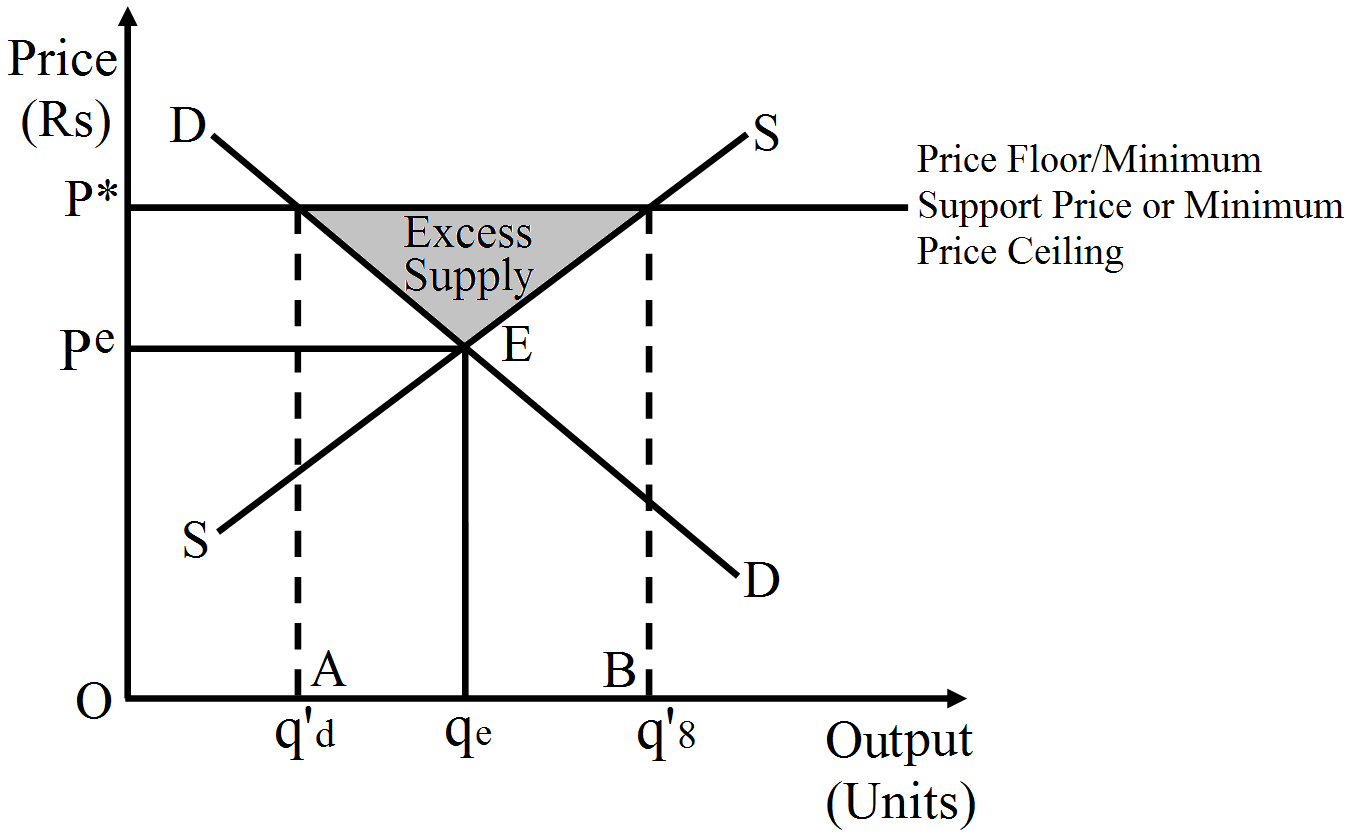
b. Price floor implies legislated or government fixed minimum price that should be charged by the seller. The minimum price is fixed above the equilibrium price. In the following figure, DD represents the market demand and SS represents the market supply. The point 'E' represents the market equilibrium point, where the market demand and market supply intersect. The equilibrium price is $Op ^e$ and equilibrium output is $Oq ^e$.
Now, assume that the government imposes price floor at price $OP _1$. At this price, the quantity demanded is $q ^{\prime} d$, whereas, the quantity supplied is $q^{\prime} s$ units. As quantity supplied ( $q^{\prime} s$ ) is more than quantity demanded ( $q^{\prime} d$ ), so there exists a situation of excess supply of $A B$ units of a given good. (i.e. $q^{\prime} s-q^{\prime} d$ ).


View full question & answer
Question 314 Marks
Explain the implications of the following features of monopolistic competition.
  1. Product differentiation.
  2. Free entry or exit of firms.
Answer
  1. Product Differentiation: It is a distinct feature of monopolistic competition. A product is often differentiated by way of trademarks and brand names. The differentiated products are close substitutes of each other like colgate and closeup toothpaste.
Because of product differentiation, each firm can influence its price. So that, each firm has a partial control over price of its product.
  1. Free Entry or Exit of Firms: Firms are free to enter the industry or leave it. However, new firms have no absolute freedom of entry into industry. Products of some firms may be legally patented. New firms cannot produce those products, e.g. no rival firm can produce or sell a patented item like Woodland shoes.
View full question & answer
Question 324 Marks
Is a firm under perfect competition a price taker, or a price maker? Justify your answer.
Answer
A firm under perfect competition is a price taker because of the following reasons:
  1. A firm under perfect competition is contributing such a small fragment to the market supply that total supply schedule remains unaffected by any change in individual firm's supply.
  2. All firms are selling homogeneous product. Accordingly, even partial control over price is not possible.
  3. If any firm tries to fix its own price, it won't succeed. Higher price would drive the buyers to a large number of other sellers. Lower price would bring so many buyers to a firm that it cannot cope with the demand.
View full question & answer
Question 334 Marks
Mrs Ramgopal says that economists say inconsistent things: as price falls, demand rises but as demand rises, a price rises. Defend or refute.
Answer
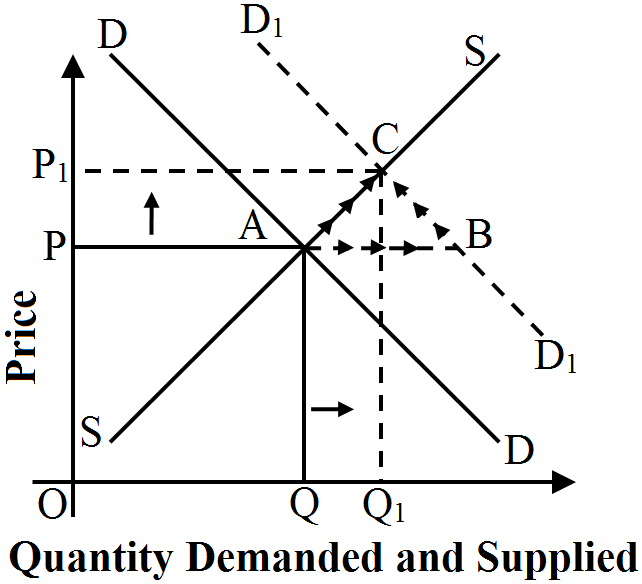
We defend the statement of Mrs Ramgopal. As price falls, demand rises. According to Law of Demand, there is inverse relationship between demand and price. Lesser price leads to higher demand. Demand = f (price) When demand rises, prices also rises. Price is function of twin forces of demand and supply. Price = f (demand, supply) In the given figure, price is measured on vertical axis and quantity demanded and supplied is measured on horizontal axis. Initially, the equilibrium price is $OP $and equilibrium quantity is $OQ$. But due increase in demand, the demand curve shifts rightward from DD to $D_1D_1.$​​​​​​​
With new demand curve $D_1 D_1$, there is excess demand at initial price $O P$ because at price OP, demand is PB and supply is PA, so there is excess demand of $A B$ at price $O P$. Due to this excess demand, competition among the consumer will raise the price. With the rise in price, there is upward movement along the demand curve (contraction in demand) from B to C and similarly, there is upward movement along the supply curve (expansion in supply) from A to C . So, finally equilibrium price rises from OP to $O P_1$. So, demand rises, price rises.​​​​​​​
View full question & answer
Question 344 Marks
Suppose the demand and supply equations of a commodity $X$ in a perfectly competitive market are given by:
$Q_d = 1700 - 2P$
$Q_s = 1300 + 3P$
Calculate the value of equilibrium price and equilibrium quantity of the commodity $X$.
Answer
At the point of equilibrium demand is equal to supply in a perfectly competitive market. So, $Q_d=1700-2 P ~Q_s=$ $1300+3 P$ At point of equilibrium, $Q_d=Q_s=1700-2 P=1300+3 P=1700-1300=3 P+2 P=400=5 P \frac{400}{5}=P e$ $80=P_e ~Q_e=1700-2(80)=1700-160=1540$ The equilibrium price is equal to 80 and equilibrium quantity is equal to $1540$ units of a commodity $X$.
View full question & answer
Question 354 Marks
Can you think of any commodity on which price ceiling is imposed in India? What may be the consequence of price-ceiling?
Answer
Price ceiling means deciding lower prices as compared to market price of goods. In India, there are many goods on which government has imposed price ceiling, in order to keep them available within the reach of the BPL (below poverty line) people. These goods are kerosene, sugar, wheat, rice, etc.
The following are the consequences of price ceiling:
  1. Excess demand: Due to artificially imposed price, cutting lower than the equilibrium price leads to the emergence of the problem of excess demand.
  2. Fixed Quota: Each consumer gets a fixed quantity of good (as per the quota). The quantity often falls short of meeting the individual's requirements. This further leads to the problem of shortage and the consumer remains unsatisfied.
  3. Inferior goods: Often it has been found that the goods that are rationed are usually inferior goods and are adulterated.
  4. Black marketing: The needs of a consumer remain unfulfilled as per the quota laid by the government. Consequently, some of the unsatisfied consumers get ready to pay higher price for the additional quantity. This leads to black-marketing and artificial shortage in the market.
View full question & answer
Question 364 Marks
Explain with the help of a diagram the effect of a decrease in demand for a commodity on its equilibrium price and quantity
OR
Explain the chain of effects on demand, supply and price of a commodity caused by a leftward shift of its demand curve. Use diagram.
Answer


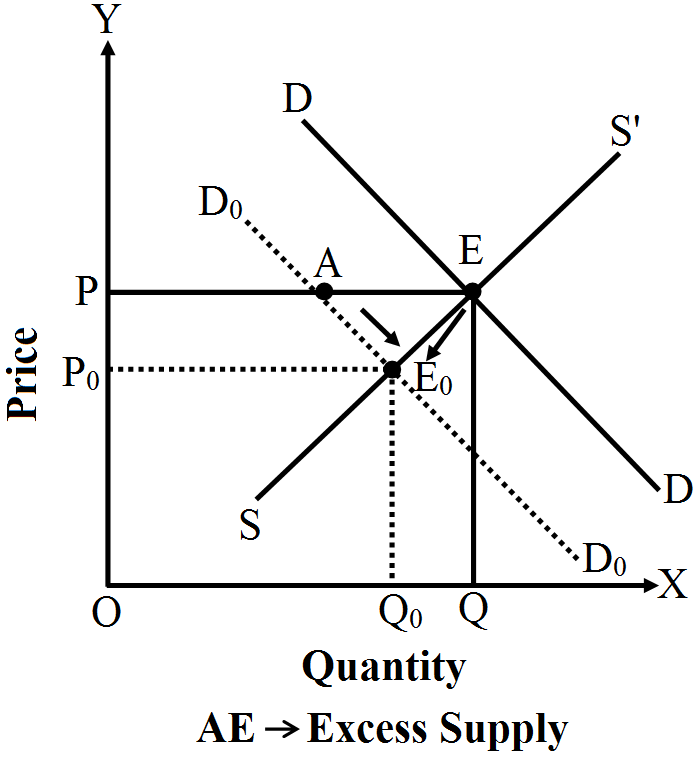
In the given diagram, $DD'$ shows the demand curve and $SS'$ shows the supply curve of a commodity. Point E denotes the point of equilibrium where $DD' = SS'$. $OP$ is the given equilibrium price and $OQ$ is the given equilibrium quantity. A decrease in demand leads to leftward shift of the demand curve. It is denoted by $D_0D_0$ curve. Now, at given price $OP$, new quantity demanded is $OQ_0$ which is less than supply by $QQ_0$. The excess supply equal to AE emerges.
This excess supply results in competition among the sellers leading to a fall in price. A fall in price results in rise in quantity demanded (a downward movement along the new demand curve) and a fall in quantity supplied (a downward movement along the supply curve) shown by arrows in the diagram. These changes continue till we reach price $OP_0$. This is new equilibrium price at which quantity demanded and supplied are equal at $OQ$. Hence equilibrium price falls from $OP$ to $OP_0$ and equilibrium quantity also falls from $OQ$ to $OQ_0$.
View full question & answer
Question 374 Marks
Explain the effects of an increase in both demand and supply of a commodity on its equilibrium price.
OR
What can be the effects on the equilibrium price of a commodity, when the demand and supply curves shift to right? Show three effects on a diagram.
Answer
When both demand and supply of a commodity increase (i.e., when both the demand and supply curve of a commodity shift to the right), the equilibrium quantity will increase but the equilibrium price may or may not be affected. There may be three situations:
  1. When both demand and supply of a commodity increase in equal proportion, the equilibrium price will remain the same.
  1. When both demand and supply increase but increase in demand is more than the increase in supply, equilibrium price will rise.
  1. When both demand and supply increase but the increase in demand is less than increase in supply, equilibrium price will fall.
View full question & answer
Question 384 Marks
Distinguish between collusive and non-collusive oligopoly.
Answer
Difference between collusive and non-collusive oligopoly are:
S. No
Basis
Collusive oligopoly
Non-collusive oligopoly
1.
Meaning
Under this form, firms might decide to collude together and not to compete with each other.
In this form of oligopoly, firms do not collude, but compete with each other.
2.
Firms behave
Under this oligopoly, the firms would behave as a single monopoly.
Under this oligopoly, the firms behave independently.
3.
Aim
They aim at maximising their collective profit rather than their individual profit.
The firms aim to maximising its own profits and decides how much quantity to be produced assuming that the other firms would not change their quantity supplied.
View full question & answer
Question 394 Marks
How is equilibrium price determined? How is it affected by changes in demand for the commodity?
Answer
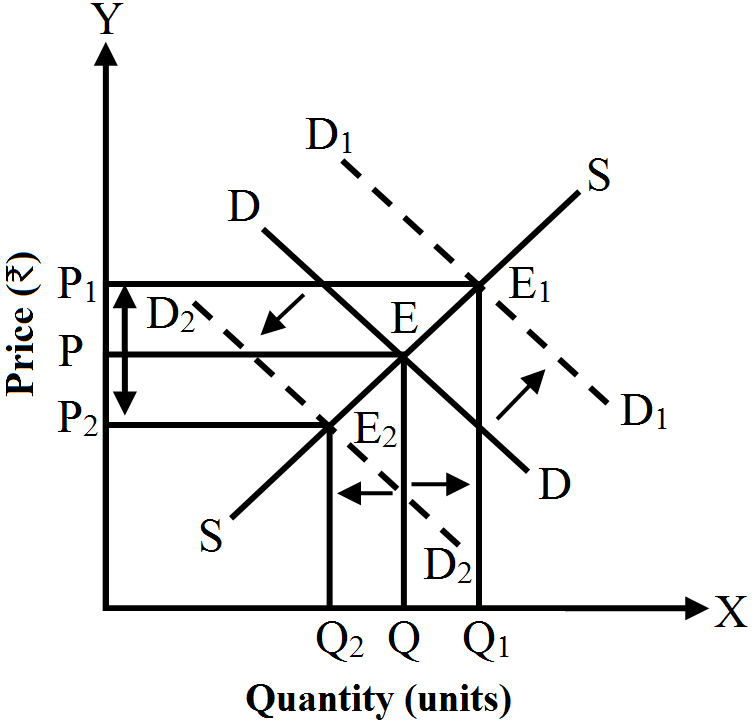
Equilibrium price is determined at a point where market demand is equal to market supply. Other things being equal, equilibrium price increases with an increase in demand and falls with a decrease in demand, as shown in the given figure
At $DD$ demand curve Equilibrium point = E, equilibrium price = $OP$ At $D_1 D_1$ demand curve (increase in demand) New equilibrium point = $E_1$ Equilibrium price = $OP_1 ~OP_1 > OP$ (increase in price) At $D_2D_2$ demand curve (decrease in demand) New equilibrium point = $E_2$ Equilibrium price = $OP_2 ~OP_2 < OP$ (decrease in price) Assumption Supply remains constant.
View full question & answer
Question 404 Marks
Explain the implications of the "freedom of entry and exit" feature of perfect competition.
Answer
There are no obstacles in the way of new firms joining the industry and existing firms leaving the industry in the long run. This ensures that there are neither abnormal profits nor losses by any firm in the long run. In the short run, profits and losses are possible. If firms are making profits, new firms enter and raise the total supply of the industry. This reduces market price and wipes out profits. However, if the firms are incurring losses, the existing firms start leaving the industry and reduce the total supply. This raises the price till all the losses are wiped out.
View full question & answer
Question 414 Marks
Explain the effects of a 'price ceiling'.
OR
Explain the effects of 'maximum price ceiling' on the market of a good. Use diagram.
Answer
  1. When the government imposed upper limit on the price (maximum price) of a good or service which is lower than equilibrium price is called price ceiling.
  2. Price ceiling is generally imposed on necessary items like wheat, rice, kerosene etc.
  3. It can be explained with the help of diagram below:
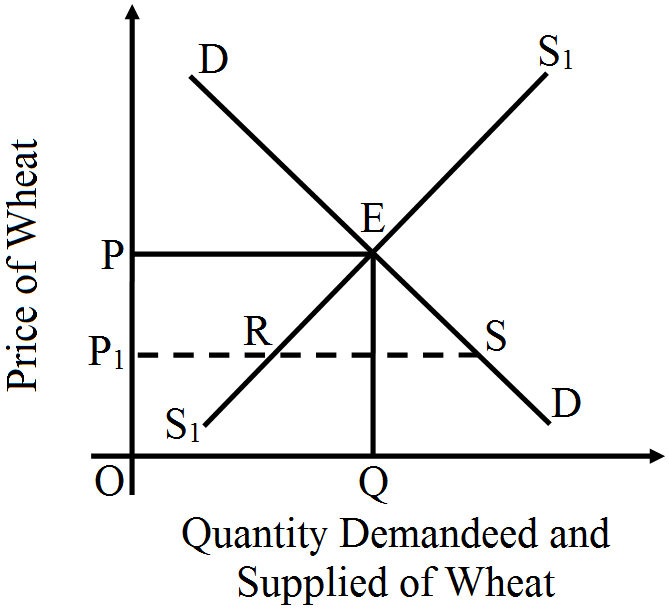
  1. In the given diagram, $DD$ is the market demand curve and SS is the market supply curve of Wheat. Suppose, equilibrium price $OP$ is very high for many individuals and they are unable to afford at this price.
  2. As wheat is necessary product, government has to intervene and impose price ceiling of $P_1$, which is below the equilibrium level.
  3. Since this price is below equilibrium price, there is excess demand in the market. With shortages, sellers tend to hoard the product. It could also lead to black marketing.
View full question & answer
Question 424 Marks
What is 'price floor'? Explain its implications.
Answer
Price floor means the minimum price fixed by the government for a good in the market. The government fixes this price on agricultural products and food grains in particular. A minimum price is fixed which the traders must pay to the farmers in the wholesale market. Thus, the income of the farmer is regulated and a continuous production is assured.Implications of price floor:
  1. The government ensures to buy the full produce of the farmers which are not sold in the market at the price floor. Hence, they are able to produce the maximum level of output.
  2. Farmers are ensured with the minimum returns as their products are completely sold in the market at comparatively higher price. This leads to an increase in their level of income.
  3. Because of price floor, consumers and traders in the market are forced to pay higher price than the equilibrium price.
View full question & answer
Question 434 Marks
Explain the conditions of perfect competition. Why is the demand curve facing a firm under perfect competition is perfectly elastic?
Answer
The main conditions of perfect competition are:
  1. Large number of buyers and sellers.
  2. Homogeneous product.
  3. Perfect knowledge.
  4. Perfect mobility of factors of production.
  5. Free exit and entry of the firms.
  6. No transport cost.
When goods are purchased across different buyers, demand curve of a firm is perfectly elastic$(\text{E})_{\text{d}}\text{a}=\infty$because even the slightest change in price will cause an infinite change in demand. Because of this feature, it is also referred to be an imaginary market form.
View full question & answer
Question 444 Marks
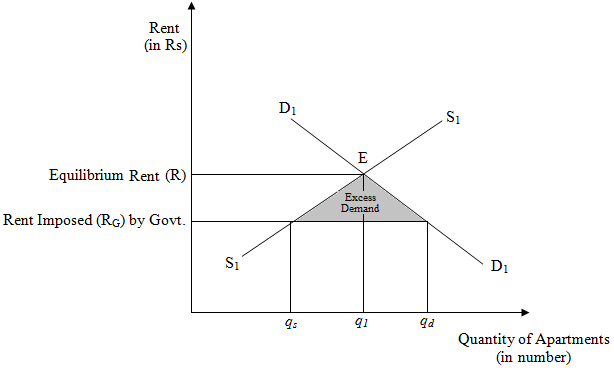
Suppose the market determined rent for apartments is too high for common people to afford. If the government comes forward to help those seeking apartments on rent by imposing control on rent, what impact will it have on the market for apartments?
Answer

The above figure depicts an equilibrium and an effect of price ceiling (maximum rent).
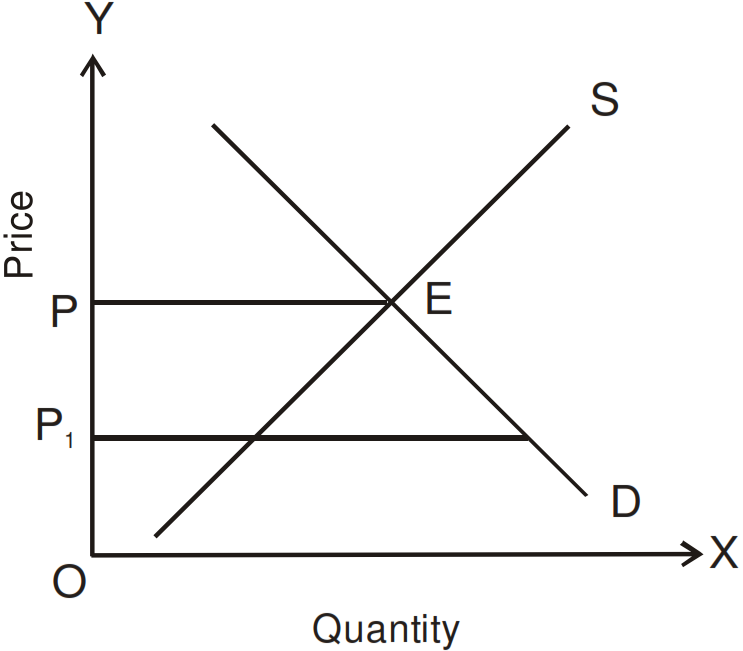
The market demand for apartments is depicted by the $D_1D_1$ curve and the supply of apartments is depicted by $S_1S_1$. The equilibrium price determined is $R$ and the equilibrium quantity is $q$.
If the government steps in and imposes rent ceiling (maximum rent) equivalent to $R_G$,then at this rent, there will be an excess demand. The quantity of apartments demanded will be $q_d$. Whereas, the quantity of apartments supplied is $q_s$. So, there exists an excess demand equivalent to $q_d−q_s$. At the rate $R_G$, common people can afford apartments to live in, which earlier they were not able to. However, besides this positive effect of imposition of maximum rent, it might happen that some landlords indulge in the practice of black marketing and offer apartments for rent at comparatively higher price.
View full question & answer
Question 454 Marks
Explain the implications of "freedom of entry and exit of firms" under perfect competition.
Answer
'Freedom of Entry', signifies that there are no barriers to the entry of new firms into industry. When the existing firms are earning supernormal profits, the new firms, attracted by the prospects of profit, enter the industry. This raises market supply which in turn leads to fall in market price and consequently profits. The entry continue still each firm is earning just the normal profits.
'Freedom to exit', signifies that there are no barriers which restrict the existing firms from leaving the industry. The firms try to leave when they are facing losses. As the firms start leaving market supply falls leading to rise in market price and consequently reduction in losses. The firms continue to leave till the losses are wiped out and each existing firm is earning just the normal profits.
View full question & answer
Question 464 Marks
What would be an effect on equilibrium price and equilibrium quantity if demand and supply both fall at the same rate?
OR
Market for a good is in equilibrium. There is simultaneous "decrease" both in demand and supply but there is no change in market price. Explain with the help of a schedule how is it possible.
Answer
When demand and supply both decrease at the same rate, equilibrium price remains constant and equilibrium quantity falls. It can be shown with the help of the following diagram.

In the given diagram price is measured on vertical axis and quantity demanded and supplied is measured on horizontal axis. Initially, the equilibrium price is $OP$ and equilibrium quantity is $OQ$. But as given in the examination problem, "demand and supply both decrease at the same rate”, then,
  1. Equilibrium price remains constant Beat $OP$.
  2. quilibrium quantity falls from $OQ$ to $OQ_1$.
View full question & answer
Question 474 Marks
What is meant by price ceiling? Explain its implications.
Answer
Price ceiling means, fixing the price of commodity by government below the equilibrium price to benifit the consumers (when the equilibrium price is presumed to be too high so that the common buyer is unable to afford such commodities at that price). Sometimes the equilibrium price determined $(OP)$ by the independent powers of demand and supply may be very high, so that most of the consumers are unable to purchase this commodity at the prevailling prices, specially in the case of necessary commodities like wheat, sugar, rice etc.

In those cases government directly interfere in price determination and decide the price $(OP_1)$ of the commodity below the equilibrium price. This price is also known as control price. In this condition government decides the maximum limit of price. At this price level the quantity demanded is more than the quantity supplied.
The implication of Price Ceiling is as follows:
  1. Shortage: Control price are lesser than equilibrium price, therefore sellers wants to sale less of the commodity whereas consumers wants to purchase more of the commodity, which creates the problem of shortage in market.
  2. Hoarding and Black Marketing: Because control price is lesser than the equilibrium price which will decrease the profit margin of sellers, therefore they will try to hoard the commodity as much as possible. Due to shortage and rationing some buyer will try to purchase more units by giving higher prices than control price, which lead to black-marketing.
View full question & answer
Question 484 Marks
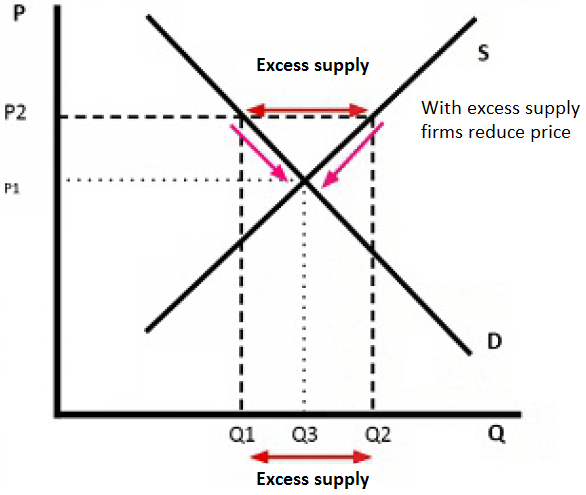
When do we say there is excess supply for a commodity in the market?
Answer
  • If price was above the equilibrium (e.g. P1), then supply (Q1) would be greater than demand (Q3) and therefore there is too much supply. There is a surplus.
  • Therefore firms would reduce price and supply less. This would encourage more demand and therefore the surplus will be eliminated. The market equilibrium will be at Q2 and Pe.
View full question & answer
Question 494 Marks
State three features of monopolistic competition.
Answer
Three features of monopolistic competition are as follows:
  1. Large Number of Buyers and Sellers As under perfect competition, in this form also, there are a large number of buyers and sellers. Also, the size of each firm is sniall. Each firm has a limited share of the market.
  2. Product Differentiation It is a distinct feature of monopolistic competition. A product is often differentiated by way of trademarks and brand names. The differentiated products are close substitutes of each other, like colgate and closeup toothpaste. Because of product differentiation, each firm can decide its price policy independently, so that each firm has a partial control over price of its product.
  3. Selling Cost Each firm has to incur selling costs (expenditure on advertisement, etc) to promote its sales. This is because there are a large number of close substitutes available in the market.
View full question & answer
Question 504 Marks
Explain why firms are mutually interdependent in an oligopoly market.
Answer
Under oligopoly, there is a high degree of interdependence between the firms. Price and output policy of one firm has a significant impact on the price and output policy of the rival firms in the market.
When one firm lowers its price, the rival firms may also lower the price. And when one firm raises the price, the rival firms may not do it. Accordingly, while taking an action on price or output, a firm must take into account the possible reaction of the rival firms in the market.
View full question & answer
4 Marks Question - Economics STD 11 Commerce Questions - Vidyadip