When $5\ V$ potential difference is applied across a wire of length $0.1\ m$, the drift speed of electrons is $2.5 \times 10^{-4}$ $ms^{-1}$ . If the electron density in the wire is $8 \times 10^{28}$ $m^{-3}$ the resistivity of the material is close to
JEE MAIN 2015, Medium
Download our app for free and get started
$V=I R=\left(n e A v_{d}\right) \rho \frac{\ell}{A}$
$\therefore \quad \rho=\frac{\mathrm{V}}{\mathrm{V}_{\mathrm{d}} \mathrm{lne}}$
Here $\mathrm{V}=$ potential difference
$\mathrm{I}=$ length of wire
$\mathrm{n}=\mathrm{no} .$ of electrons per unit volume of conductor.
$\mathrm{e}=\mathrm{no.}$ of electrons
Placing the value of above parameters we get resistivity
$\rho=\frac{5}{8 \times 10^{28} \times 1.6 \times 10^{-19} \times 2.5 \times 10^{-4} \times 0.1}$
$=1.6 \times 10^{-5} \,\Omega m$

Download our appand get started for free
Experience the future of education. Simply download our apps or reach out to us for more information. Let's shape the future of learning together!No signup needed.*
Similar Questions
- 1The supply voltage to room is $120\ V$. The resistance of the lead wires is $6\,\Omega$ . A $60\ W$ bulb is already switched on. What is the decrease of voltage across the bulb, when a $240\ W$ heater is switched on in parallel to the bulb? ............. $V$View Solution
- 2View SolutionWhich of the following statement is false
- 3$12$ cells each having the same emf are connected in series and are kept in a closed box. Some of the cells are wrongly connected. This battery is connected in series with an ammeter and two cells identical with each other and also identical with the previous cells. The current is $3\, A$ when the external cells aid this battery and is $2\,A$ when the cells oppose the battery. How many cells in the battery are wrongly connected :-View Solution
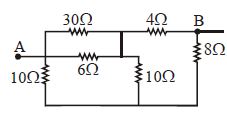
- 4The equivalent resistance across $AB$ would be ............ $\Omega$View Solution
- 5When a current of $2\, A$ flows in a battery from negative to positive terminal, the potential difference across it is $12\, V$. If a current of $3\, A$ flows in the opposite direction potential difference across the terminals of the battery is $15\, V$, the $emf$ of the battery is ............... $\mathrm{V}$View Solution
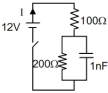
- 6Find the charge in steady state of the capacitor. (in $nC)$View Solution
- 7An insulating pipe of cross-section area $'A'$ contains an electrolyte which has two types of ions $\rightarrow$ their charges being $-e$ and $+2e$. $A$ potential difference applied between the ends of the pipe result in the drifting of the two types of ions, having drift speed $= v$ ($-ve$ ion) and $v/4$ ($+ve$ ion). Both ions have the same number per unit volume $= n$. The current flowing through the pipe isView Solution
- 8A cell of emf $6\, V$ and resistance $0.5\, ohm$ is short circuited. The current in the cell is ............... $amp$View Solution
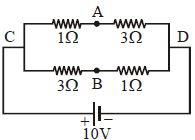
- 9A battery of $emf$ $10\,V$ is connected to resistances as shown in the figure. The potential difference between $A$ and $B,\,\,(V_A -V_B)$ is ................ $V$View Solution
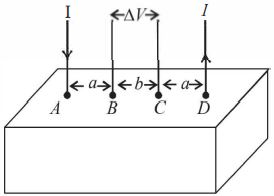
- 10Consider a block of conducting material ofresistivity '$\rho$' shown in the figure. Current '$I$' enters at '$A$' and leaves from '$D$'. We apply superp osition principle to find voltage '$\Delta V$ ' developed between '$B$' and '$C$'. The calculation is done in the following steps:View Solution
$(i)$ Take current '$I$' entering from '$A$' and assume it to spread over a hemispherical surface in the block.
$(ii)$ Calculatefield $E(r)$ at distance '$r$' from $A$ by using Ohm's law $E = \rho j$, where j is the current per unit area at '$r$'.
$(iii)$ From the '$r$' dependence of $E(r)$, obtain the potential $V(r)$ at $r$.
$(iv)$ Repeat $(i), (ii)$ and $(iii)$ for current '$I$' leaving '$D$' and superpose results for '$A$' and '$D$'.For current entering at $A$, the electric field at a distance '$r$'
from $A$ is