Consider a block of conducting material ofresistivity '$\rho$' shown in the figure. Current '$I$' enters at '$A$' and leaves from '$D$'. We apply superp osition principle to find voltage '$\Delta V$ ' developed between '$B$' and '$C$'. The calculation is done in the following steps:
$(i)$ Take current '$I$' entering from '$A$' and assume it to spread over a hemispherical surface in the block.
$(ii)$ Calculatefield $E(r)$ at distance '$r$' from $A$ by using Ohm's law $E = \rho j$, where j is the current per unit area at '$r$'.
$(iii)$ From the '$r$' dependence of $E(r)$, obtain the potential $V(r)$ at $r$.
$(iv)$ Repeat $(i), (ii)$ and $(iii)$ for current '$I$' leaving '$D$' and superpose results for '$A$' and '$D$'.
$(i)$ Take current '$I$' entering from '$A$' and assume it to spread over a hemispherical surface in the block.
$(ii)$ Calculatefield $E(r)$ at distance '$r$' from $A$ by using Ohm's law $E = \rho j$, where j is the current per unit area at '$r$'.
$(iii)$ From the '$r$' dependence of $E(r)$, obtain the potential $V(r)$ at $r$.
$(iv)$ Repeat $(i), (ii)$ and $(iii)$ for current '$I$' leaving '$D$' and superpose results for '$A$' and '$D$'.
For current entering at $A$, the electric field at a distance '$r$'
from $A$ is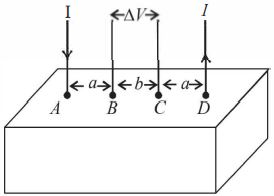
AIEEE 2008, Diffcult
Download our app for free and get started
Let j be the current density.
Then $j \times 2 \pi r^{2}=I \Rightarrow j=\frac{I}{2 \pi r^{2}} \therefore E=\rho j=\frac{\rho I}{2 \pi r^{2}}$
Now, $\Delta V_{BC}^\prime = - \int\limits_{a + b}^a {\vec E} .\overline {dr} = - \int\limits_{a + b}^a {\frac{{\rho I}}{{2\pi {r^2}}}dr} $
$=-\frac{\rho I}{2 \pi}\left[-\frac{1}{r}\right]_{a+b}^{a}=\frac{\rho I}{2 \pi a}-\frac{\rho I}{2 \pi(a+b)}$
On applying superposition as mentioned we get
$\Delta V_{B C}=2 \times \Delta V_{B C}^{\prime}=\frac{\rho I}{\pi a}-\frac{\rho I}{\pi(a+b)}$
As shown above $\quad E=\frac{\rho I}{2 \pi r^{2}}$

Download our appand get started for free
Experience the future of education. Simply download our apps or reach out to us for more information. Let's shape the future of learning together!No signup needed.*
Similar Questions
- 1The Kirchhooff's first law $\left(\sum i=0\right)$ and second law ( $\left.\sum i R=\sum E\right)$, where the symbols have their usual meanings, are respectively based onView Solution
- 2If a $2\, kW$ boiler is used everyday for $1$ hour, then electrical energy consumed by boiler in thirty days is .......... $uint$View Solution
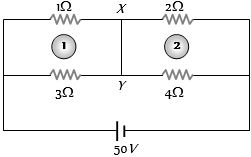
- 3Current through wire $XY$ of circuit shown is ................ $A$View Solution
- 4Four resistances of $100$ $\Omega$ each are connected in the form of square. Then, the effective resistance along the diagonal points is .............. $\Omega$View Solution
- 5Two wires of same material have length $L$ and $2L $ and cross-sectional areas $4A$ and $A$ respectively. The ratio of their specific resistance would beView Solution
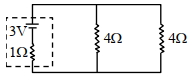
- 6View SolutionIn the given circuit, the terminal potential difference of the cell is:
- 7View SolutionAssertion : An electric bulb becomes dim, when the electric heater in parallel circuit is switched on.
Reason : Dimness decreases after sometime.
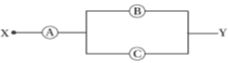
- 8$A, \,B$ and $C$ are voltmeters of resistance $R, \,1 .5R$ and $3R$ respectively as shown in the figure. When some potential difference is applied between $X$ and $Y,$ the voltmeter readings are $V_A, \,V_B$ and $V_C$ respectively. ThenView Solution
- 9The current in a simple series circuit is $5.0\, amp$. When an additional resistance of $2.0\, ohms$ is inserted, the current drops to $4.0\, amp$. The original resistance of the circuit in $ohms$ wasView Solution
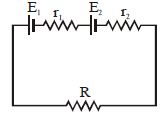
- 10Under what conditions current passing through a resistance $R$ can be increased by short circuiting the battery of emf $E_2$. The internal resistances of the two batteries are $r_1$ and $r_2$ respectivelyView Solution