MCQ
When a bar magnet is broken into two pieces:
- AWe will have a single pole on each piece.
- BEach piece will have two unlike poles.
- CEach piece will have two like poles.
- DNone of these.
Explanation:
When we break a magnet into two, both act as magnets, that is both have a north and south pole each. In both these pieces the corresponding north and south poles remain on the sides as in the original magnet. This means that the 2 broken sides must get oppositely polarized.
Generate a complete, print-ready paper with questions like this in minutes — across 16+ boards, with answer keys.
An electric motor operates on a 50 volt supply and a current of 12A. If the efficiency of the motor is 30%, what is the resistance of the winding of the motor
|
(a) 6 Ω |
(b) 4 Ω |
(c) 2.9 Ω |
(d) 3.1 Ω |
Amplification factor of a triode is 10. When the plate potential is 200 volt and grid potential is – 4 volt, then the plate current of 4mA is observed. If plate potential is changed to 160 volt and grid potential is kept at – 7 volt, then the plate current will be
|
(a) 1.69 mA |
(b) 3.95 mA |
(c) 2.87 mA |
(d) 7.02 mA |
The mutual characteristic curves of a triode are as shown in figure. The cut off voltage for the triode is
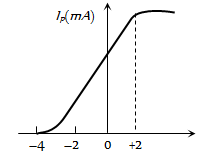
| (a) 0 V | (b) 2 V | (c) – 4 V | (d) 6 V |
The equation  is
is
|
(a) b -emission |
(b) a -emission |
(c) e– capture |
(d) Fission |
A change of 0.8 mA in the anode current of a triode occurs when the anode potential is changed by 10 V. If m = 8 for the triode, then what change in the grid voltage would be required to produce a change of 4 mA in the anode current
|
(a) 6.25 V |
(b) 0.16 V |
(c) 15.2 V |
(d) None of these |
Two coherent sources have intensity in the ratio of  . Ratio of (intensity) max/(intensity) min is
|
(a) |
(b) |
(c) |
(d) |
Two insulated rings, one of slightly smaller diameter than the other are suspended along their common diameter as shown. Initially the planes of the rings are mutually perpendicular. When a steady current is set up in each of them

|
(a) The two rings rotate into a common plane |
|
(b) The inner ring oscillates about its initial position |
|
(c) The inner ring stays stationary while the outer one moves into the plane of the inner ring |
|
(d) The outer ring stays stationary while the inner one moves into the plane of the outer ring |


