MCQ
When a body moves in a circular path, no work is done by the force since
  • A
    there is no net force
  • B
    there is no displacement
  • C
    force is always away from the centre
  • force and displacement are perpendicular to each other

Answer

Correct option: D.
force and displacement are perpendicular to each other
d
The radial force and displacement are normal to each other in circular motion.

Need a full question paper?

Generate a complete, print-ready paper with questions like this in minutes — across 16+ boards, with answer keys.
Start Generating Free

Similar questions

A closed pipe and an open pipe have their first overtones identical in frequency. Their lengths are in the ratio
A large number of bullets are fired in all directions with same speed $v$. What is the maximum area on the ground on which these bullets will spread
If a cycle wheel of radius $4 \,m$ completes one revolution in two seconds. Then acceleration of a point on the cycle wheel will be
A circular disc rotating with frequency $f_0 = 1.3\, rev/sec$ comes to a stop in $30\, seconds$. The approximate angular acceleration is ....... $rad/{\sec ^2}$
The angle between the two vectors $\vec A = 3\hat i + 4\hat j + 5\hat k$ and $\vec B = 3\hat i + 4\hat j - 5\hat k$ will be....... $^o$
A satellite whose mass is $M$, is revolving in circular orbit of radius $r$ around the earth. Time of revolution of satellite is
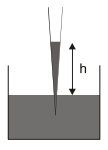
A glass capillary tube is of the shape of a truncated cone with an apex angle $\alpha$ so that its two ends have cross sections of different radii. When dipped in water vertically, water rises in it to a height $h$, where the radius of its cross section is $b$. If the surface tension of water is $S$, its density is $\rho$, and its contact angle with glass is $\theta$, the value of $h$ will be ( $g$ is the acceleration due to gravity)
In an adiabatic process, the state of a gas is changed from ${P_1},{V_1},{T_1} $ to ${P_2},{V_2},{T_2}$. Which of the following relation is correct
If temperature of a black body increases from ${7^o}C$ to ${287^o}C$, then the rate of energy radiation increases by
A $U-$ tube with limbs of diameters $5\, mm$ and $2\, mm$ contains water of surface  tension $7 \times 10^{-2}$ newton per metre, angle of contact is zero and density $10^3\, kg/m^3$. If $g$ is $10 \,m/s^2$, then the difference in level of two limbs is :-