MCQ
When a body moves with a constant speed along a circle
  • No work is done on it
  • B
    No acceleration is produced in the body
  • C
    No force acts on the body
  • D
    Its velocity remains constant

Answer

Correct option: A.
No work is done on it
a
(a)When speed is constant in circular motion, it means work done by centripetal force is zero.

Need a full question paper?

Generate a complete, print-ready paper with questions like this in minutes — across 16+ boards, with answer keys.
Start Generating Free

Similar questions

A rod of length $1.2\,m$ is clamped at the mid point and its fundamental frequency is $2\,MHz$ , then speed of wave inside the rod?
A resonance air column of length $20 cm$ resonates with a tuning fork of frequency $250 Hz$. The speed of sound in air is .... $m/s$
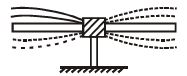
Which of the following diagrams does not represent a streamline flow?
A particle has initial velocity $\left( {2\hat i + 3\hat j} \right)$ and acceleration $\left( {0.3\hat i + 0.2\hat j} \right)$. The magnitude of velocity after $10\, seconds$ will be 
A tuning fork produces $4\text{beats/ sec}$ with another fork of frequency $288\ \text{c.p.s}$. A little wax is placed on the unknown fork and it then produces $2\text{beats/ sec.}$ The unknown frequency is:
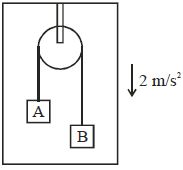
Block $A$ and $B$ of mass $2\,kg$ and $4\,kg$ are suspended through a string using a pulley, inside an elevator moving downward with constant acceleration $2\,m/s^2$. The tension in the string which is joining two blocks
A thermometer graduated according to a linear scale reads a value $x_0$ when in contact with boiling water, and $x_0/3$ when in contact with ice. What is the temperature of an object in ${}^oC$, if this thermometer in the contact with the object reads $x_0/2$ ?
The distance between the carbon atom and the oxygen atom in a carbon monoxide molecule is $1.1\ Å$.  Given, mass of carbon atom is $12\ a.m.u.$ and mass of oxygen atom is $16\ a.m.u.$, calculate the position of the center of mass of the carbon monoxide molecule
A black body is at $727^\circ C.$ It emits energy at a rate which is proportional to:
A diatomic gas of molecular mass $40 \,g / mol$ is filled in a rigid container at temperature $30^{\circ} C$. It is moving with velocity $200 \,m / s$. If it is suddenly stopped, the rise in the temperature of the gas is .........