MCQ
A particle has initial velocity $\left( {2\hat i + 3\hat j} \right)$ and acceleration $\left( {0.3\hat i + 0.2\hat j} \right)$. The magnitude of velocity after $10\, seconds$ will be 
  • A
    $5\, units$
  • B
    $9\, units$
  • C
    $9\sqrt 2 \,unit$
  • $5\sqrt 2 \,unit$

Answer

Correct option: D.
$5\sqrt 2 \,unit$
d
$(\overrightarrow{\mathrm{v}})_{\mathrm{att}=10 \mathrm{sec}}=\overrightarrow{\mathrm{u}}+\overrightarrow{\mathrm{a}} \mathrm{t}=(2 \hat{\mathrm{i}}+3 \hat{\mathrm{j}})+(0.3 \hat{\mathrm{i}}+0.2 \hat{\mathrm{j}}) \times 10$

$=5 \hat{\mathrm{i}}+5 \hat{\mathrm{j}}$

$\therefore$ Magnitude $=\sqrt{5^{2}+5^{2}}=5 \sqrt{2} \mathrm{units}$

Need a full question paper?

Generate a complete, print-ready paper with questions like this in minutes — across 16+ boards, with answer keys.

Start Generating Free

Similar questions

A ball $P$ is dropped vertically and another ball Q is thrown horizontally with the same velocities from the same height and at the same time. If air resistance is neglected, then
The meniscus of mercury in the capillary tube is
During the adiabatic expansion of $2$ moles of a gas, the internal energy of the gas is found to decrease by $2$ joules, the work done during the process on the gas will be equal to ....... $J$
A second harmonic has to be generated in a string of length $l$ stretched between two rigid supports. The point where the string has to be plucked and touched are
If the velocity of a particle moving in simple harmonic motion is $\text v_1$ and $\text v_2$ respectively from its mean position and distance, then the period of the particle is :
If a body $A$ of mass $M$ is thrown with velocity $v$ at an angle of ${30^o}$ to the horizontal and another body $B$ of the same mass is thrown with the same speed at an angle of ${60^o}$ to the horizontal. The ratio of horizontal range of $A$ to $B$ will be
Velocity $(v)$ and acceleration $(a)$ in two systems of units $1$ and $2$ are related as $V _{2}=\frac{ n }{ m ^{2}} v _{1}$ and $a_{2}=\frac{a_{1}}{m n}$ respectively. Here $m$ and $n$ are constants. The relations for distance and time in two systems respectively are
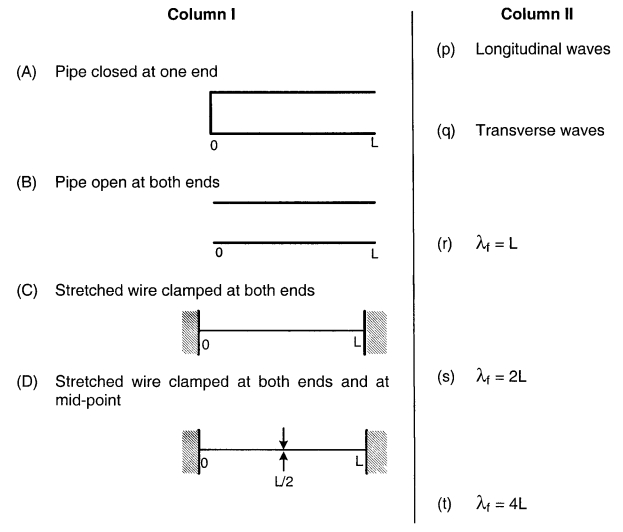
Column $I$ shows four systems, each of the same length $L$, for producing standing waves. The lowest possible natural frequency of a system is called its fundamental frequency, whose wavelength is denoted as $\lambda_{ f }$. Match each system with statements given in Column $II$ describing the nature and wavelength of the standing waves.
Two satellite are revolving around the earth with velocities ${v_1}$and ${v_2}$ and in radii ${r_1}$ and ${r_2}({r_1} > {r_2})$respectively. Then
A particle is rotating in a circle of radius $1\,m$ with constant speed $4\,m / s$. In time $1\,s$, match the following (in $SI$ units) columns.
Colum $I$ Colum $II$
$(A)$ Displacement $(p)$ $8 \sin 2$
$(B)$ Distance $(q)$ $4$
$(C)$ Average velocity $(r)$ $2 \sin 2$
$(D)$ Average acceleration $(s)$ $4 \sin 2$