MCQ
When a ceiling fan is switched off, its angular velocity falls to half while it makes $36$ $rotations.$ How many more rotations will it make before coming to rest (Assume uniform angular retardation)
  • A
    $36$
  • B
    $24$
  • C
    $18$
  • $12$

Answer

Correct option: D.
$12$
d
$1st \,case:$­­­­­­­

We can write the equation of motion for circular motion as:

$\omega^{2}=\omega_{0}^{2}+2 a \theta_{n}$

Now, $\omega=\frac{\omega_{0}}{2}, \theta=36 \times 2 \pi$ (given)

So, $\frac{\omega_{0}^{2}}{4}=\omega_{o}^{2}+2 \alpha \times 36 \times 2 \pi$

So, $\alpha=\frac{-3 \omega_{0}^{2}}{4 \times 144 \pi}$

$2nd \,case:$

$0=\frac{\omega_{0}^{2}}{4}-2 \times \frac{3 \omega_{0}^{2}}{4 \times 144 \pi} \times \theta$

So, $\theta=24 \pi$ 

So, number of rotations made by the fan before coming to rest

$=\frac{24 \pi}{2 \pi}=12$

Need a full question paper?

Generate a complete, print-ready paper with questions like this in minutes — across 16+ boards, with answer keys.
Start Generating Free

Similar questions

A solid cube and a solid sphere of the same material have equal surface area. Both are at the same temperature ${120^o}C$, then
A ball is travelling with uniform translatory motion. This means that:
  1. It is at rest.
  2. The path can be a straight line or circular and the ball travels with uniform speed.
  3. All parts of the ball have the same velocity (magnitude and direction) and the velocity is constant.
  4. The centre of the ball moves with constant velocity and the ball spins about its centre uniformly.
The density of a material in $SI\, units$ is $128\, kg\, m^{-3}$. In certain units in which the unit of length is $25\, cm$ and the unit of mass $50\, g$, the numerical value of density of the material is
The potential energy of a particle varies with distance $x$ from a fixed origin as $V = \frac{{A\sqrt x }}{{x + B}}$,where
$A$ and $B$ are constants. The dimensions of $AB$ are
If the radius of a star is $R$ and it acts as a black body, what would be the temperature of the star, in which the rate of energy production is Q? ( $\sigma$ stands for Stefan's constant.)
As the temperature of a conductor increases, its resistivity and conductivity change. The ratio of resistivity to conductivity:
  1. Increases.
  2. Decreases.
  3. Remains constant.
  4. May increase or decrease, depending on the actual temperature.
A solid sphere, of radius $R$ acquires a terminal velocity $\nu_1 $ when falling (due to gravity) through a viscous fluid having a coefficient of viscosity $\eta $. The sphere is broken into $27$ identical solid spheres. If each of these spheres acquires a terminal velocity, $\nu_2$, when falling through the same fluid, the ratio $(\nu_1/\nu_2)$ equals
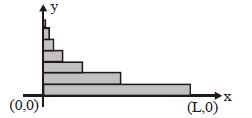
Infinite rods of uniform mass density and length $L, L/2, L/4....$ are placed one upon another upto infinite as shown in figure. Find the $x-$ coordinate of centre of mass
The distance of two planets (neptune and saturn) from sun are 1013 and 1012m respectively. The ratio of time period of the planets is:
In an adiabatic change, the pressure P and temperature T of a diatomic gas are related by the relation $\text{P}\propto\text{T}^{\text{c}}$ where c equals: