Question
When a current in a circular loop is equivalently replaced by a magnetic dipole:
  1. The pole strength m of each pole is fixed.
  2. The distance d between the poles is fixed.
  3. The product md is fixed.
  4. None of the above.

Answer

  1. The product md is fixed.

Explanation:

When we replace a circular current-carrying loop with a magnetic dipole to resemble field lines of the circular loop, the pole strength m and the distance between the poles are not fixed.

But the magnetic dipole moment of both systems is always fixed. It is the product of the magnetic moment and the distance between the poles. In other words, md is fixed.

A current loop of area A and current I can be replaced with a magnetic dipole of dipole moment md.

i.e. md = IA

Need a full question paper?

Generate a complete, print-ready paper with questions like this in minutes — across 16+ boards, with answer keys.

Start Generating Free

Similar questions

For a body moving in a circular path, a condition for no skidding if $\mu $ is the coefficient of friction, is
A particle is projected from horizontal making an angle of $53^{\circ}$ with initial velocity $100\,m / s$. The time taken by the particle to make angle $45^{\circ}$ from horizontal is $.........\,s$
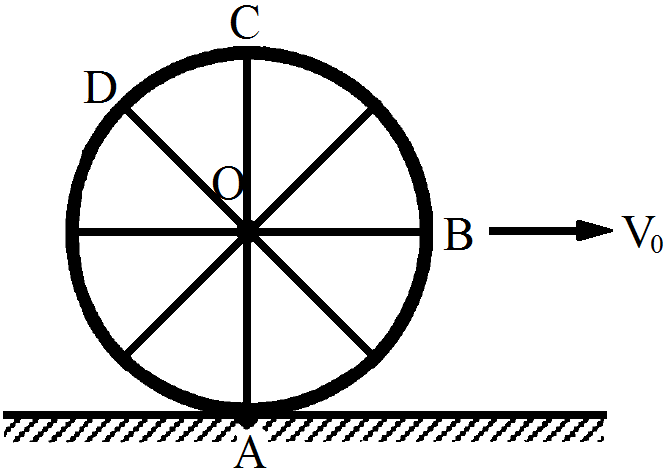
Consider a wheel of a bicycle rolling on a level road at a linear speed v0:

  1. The speed of the particle A is zero.
  2. The speed of B, C and D are all equal to v0.
  3. The speed of C is 2v0.
  4. The speed of B is greater than the speed of O.
The displacement y of a particle executing periodic motion is given by $y = 4{\cos ^2}(t/2)\sin (1000t)$. This expression may be considered to be a result of the superposition of ........... independent harmonic motions
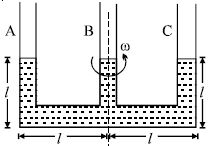
Figure shows a three arm tube in which a liquid is filled upto levels of height $l$. It is now rotated at an angular frequency $\omega$ about an axis passing through arm $B$. The angular frequency $\omega$ at which level of liquid in arm $B$ becomes zero. 
The kinetic energy of a body decreases by $36\%$. The decrease in its momentum is ............... $\%$
A couple is acting on a two particle systems. The resultant motion will be:
The increase in length is $l$ of a wire of length $L$ by the longitudinal stress. Then the stress is proportional to
$A$ system of $N$ particles is free from any external forces. Which of the following must be true for the sum of the magnitudes of the momenta of the individual particles in the system?
A ball is projected at an angle $45^o$ with horizontal. It passes through a wall of height $h$  at horizontal distance $d_1$ from the point of projection and strikes the ground at a  horizontal distance $(d_1 + d_2)$ from the point of projection, then $h$ is