MCQ
When a forward bias is applied to a p-n junction, it
  • A
    raises the potential barrier.
  • B
    reduces the majority carrier current to zero.
  • lowers the potential barrier.
  • D
    None of the above.

Answer

Correct option: C.
lowers the potential barrier.
C

Need a full question paper?

Generate a complete, print-ready paper with questions like this in minutes — across 16+ boards, with answer keys.
Start Generating Free

Similar questions

Heavy water is used as moderator in a nuclear reactor. The function of the moderator is(a) To control the energy released in the reactor(b) To absorb neutrons and stop chain reaction(c) To cool the reactor faster(d) To slow down the neutrons to thermal energies


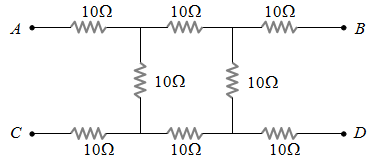
What will be the equivalent resistance between the two points $A$ and $D$
A charged particle oscillates about its mean equilibrium position with a frequency of $10^9 \ Hz.$ The electromagnetic waves produced$:$
Energy in a current carrying coil is stored in the form of:
In an isothermal process on an ideal gas, the pressure increases by 0.5%. The volume decreases by about
  1. 0.25%
  2. 0.5%
  3. 0.7%
  4. 1%​​
Assertion  :   The electric bulbs glows immediately when switch is on.
Reason      : The drift velocity of electrons in a metallic wire is very high.(a) If both assertion and reason are true and the reason is the correct explanation of the assertion.(b) If both assertion and reason are true but reason is not the correct explanation of the assertion.(c) If assertion is true but reason is false.(d) If the assertion and reason both are false.


Radioactivity was discovered by (a) Becquerel(b) Pierre Curie(c) Roentgen(d) Rutherford
       
The Rutherford $\alpha$-particle experiment shows that most of the $\alpha$-particles pass through almost unscattered while some are scattered through large angles. What information does it give about the structure of the atom
A ray of light propagates from glass $($refractive index $=3 / 2 )$ to water $($refractive index $=4 / 3 ).$ The value of the critical angle
 
The logic behind ‘NOR’ gate is that it gives(a) High output when both the inputs are low(b) Low output when both the inputs are low(c) High output when both the inputs are high(d) None of these