MCQ
When a hydrogen atom is raised from the ground state to an excited state
  • $P.E.$ increases and $K.E.$ decreases
  • B
    $P.E.$ decreases and $K.E.$ increases
  • C
    Both kinetic energy and potential energy increase
  • D
    Both $K.E.$ and $P.E.$ decrease

Answer

Correct option: A.
$P.E.$ increases and $K.E.$ decreases
a
(a) $P.E.$ $ \propto - \frac{1}{r}$ and $K.E.$ $ \propto \frac{1}{r}$
As $r$ increases so $K.E.$ decreases but $P.E.$ increases.

Need a full question paper?

Generate a complete, print-ready paper with questions like this in minutes — across 16+ boards, with answer keys.
Start Generating Free

Similar questions

A bulb and a capacitor are in series with an $ac$ source. On increasing frequency how will glow of the bulb change
The bob of simple pendulum having length $l$, is displaced from mean position to an angular position $\theta$ with respect to vertical. If it is released, then velocity of bob at lowest position
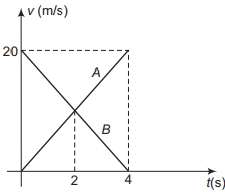
Speed-time graph of two cars $A$ and $B$ approaching towards each other is shown in figure. Initial distance between them is $60\,m$. The two cars will cross each other after time $..........\,s$
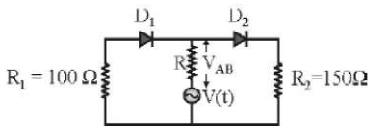
In the circuit given below, $V ( t )$ is the sinusoidal voltage source, voltage drop $V_{A B}(t)$ across the resistance $R$ is
A cell of emf $6\, V$ and resistance $0.5\, ohm$ is short circuited. The current in the cell is ............... $amp$
Orbital velocity of an artificial satellite does not depend upon
$N$ identical spherical drops charged to the same potential $V$ are combined to form a big drop. The potential of the new drop will be
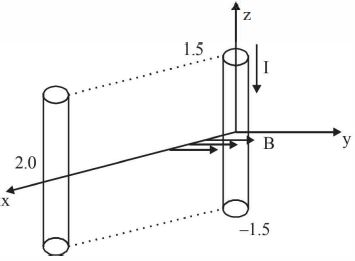
A conductor lies along the $z-$axis $a$ $-1.5$$ \le Z < 1.5\,m$ carries a fixed current of $10.0\ A$ in $ - {\hat a_z}$ direction (see figure). For a field $\vec B$ $=$ $3.0 \times  10^{-4}$  $e^{-0.2x}$ ${\hat a_y}\,T$ find the power required to move the conductor at constant speed to $x = 2.0\ m, y = 0\ m$ in $5 \times 10^{-3}\ s$. Assume parallel motion along the $x-$axis........$ W$
$Assertion$ : A body can have acceleration even if its velocity is zero at a given instant of time.

$Reason$ : A body is numerically at rest when it reverses its direction.
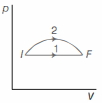
An ideal gas undergoes change in its state from the initial state $I$ to the final state $F$ via two possible paths as shown below. Then,