MCQ
When a loop moves towards a stationary magnet with speed v, the induced emf in the loop is E. If the magnet also moves away from the loop with the same speed, then the emf induced in the loop is.
- AE
- B2E
- C$\frac{\text{E}}{2}$
- Dzero
Explanation:
Faraday's Law states that an electric field is induced by changing magnetic flux.
If both move with the same velocity in the same direction, the relative velocity is zero, hence there is no change of magnetic flux across the loop with time.
Generate a complete, print-ready paper with questions like this in minutes — across 16+ boards, with answer keys.
If the ammeter in the given circuit reads 2 A, the resistance R is
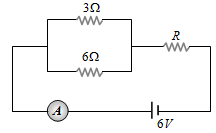
|
(a) 1 ohm |
(b) 2 ohm |
(c) 3 ohm |
(d) 4 ohm |
When the distance between the charged particles is halved, the force between them becomes
|
(a) One-fourth |
(b) Half |
(c) Double |
(d) Four times |
The radius of curvature for a convex lens is 40 cm, for each surface. Its refractive index is 1.5. The focal length will be
|
(a) 40 cm |
(b) 20 cm |
(c) 80 cm |
(d) 30 cm |
A nucleus with mass number 220 initially at rest emits an a-particle. If the Q value of the reaction is 5.5 MeV, calculate the kinetic energy of the a-particle
|
(a) 4.4 MeV |
(b) 5.4 MeV |
(c) 5.6 MeV |
(d) 6.5 MeV |
The electrochemical equivalent of a material in an electrolyte depends on
|
(a) The nature of the material |
|
(b) The current through the electrolyte |
|
(c) The amount of charge passed through electrolyte |
|
(d) The amount of material present in electrolyte |
The k line of singly ionised calcium has a wavelength of 393.3 nm as measured on earth. In the spectrum of one of the observed galaxies, this spectral line is located at 401.8 nm. The speed with which the galaxy is moving away from us, will be
|
(a) 6480 km/s |
(b) 3240 km/s |
(c) 4240 km/sec |
(d) None of these |