Question
When a monochromatic radiations of suitable frequency obtained from source $S,$ after being filtered by a filter attached on the window $W,$ fall on the photosensitive place $C,$ the photo electrons are emitted from $C,$ which get accelerated towards the plate $A$ if it is kept at positive potential. These electrons flow in the outer circuit resulting in photoelectric current. Due to it, the microammeter shows a deflection. The reading of micrommeter measures the photoelectric current.
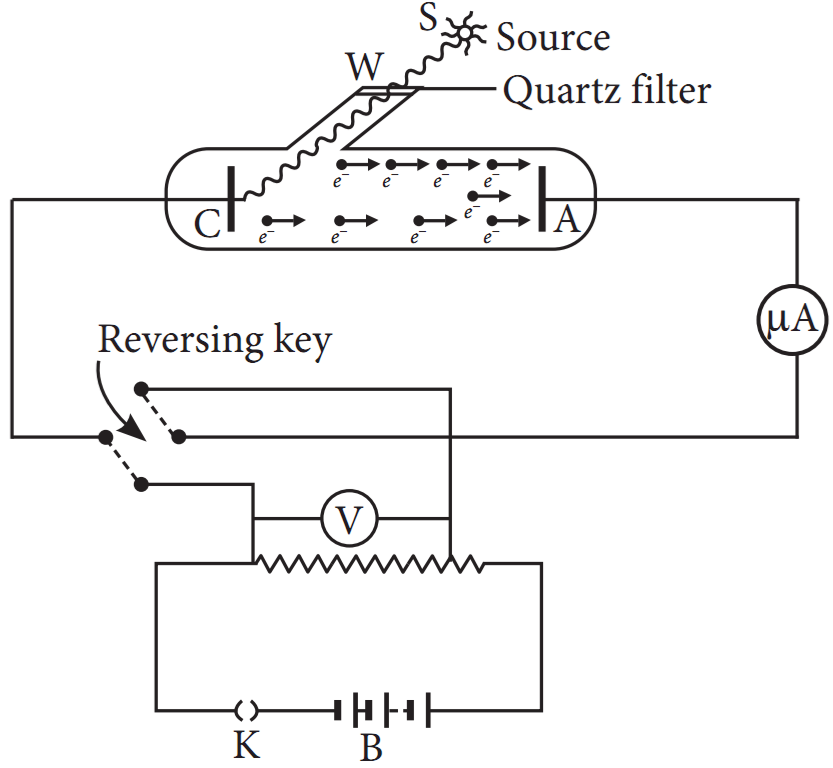
An experimental setup of verification of photoelectric effect is shown in figure. The voltage across the electrodes is measured with the help ofan ideal voltmeter, and which can be varied by moving jockey Jon the potentiometer wire. The battery used in potentiometer circuit is of $16 V$ and its internal resistance is $2\Omega$. The resistance of $100\ cm$ long potentiometer wire is $8\Omega$.
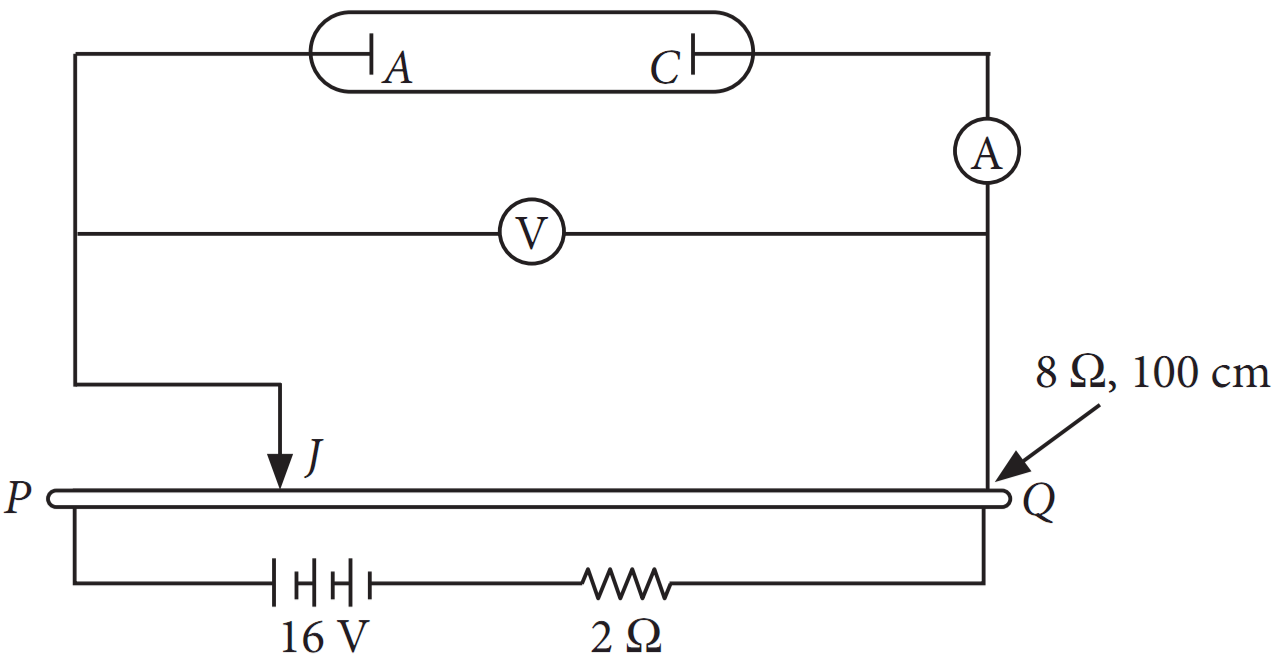
The photocurrent is measured with the help of an ideal ammeter. Two plates of potassium oxide of area $50\ cm^2$ at separation $0.5\ mm$ are used in the vacuum tube. Photocurrent in the circuit is very small, so we can treat the potentiometer circuit as an independent circuit.​​​​​​​
Light
$1$ Violet
$2$ Blue
$3$ Green
$4$ Yellow
$5$ Orange
$6$ Red
$\lambda(\text{in } \mathring{\text{A}})$
$4000-500$ $4500-5000$ $5000-5500$ $5500-6000$ $6000-6500$ $6500-7000$
  1. When radiation falls on the cathode plate, a current of $2\mu\text{A}$ is recorded in the ammeter. Assuming that the vacuum tube setup follows Ohm's law, the equivalent resistance of vacuum tube operating in the case when jockey is at end $P$ is:
  1. $8\times10^8\Omega$
  2. $16\times10^6\Omega$
  3. $8\times10^6\Omega$
  4. $10\times10^6\Omega$
  1. It is found that ammeter current remains unchanged $(2\mu\text{A})$ even when the jockey is moved from the end $P$ to the middle point of the potentiometer wire. Assuming that all the incident photons eject electrons and the power of the light incident is $4\times10^{-6}\Omega$. Then, the color of the incident light is:
  1. Green
  2. Violet
  3. Red
  4. Orange
  1. Which of the following colors may not give photoelectric effect for this cathode?
  1. Green
  2. Violet
  3. Red
  4. Orange
  1. When other light falls on the anode plate, the anuneter reading zero till jockey is moved from the end $P$ to the middle point of the wire $PQ$. Therefore, the deflection is recorded in the anuneter. The maximum kinetic energy of the emitted electron is:
  1. $16eV$
  2. $8eV$
  3. $4eV$
  4. $10eV$
  1. If the intensity of incident radiation is increased twice, the number of photoelectrons emitted per second will be:
  1. Halves
  2. Double
  3. Remain same
  4. Four times

Answer

  1. $(c)\  8\times10^6\Omega$
Equivalent resistance
$\text{A}=\frac{\text{V}}{\text{I}}=\frac{16\text{V}}{2\times10^{-6}\text{A}}=8\times10^6\Omega$
  1. $(d)\ 10\times10^6\Omega$
$\text{P}=\frac{\text{IhC}}{\text{e}\lambda}$
$\lambda=\frac{(2\times10^{-6})(6.6\times10^{-34})(3\times10^8)}{(4\times10^{-6})(1.6\times10^{-19})}$
$\frac{9.9}{1.6}\times10^{-7}\text{m}=\frac{9900}{1.6}\mathring{\text{A}}=6187\mathring{\text{A}}$
Which is in the range of orange light.
  1. $(c)$ Red
The range of wavelength for red light is beyond the wavelength of incident light.
  1. $(b) \ 8eV$
Stopping potential $, V_s = 8V$ and $K.E. = eV_s$
$\therefore K.E. = 8eV$
  1. $(b)$ Double
Photoelectric current varies linearly with the intensity of the incident radiation.

Need a full question paper?

Generate a complete, print-ready paper with questions like this in minutes — across 16+ boards, with answer keys.

Start Generating Free

Similar questions

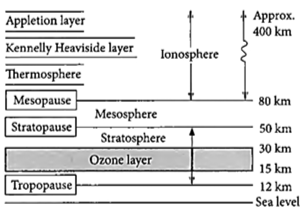
Radio waves are produced by the accelerated motion of charges in conducting wires. Microwaves are produced by special vacuum tubes. Infrared waves are produced by hot bodies and molecules also known as heat waves. UV rays are produced by special lamps and very hot bodies like Sun. 
Image
(i) Solar radiation is
i. transverse electromagnetic wave
ii. longitudinal electromagnetic waves
iii. both longitudinal and transverse electromagnetic waves
iv. none of these.
(a) Option (i)  (b) Option (iv)  (c) Option (iii)  (d) Option (ii)

(ii) What is the cause of greenhouse effect?
(a) Ultraviolet rays (b) X-rays (c) Infrared rays (d) Radiowaves

(iii) Biological importance of ozone layer is
(a) it stops ultraviolet rays
(b) none of these.
(c) it reflects radiowaves
(d) It layer reduces greenhouse effect

OR

Earth's atmosphere is richest in
(a) ultraviolet (b) infrared (c) X-rays (d) microwaves

(iv) Ozone is found in
(a) troposphere (b) mesosphere (c) ionosphere (d) stratosphere
To keep valuable instruments away from the earth's magnetic field, they are enclosed in iron boxes. Explain.
Establish the expression for equivalent parallel combination of resistance separately.

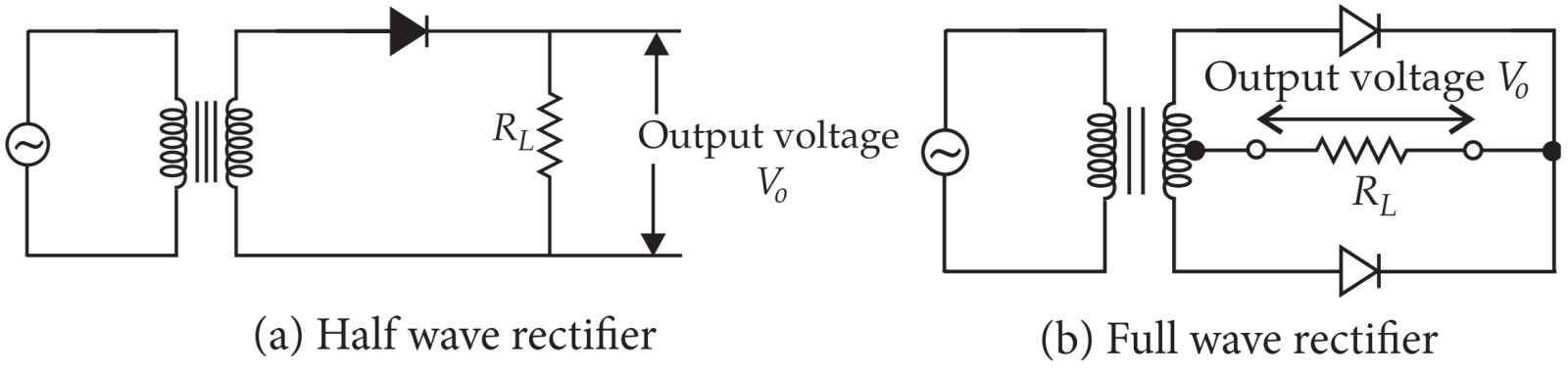
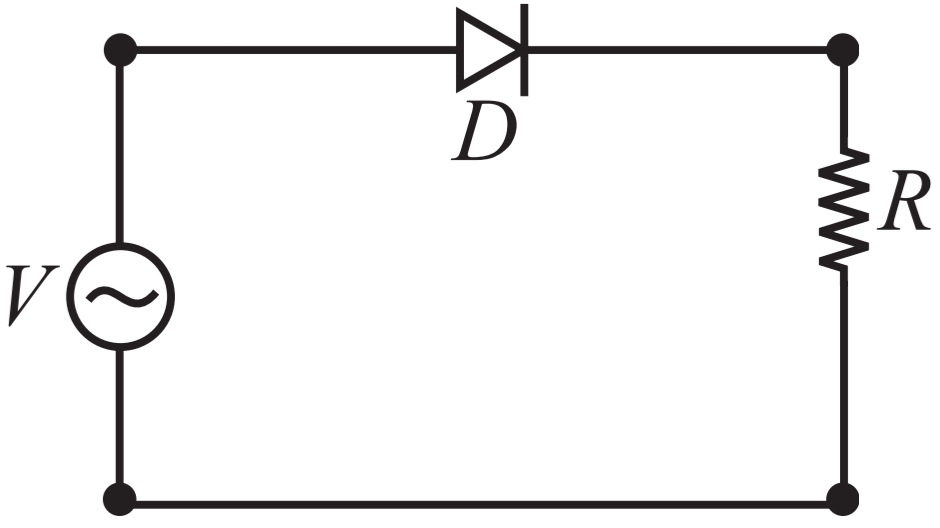
Rectifier is a device which is used for converting alternating current or voltage into direct current or voltage. Its working is based on the fact that the resistance of p-n junction becomes low when forward biased and becomes high when reverse biased. A half-wave rectifier uses only a single diode while a full wave rectifier uses two diodes as shown in figures (a) and (b).
  1. If the rms value of sinusoidal input to a full wave rectifier is $\frac{\text{V}_0}{\sqrt{2}}$ then the rms value of the rectifier's output is:
  1. $\frac{\text{V}_0}{\sqrt{2}}$
  2. $\frac{\text{V}_0^2}{\sqrt{2}}$
  3. $\frac{\text{V}_0^2}{2}$
  4. $\sqrt{2}\text{V}_0^2$
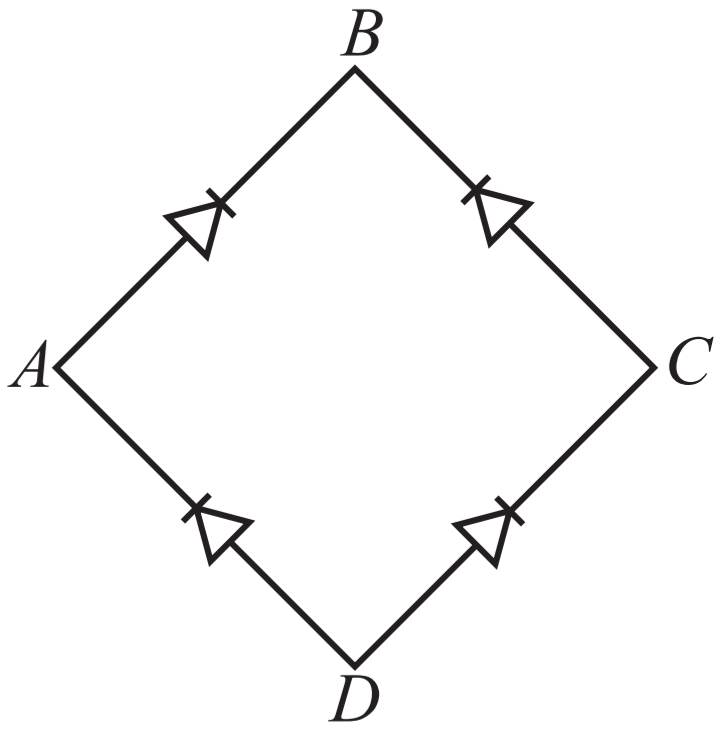
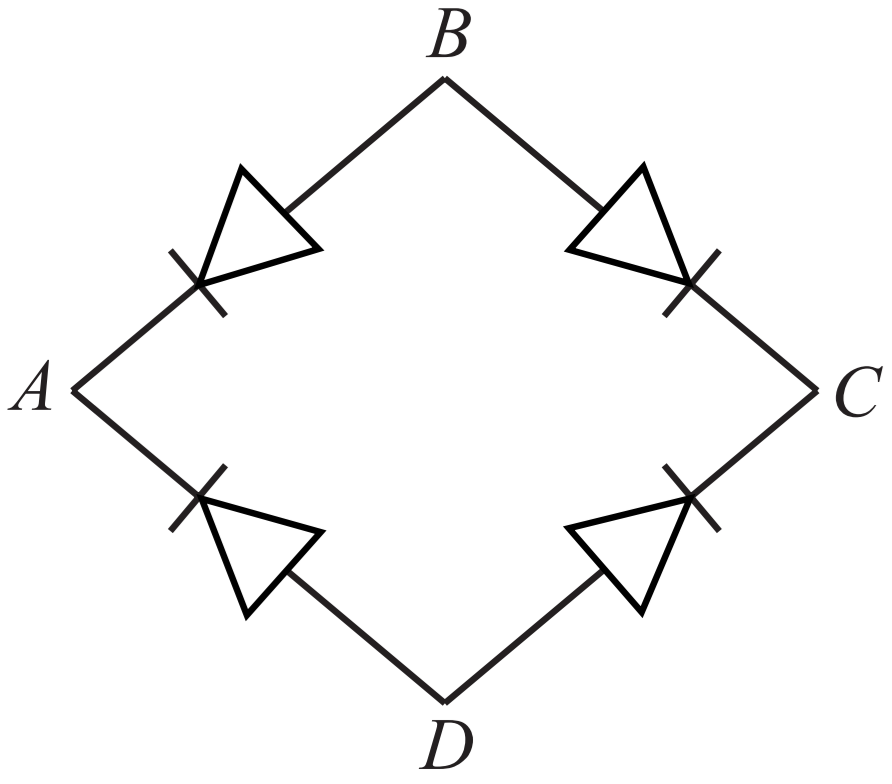
  1. In the diagram, the input ac is across the terminals A and C. The output across B and D is:
  1. Same as the input.
  2. Half wave rectified.
  3. Zero.
  4. Full wave rectified.
  1. A bridge rectifier is shown in figure. Alternating input is given across A and C. If output is taken across BD, then it is:
  1. Zero.
  2. Same as input.
  3. Half wave rectified.
  4. Full wave rectified.
  1. A p-n junction (D) shown in the figure can act as a rectifier. An alternating current source (V) is connected in the circuit. The current (I) in the resistor (R) can be shown by:

  1. With an ac input from 50Hz power line, the ripple frequency is:
  1. 50Hz in the de output of half wave as well as full wave rectifier.
  2. 100Hz in the de output of half wave as well as full wave rectifier.
  3. 50Hz in the de output of half wave and I 00Hz in de output of full wave rectifier.
  4. 100Hz in the de output of half wave and 50Hz in the de output of full wave rectifier.
A magnetic dipole of magnetic moment $1.44A-m^2$ is placed horizontally with the north pole pointing towards north. Find the position of the neutral point if the horizontal component of the earth's magnetic field is $18 \mu\text{T}.$
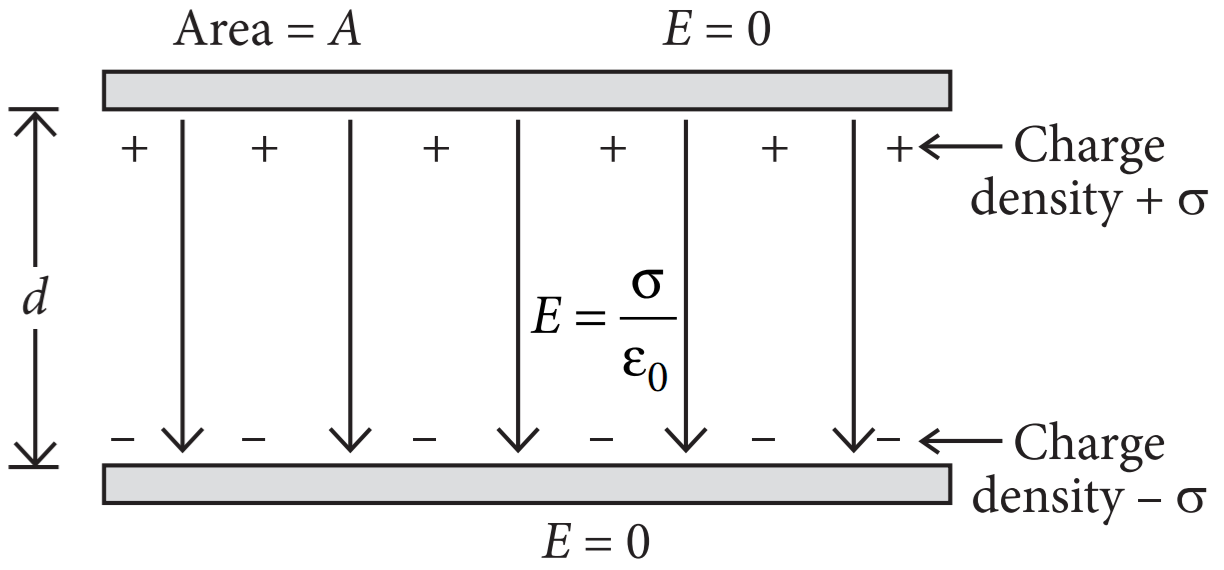
The simplest and the most widely used capacitor is the parallel plate capacitor. It consists of two large plane parallel conducting plates, separated by a small distance. In the outer regions above the upper plate and below the lower plate, the electric fields due to the two charged plates cancel out. The net field is zero. In the inner region between the two capacitor plates, the electric fields due to the two charged plates add up. The net field is $\frac{\sigma}{\epsilon_0}.$
For a uniform electric field, potential difference between the plates $=$ Electric field x distance between the plates. Capacitance of the parallel plate capacitor is the charge required to supplied to either of the conductors of the capacitor so as to increase the potential difference between then by unit amount.
  1. A parallel plate capacitor is charged and then isolated. The effect of increasing the plate separation on charge, potential and capacitance respectively are:
  1. Increases, decreases, decreases.
  2. Constant, increases, decreases.
  3. Constant, decreases, decreases.
  4. Constant, decreases, increases.
  1. In a parallel plate capacitor, the capacity increases if:
  1. Area of the plate is decreases.
  2. Distance between the plates increases.
  3. Area of the plate is increases.
  4. Dielectric constant decreases.
  1. A parallel plate capacitor has two square plates with equal and opposite charges. The surface charge densities on the plates are $+\sigma$ and $-\sigma$ respectively. In the region between the plates the magnitude of the electric field is:
  1. $\frac{\sigma}{2\epsilon_0}$
  2. $\frac{\sigma}{\epsilon_0}$
  3. $0$
  4. None of these.
  1. If a parallel plate air capacitor consists of two circular plates of diameter $8\ cm$. At what distance should the plates be held so as to have the same capacitance as that of sphere of diameter $20\ cm$?
  1. $9\ mm$
  2. $4\ mm$
  3. $8\ mm$
  4. $2\ mm$
  1. If a charge of $+ 2.0 \times 10^{-8}C$ is placed on the positive plate and a charge of $- 1.0 \times 10^{-8}C$ on the negative plate of a parallel plate capacitor of capacitance $1.2\times10^{-3}\mu\text{F},$ then the potential difference developed between the plates is:
  1. $6.25V$
  2. $3.0V$
  3. $12.5V$
  4. $25V$
A player hits a baseball at some angle. The ball goes high up in space. The player runs and catches the ball before it hits the ground. Which of the two (the player or the ball) has greater displacement?
Derive the formula of electric potential at a point due to electric dipole.
For a single slit of width "a", the first minimum of the interference pattem of a monochromatic light of wavelength$\lambda$. Occurs at an angle of$\frac{\lambda}{\text{a}}$. At the same angle of$\frac{\lambda}{\text{a}},$ we get a maximum for two narrow slits separated by a distance "a". Explain.

The field of a hollow wire with constant current is homageneous.
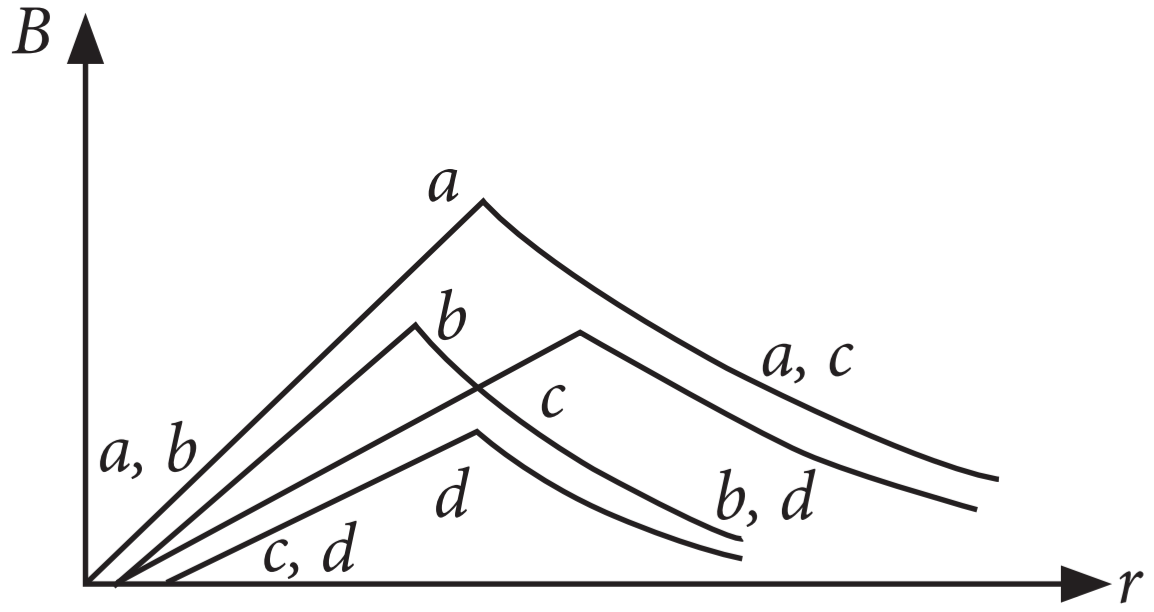
Curves in the graph shown give, as functions of radius distance r, the magnitude B of the magnetic field inside and outside four long wires a, b, c and d, carrying currents that are uniformly distributed across the cross sections of the wires. Overlapping portions of the plots are indicated by double labels.
  1. Which wire has the greatest magnitude of the magnetic field on the surface?
  1. a
  2. b
  3. c
  4. d
  1. The current density in a wire a is:
  1. Greater than in wire c.
  2. Less than in wire c.
  3. Equal to that in wire c.
  4. Not comparable to that of in wire c due to lack of information.
  1. Which wire has the greatest radius?
  1. a
  2. b
  3. c
  4. d
  1. A direct current I flows along the length of an infinitely long straight thin walled pipe, then the magnetic field is:
  1. Uniform throughout the pipe but not zero.
  2. Zero only along the axis of the pipe.
  3. Zero at any point inside the pipe.
  4. Maximum at the centre and minimum at the edges.
  1. In a coaxial, straight cable, the central conductor and the outer conductor carry equal currents in opposite direction. The magnetic field is zero.
  1. Outside the cable.
  2. Inside the inner conductor.
  3. Inside the outer conductor.
  4. In between the two conductor.