Question
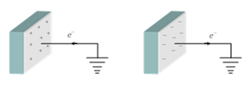
When a negatively charged conductor is connected to earth

Answer

(d) Electrons flow from the conductor to the earth
Explanation: After earthing a positively charged conductor electrons flow from earth to conductor and if a negatively charged conductor is earthed then electrons flows from conductor to earth.
Image

Need a full question paper?

Generate a complete, print-ready paper with questions like this in minutes — across 16+ boards, with answer keys.
Start Generating Free

Similar questions

An electron enters a region where electrostatic field is $20 N / C$ and magnetic field is $5 T .$ If electron passes undeflected through the region, then velocity of electron will be
The minimum wavelength of the $X-$rays produced by electrons accelerated through a potential difference of $V$ volts is directly proportional to
The e.m.f. of a standard cell balances across 150 cm length of a wire of potentiometer. When a resistance of 2 Ω is connected as a shunt with the cell, the balance point is obtained at 100 cm. The internal resistance of the cell is(a) 0.1 Ω(b) 1 Ω(c) 2 Ω(d) 0.5 Ω
       
A bulb has specification of one kilowatt and $250$ volts, the resistance of bulb is
When an impurity is doped into an intrinsic semiconductor, the conductivity of the semiconductor:
  1. Increases.
  2. Decreases.
  3. Remains the same.
  4. Becomes zero.
A battery of e.m.f. 3 volt and internal resistance 1.0 ohm is connected in series with copper voltameter. The current flowing in the circuit is 1.5 amperes. The resistance of voltameter will be(a) Zero(b) 1.0 ohm(c) 1.5 ohm(d) 2.0 ohm
       
In Young's double slit experiment, a glass plate is placed before a slit which absorbs half the intensity of light. Under this case(a) The brightness of fringes decreases(b) The fringe width decreases(c) No fringes will be observed(d) The bright fringes become fainter and the dark fringes have finite light intensity


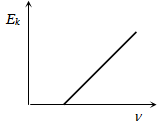
For the photoelectric effect, the maximum kinetic energy $E_k$  of the emitted photoelectrons is plotted against the frequency $n$ of the incident photons as shown in the figure. The slope of the curve gives
The heavier nuclei tend to have larger $\frac{\text{N}}{\text{Z}}$ ratio because:
The time period of oscillation of a magnet in a vibration magnetometer is 1.5 sec. The time period of oscillation of another magnet similar in size, shape and mass but having 1/4 magnetic moment than that of the 1st magnet oscillating at the same place will be: