MCQ
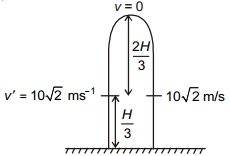
When a particle is thrown vertically upwards, its velocity at one third of its maximum height is $10 \sqrt{2}\,m / s$. The maximum height attained by it is .......... $m$
  • A
    $20 \sqrt{2}$
  • B
    $30$
  • $15$
  • D
    $12.8$

Answer

Correct option: C.
$15$
c
(c)

$v^2-u^2=-2 g \times \frac{2 H}{3}$

$\Rightarrow-100 \times 2=-2 \times 10 \times \frac{2 H}{3}$

$\Rightarrow H=15 \,m$
Need a full question paper?

Generate a complete, print-ready paper with questions like this in minutes — across 16+ boards, with answer keys.
Start Generating Free

Similar questions

$\frac{1}{2} $ mole of helium gas is contained in a container at $S.T.P.$ The heat energy needed to double the pressure of the gas, keeping the volume constant (specific heat of the gas $ = 3\,J\,g{m^{ - 1}}\,{K^{ - 1}})$ is ...... $J$
A rod of length $1\,meter$ is standing vertically, when its other end touches the ground without slipping then the speed of other end will be
If a black body is heated at a high temperature, it seems to be
Tangent galvanometer is used to measure
A rod of length $L$ is held vertically on a smooth horizontal surface. The top end of the rod is given a gentle push. At a certain instant of time, when the rod makes an angle $\theta$ with horizontal the velocity of $COM$ of the rod is $v_0.$ The velocity of the end of the rod in contact with the surface at that instant is :
Ice at $-20\,^oC$ is added to $50\,g$ of water at $40\,^oC.$ When the temperature of the mixture reaches $0\,^oC,$ it is found that $20\,g$ of ice is still unmelted. The amount of ice added to the water was close to ........$g$ (Specific heat of water $= 4.2\,J/g/^oC)$ Heat of fusion of water at $0^oC = 334\,J/g$ )
......... $m/s^2$ is magnitude of acceleration of a block moving with speed $10\,m/s$ on a rough surface if coefficient of friction is $0.2$.
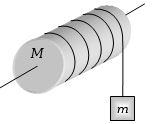
A mass $M$ is supported by a mass less string would wound a uniform cylinder of mass $M$ and radius $R$. On releasing the mass from rest, it will fall with acceleration
A circular loop of radius $0.3\,cm$ lies parallel to a much bigger circular loop of radius $20\,cm$. The centre of the smaller loop is on the axis of the bigger loop. The distance between their centres is $15\,cm$. If a current of $2.0\,A$ flows through the smaller loop, then the flux linked with bigger loop $.............\times 10^{-11} weber$
An ac current is represented as $\mathrm{i}=5 \sqrt{2}+10 \cos \left(650 \pi \mathrm{t}+\frac{\pi}{6}\right) \mathrm{Amp}$
The r.m.s value of the current is