MCQ
When a particle moves in a uniform circular motion. It has
  • A
    Radial velocity and radial acceleration
  • Tangential velocity and radial acceleration
  • C
    Tangential velocity and tangential acceleration
  • D
    Radial velocity and tangential acceleration

Answer

Correct option: B.
Tangential velocity and radial acceleration
b
An object moving in a circle is accelerating. Accelerating objects are objects which are changing their velocity - either the speed (i.e., magnitude of the velocity vector) or the direction. An object undergoing uniform circular motion is moving with a constant speed.

Need a full question paper?

Generate a complete, print-ready paper with questions like this in minutes — across 16+ boards, with answer keys.
Start Generating Free

Similar questions

A source of sound placed at the open end of a resonance column sends an acoustic wave of pressure amplitude ${\rho _0}$ inside the tube. If the atmospheric pressure is ${\rho _A},$ then the ratio of maximum and minimum pressure at the closed end of the tube will be
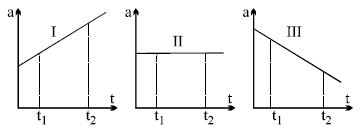
Each of the three graphs represents acceleration versus time for an object that already has a positive velocity at time $t_1$. Which graphs show an object whose speed is increasing for the entire time interval between $t_1$ and $t_2$ ?
An engine pumps up $100 kg $ of water through a height of  $10 m$  in $ 5 s. $ Given that the efficiency of the engine is $ 60\%$  . If $g = 10m{s^{ - 2}}$, the power of the engine is .............. $\mathrm{kW}$
A crew of scientists has built a new space station. The space station is shaped like a wheel of radius $R,$ with essentially all its mass $M$ at the rim. When the crew arrives, the station will be set rotating at a rate that causes an object at the rim to have radial acceleration $g,$ thereby simulating Earth's surface gravity. This is accomplished by two small rockets, each with thrust $T$ newtons, mounted on the station's rim. How long a time $t$ does one need to fire the rockets to achieve the desired condition?
Two waves are represented by the equations : $y_1 = a\, sin\,(\omega t + kx + 0.57)\, m$ and $y_2 = a\, cos\,(\omega t + kx)\, m$, where $x$ is in $metres$ and $t$ is in $seconds$ . The phase difference between them is ..... $radian$
The length of a rod is $20\, cm$ and area of cross-section $2\,c{m^2}$. The Young's modulus of the material of wire is $1.4 \times {10^{11}}\,N/{m^2}$. If the rod is compressed by $5\, kg-wt$ along its length, then increase in the energy of the rod in joules will be
A ball of mass $160\, g$ is thrown up at an angle of $60^{\circ}$ to the horizontal at a speed of $10 \,m / s$. The angular momentum of the ball at the highest point of the trajectory with respect to the point from which the ball is thrown is nearly $\left(g=10\, m / s ^{2}\right)$ (in $kgm ^{2} / s$)
A car goes around uniform circular track of radius $R$ at a uniform speed $v$ once in every $T$ seconds. The magnitude of the centripetal acceleration is $a_c$. If the car now goes uniformly around a larger circular track of radius $2 R$ and experiences a centripetal acceleration of magnitude $8 a_c$. Then, its time period is
A Tennis ball is released from a height $h$ and after freely falling on a wooden floor it rebounds and reaches height $\frac{ h }{2} .$ The velocity versus height of the ball during its motion may be represented graphically by 

(graph are drawn schematically and on not to scale)
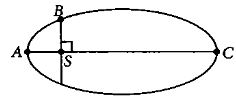
The kinetic energies of a planet in an elliptical orbit about the Sun, at positions $A, B$ and $C$ are   $K_A, K_B$ and $K_C$, respectively. $AC$ is the major axis and $SB$ is perpendicular to $AC$ at the position of the Sun $S$ as shown in the figure. Then