Question
When a proton is released from rest in a room, it starts with an initial acceleration a0 towards west. When it is projected towards north with a speed v0, it moves with an initial acceleration 3a0 towards west. Find the electric field and the maximum possible magnetic field in the room.

Answer

$\text{q}_\text{p}=\text{e},\ \text{mp}=\text{m},\ \text{F}=\text{q}_\text{p}\times\text{E}$
$\text{ma}_0=\text{eE}$
$\text{E}=\frac{\text{ma}_0}{\text{e}}$ towards west

The acceleration changes from a0 to 3a0
Hence net acceleration produced by magnetic field $\overrightarrow{\text{B}}$ is 2a0.
Force due to magnetic field
$\overrightarrow{\text{F}}_\text{B}=\text{m}\times2\text{a}_0=\text{e}\times\text{V}_0\times\text{B}$
$\Rightarrow\text{B}=\frac{2\text{ma}_0}{\text{eV}_0}$ downwards

Need a full question paper?

Generate a complete, print-ready paper with questions like this in minutes — across 16+ boards, with answer keys.

Start Generating Free

Similar questions

A copper wire having resistance 0.01 ohm in each metre is used to wind a 400-turn solenoid of radius 1.0cm and length 20cm. Find the emf of a battery which when connected the solenoid will eauee a magnetic field of 1.0 × 10⁻²T near the centre of the solenoid.
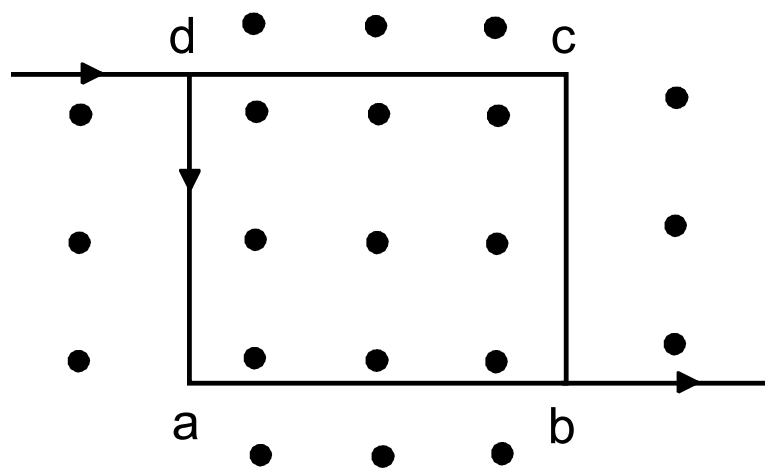
A current of 2A enters at the corner d of a square frame abcd of side 20cm and leaves at the opposite corner b. A magnetic field B = 0.1 T exists in the space in a direction perpendicular to the plane of the frame, as shown in the figure. Find the magnitude and direction of the magnetic forces on the four sides of the frame.

For a circular coil of radius R and N turns carrying current I, the magnitude of the magnetic field at a point on its axis at a distance x from its centre is given by,
$\text{B}=\frac{\mu_{0}\text{IR}^{2}\text{N}}{2(\text{x}^{2}+\text{R}^{2})^{\frac{3}{2}}}$
  1. Show that this reduces to the familiar result for field at the centre of the coil.
  2. Consider two parallel co-axial circular coils of equal radius R, and number of turns N, carrying equal currents in the same direction, and separated by a distance R. Show that the field on the axis around the mid-point between the coils is uniform over a distance that is small as compared to R, and is given by,$\text{B}=0.72\frac{\mu_{0}\text{NI}}{\text{R}}$, approximately.
[Such an arrangement to produce a nearly uniform magnetic field over a small region is known as Helmholtz coils.]
How would you set up a circuit to obtain NOT gate using a transistor?
It is found that yellow light does not eject photoelectrons from a metal. Is it advisable to try with orange light? With green light?
Two conductors are made of the same material and have the same length. Conductor A is a solid wire of diameter 1mm. Conductor B is a hollow tube of outer diameter 2mm and inner diameter 1mm. Find the ratio of resistance RA to RB.
In an intrinsic semiconductor the energy gap Eg is 1.2eV. Its hole mobility is much smaller than electron mobility and independent of temperature. What is the ratio between conductivity at 600K and that at 300K? Assume that the temperature dependence of intrinsic carrier concentration ni is given by,
$\text{n}_{\text{i}}=\text{n}_{\text{0}}\ {\text{exp}}\Big(-\frac{\text{E}_\text{g}}{2{\text{K}_{\text{B}}}{\text{T}}}\Big)$
where n0 is a constant.
The temperature and pressure at Simla are 15.0°C and 72.0cm of mercury and at Kalka these are 35.0°C and 76.0cm of mercury. Find the ratio of air density at Kalka to the air density at Simla.
Consider a circular current-carrying loop of radius R in the x-y plane with centre at origin. Consider the line intergral $\Im(\text{L})=\begin{vmatrix}\int\limits_{-\text{L}}^{\text{L}}\text{B.dl} \end{vmatrix}$ taken along z-axis.
  1. Show that $\Im(\text{L})$ monotonically increases with L.
  2. Use an appropriate Amperian loop to show that $\Im(\infty)=\mu_0\text{I}$, where I is the current in the wire.
  3. Verify directly the above result.
  4. Suppose we replace the circular coil by a square coil of sides R carrying the same current I. What can you say about $\Im(\text{L})$ and $\Im(\infty)$?
Consider a solid sphere of radius r and mass m that has a charge q distributed uniformly over its volume. The sphere is rotated about its diameter with an angular speed $\omega.$ Show that the magnetic moment $\mu$ and the angular momentum l of the sphere are related as $\mu=\frac{\text{q}}{2\text{m}}\text{l}.$