MCQ
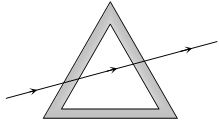
When a white light passes through a hollow prism, then
  • There is no dispersion and no deviation
  • B
    Dispersion but no deviation
  • C
    Deviation but no dispersion
  • D
    There is dispersion and deviation both

Answer

Correct option: A.
There is no dispersion and no deviation
a
( a)Effectively there is no deviation or dispersion.

Need a full question paper?

Generate a complete, print-ready paper with questions like this in minutes — across 16+ boards, with answer keys.
Start Generating Free

Similar questions

Minimum excitation potential of Bohr's first orbit in hydrogen atom is
The current $i$ in an induction coil varies with time $t$ according to the graph shownin figure. Which of the following graphs shows the induced emf $(E$) in the coil with time
A circular coil of $1000\,turns$ and area of cross-section $1.5 \times 10^{-4}\, m^2$, is carrying a current of $2\,A$. What is the magnetic moment associated with the coil?....$Am^2$
According to Einstein’s photoelectric equation, the plot of the kinetic energy of the emitted photo electrons from a metal versus the frequency, of the incident radiation gives a straight line whose slope
Wires 1 and 2 carrying currents $i_1$ and $i_2$ respectively are inclined at an angle θ to each other. What is the force on a small element dl of wire 2 at a distance of r from wire 1 (as shown in figure) due to the magnetic field of wire1
The percentage of mass lost during nuclear fusion is:
Two batteries $V_1$ and $V_2$ are connected to three resistors as shown below. If $V_1=2 \,V$ and $V_2=0 \,V$, then the current $I=3 \,mA$. If $V_1=0 \,V$ and $V_2=4 \,V$, then the current $I=4 \,mA$. Now, if $V_1=10 \,V$ and $V_2=10 \,V$, then the current $I$ will be ............ $\,mA$
The maximum distance upto which $TV$ transmission from a $TV$ tower of height $h$ can be received is proportional to
An electric heater kept in vacuum is heated continuously by passing electric current. Its temperature
In an ideal transformer, the turns ratio is $\frac{N_p}{N_S}=\frac{1}{2}$. The ratio $V_s: V_p$ is equal to (the symbols carry their usual meaning):