Question
  1. When an AC source is connected to an ideal capacitor, show that the average power supplied by the source over a complete cycle is zero.
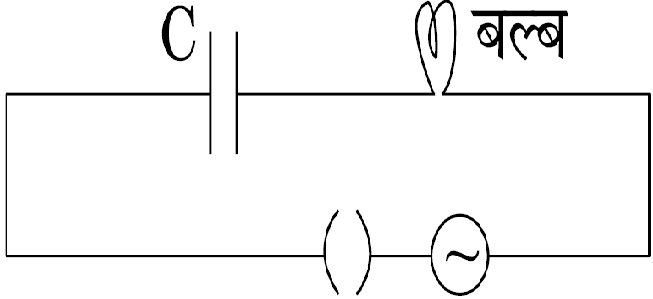
  2. A bulb is connected in series with a variable capacitor and an A.C. source as shown. What happens to the brightness of the bulb when the key is the capacitor is gradually reduced?
Answer

  1. Let the applied voltage be
$\text{V}= \text{V}_{o}\sin\omega\text{t}$
The current through an ideal capacitor, would then be
$\text{I} = \text{I}_{o}\sin(\omega\text{t} + \frac{\pi}{2}) = \text{I}_{0}\cos\omega\text{t}$
$\therefore\text{P}_{inst} = \text{VI}$
$\therefore\text{P}_{AV} = \frac{1}{\text{T}}\int^{T}_{0}\text{VIdt}$
$\therefore\text{P}_{AV} = \frac{\text{V}_{0}\text{I}_{0}}{2}\langle\sin2\omega\text{t}\rangle$
$=0.$
  1. $\text{X}_{c} = \frac{1}{\omega\text{C}}$
$\therefore\text{X}_{c}$ increases as C decreases. Hence, with decreasing C, the brightness of the bulb would decrease.

Need a full question paper?

Generate a complete, print-ready paper with questions like this in minutes — across 16+ boards, with answer keys.

Start Generating Free

Similar questions

Answer the following questions:
  1. In a double slit experiment using light of wavelength $600 \ nm$, the angular width of the fringe formed on a distant screen is $0.1^o$. Find the spacing between the two slits.
  2. Light of wavelength $5000 \mathring A$ . Propagating in air gets partly reflected from the surface of water. How will the wavelengths and frequencies of the reflected and refracted light be affected?
A long, vertical wire carrying a current of $10A$ in the upward direction is placed in a region where a horizontal magnetic field of magnitude $2·0 \times 10^{-3}T $
exists from south to north. Find the point where the resultant magnetic field is zero.
A series $\text{LCR}$ circuit is connected across an $a.c.$ source of variable angular frequency $' \omega'$. Plot a graph showing variation of current $‘i\ ’$ as a function of $' \omega'$ for two resistances $R_1$ and $R2 \ (R_1 > R_2).$
Answer the following questions using this graph:
  1. In which case is the resonance sharper and why?
  2. In which case is the power dissipation more and why?
Write three characteristic features in photoelectric effect which cannot be explained on the basis of wave theory of light, but can be explained only using Einstein’s equation.
Calculate the energy that can be obtained from $1\ kg$ of water through the fusion reaction
$^2H + ^2H \rightarrow ^3H + p.$
Assume that $1.5 \times 10^{-2}\%$ of natural water is heavy water $D_2O ($by number of molecules$)$ and all the deuterium is used for fusion.
To increase the current sensitivity of a moving coil galvanometer by $50\%,$ its resistance is increased so that the new resistance becomes twice its initial resistance. By what factor does its voltage sensitivity change?
A light ray, going through a prism with the angle of prism 60°, is found to deviate by 30°. What limit on the refractive index can be put from these data?
Obtain the answers $(a)$ to $(b)$ in Exercise $7.13$ if the circuit is connected to a high frequency supply $(240V, 10kHz).$ Hence, explain the statement that at very high frequency, an inductor in a circuit nearly amounts to an open circuit. How does an inductor behave in a dc circuit after the steady state?
The voltage and current in a series AC circuit are given by, $\text{V}=\text{V}_0\cos\omega\text{t}$ and $\text{i}=\text{i}_0\sin\omega\text{t}.$ What is the power dissipated in the circuit?
Two concentric circular coils, one of small radius $r_1$ and the other of large radius $r_2$, such that $r_1 \ll r_2$, are placed co-axially with centres coinciding. Obtain the mutual inductance of the arrangement.