MCQ
When an arrow is released from a bow, potential energy changes into kinetic energy.
  • A
    True
  • B
    False
  • C
    Ambiguous
  • D
    Data insufficient

Answer

  1. True

Explanation:

When an arrow is drawn back by a bow, the work done by us in stretching the bowstring gets stored at potential energy in the bow.

This potential energy of bow is transformed into kinetic energy when the bowstring is released and this gives kinetic energy to the arrow.

Need a full question paper?

Generate a complete, print-ready paper with questions like this in minutes — across 16+ boards, with answer keys.
Start Generating Free

Similar questions

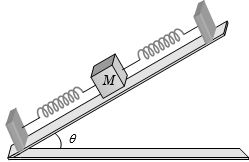
On a smooth inclined plane, a body of mass $M$ is attached between two springs. The other ends of the springs are fixed to firm supports. If each spring has force constant $K$, the period of oscillation of the body (assuming the springs as massless) is
A container has $N$ molecules at absolute temperature $T$. If the number of molecules is doubled but kinetic energy in the box remain the same as before, the absolute temperature of the gas is ...........
A cricket player catches a ball of mass $120 \mathrm{~g}$ moving with $25 \mathrm{~m} / \mathrm{s}$ speed. If the catching process is completed in $0.1 \mathrm{~s}$ then the magnitude of force exerted by the ball on the hand of player will be (in SI unit):
Two putty balls of equal mass moving with equal velocity in mutually perpendicular directions, stick together after collision. If the balls were initially moving with a velocity of $45\sqrt 2 \,m{s^{ - 1}}$ each, the velocity of their combined mass after collision is .................. $\mathrm{m} / \mathrm{s}^{-1}$
A drop of liquid of radius $\mathrm{R}=10^{-2} \mathrm{~m}$ having surface tension $\mathrm{S}=\frac{0.1}{4 \pi} \mathrm{Nm}^{-1}$ divides itself into $\mathrm{K}$ identical drops. In this process the total change in the surface energy $\Delta U=10^{-3} \mathrm{~J}$. If $\mathrm{K}=10^\alpha$ then the value of $\alpha$. . . . is
At a moment in a progressive wave, the phase of a particle executing $S.H.M.$ is $\frac{\pi }{3}$. Then the phase of the particle $15 cm$ ahead and at the time $\frac{T}{2}$ will be, if the wavelength is $60 cm$
The work done in increasing the length of a $1$ $metre$ long wire of cross-section area $1\, mm^2$ through $1\, mm$ will be ....... $J$ $(Y = 2\times10^{11}\, Nm^{-2})$
A certain amount of gas of volume $V$ at $27^{o}\,C$ temperature and pressure $2 \times 10^{7} \;Nm ^{-2}$ expands isothermally until its volume gets doubled. Later it expands adiabatically until its volume gets redoubled. The final pressure of the gas will be  (Use $\gamma=1.5$ )
A non-isotropic solid metal cube has coefficients of linear expansion as:

$5 \times 10^{-5} /^{\circ} \mathrm{C}$ along the $\mathrm{x}$ -axis and $5 \times 10^{-6} /^{\circ} \mathrm{C}$ along the $y$ and the $z-$axis. If the coefficient of volume expansion of the solid is $\mathrm{C} \times 10^{-6} /^{\circ} \mathrm{C}$ then the value of $\mathrm{C}$ is

A satellite of earth of mass $'m'$ taken from orbital radius $2R$ to $3R,$ then minimum work done