Question
When an insulator is placed in an external field, the dipoles become aligned. Induced surface charges on the insulator establish a polarization field $\vec{\text{E}}_\text{i}$ in its interior. The net field $\vec{\text{E}}$ in the insulator is the vector sum of $\vec{\text{E}}_0$ and $\vec{\text{E}}_\text{i}$ as shown in the figure.
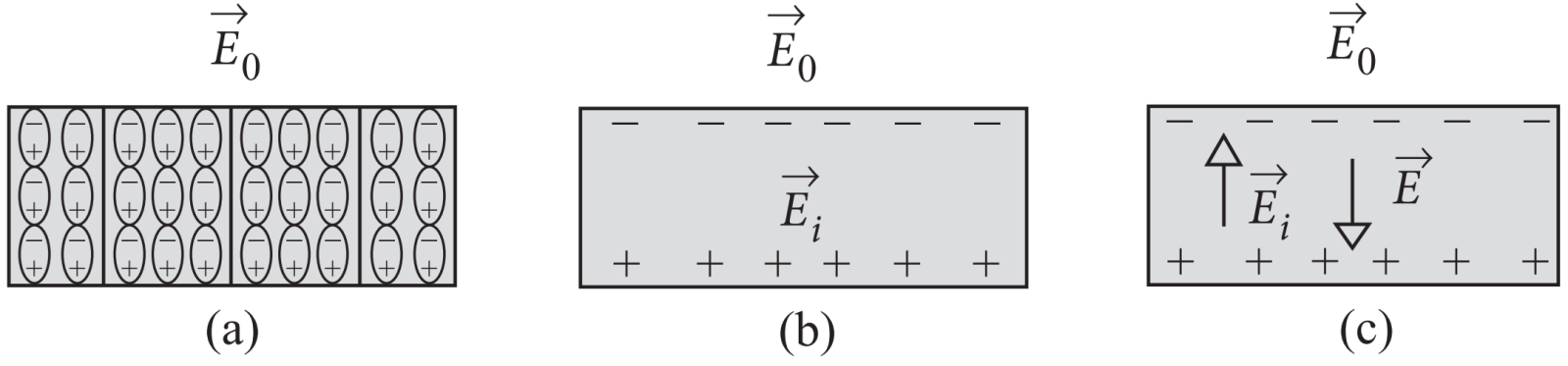
On the application of external electric field, the effect of aligning the electric dipoles in the insulator is called polarisation, and the field $\vec{\text{E}}_\text{i}$ is known as the polarisation field.

The dipole moment per unit volume of the dielectric is known as polarisation $(\vec{\text{P}}).$ For linear isotropic dielectrics, $\vec{\text{P}}=\chi\vec{\text{E}},$ where $\chi=$ electrical susceptibility of the dielectric medium.

  1. Which among the following is an example of polar molecule?
  1. O2
  2. H2
  3. N2
  4. HCI
  1. When air is replaced by a dielectric medium of constant K, the maximum force of attraction between two charges separated by a distance:
  1. Increases K times.
  2. Remains unchanged.
  3. Decreases K times.
  4. Increases 2K times.
  1. Which of the following is a dielectric?
  1. Copper.
  2. Glass.
  3. Antimony (Sb).
  4. None of these.
  1. For a polar molecule, which of the following statements is true?
  1. The centre of gravity of electrons and protons coincide.
  2. The centre of gravity of electrons and protons do not coincide.
  3. The charge distribution is always symmetrical.
  4. The dipole moment is always zero.
  1. When a comb rubbed with dry hair attracts pieces of paper. This is because the?
  1. Comb polarizes the piece of paper.
  2. Comb induces a net dipole moment opposite to the direction of field.
  3. Electric field due to the comb is uniform.
  4. Comb induces a net dipole moment perpendicular to the direction of field.
Answer

  1. (d) HCI

Explanation:

ln polar molecule the centres of positive and negative charges are separated even when there is no external field. Such molecule have a permanent dipole moment. Ionic molecule like HCI is an example of polar molecule.

  1. (c) Decreases K times.

Explanation:

As $\text{F}_\text{m}=\frac{\text{F}_0}{\text{K}}$

$\therefore$ The maximum force decreases by Klimes.

  1. (b) Glass.
  2. (b) The centre of gravity of electrons and protons do not coincide.

​​​​​​​​​​​​​​​​​​​​​Explanation:

A polar molecule is one in which the centre of gravity for positive and negative charges are separated.

  1. (a) Comb polarizes the piece of paper.

Need a full question paper?

Generate a complete, print-ready paper with questions like this in minutes — across 16+ boards, with answer keys.

Start Generating Free

Similar questions

The magnetic field due to the earth has a horizontal component of $26\mu\text{T}$ at a place where the dip is 60°. Find the vertical component and the magnitude of the field.
Out of the two magnetic materials, 'A' has relative permeability slightly greater than unity while oB' has less than unity. Identify the nature of the materials 'A' and 'B'. Will their susceptibilities be positive or negative?
Complete the following table:
Car Model
Driver X
Reaction time 0.20s
Driver Y
Reaction time 0.30s
A (deceleration on hard braking = 6.0m/s2)
Speed = 54km/h
Braking distance
a = ...
Total stopping distance
b = ...
Speed = 72km/h
Braking distance
c = ...
Total stopping distance
d = ...
B (deceleration on hard braking = 7.5m/s2)
Speed = 54km/h
Breaking distance
e = ...
Total stopping distance
f = ...
Speed 72km/h
Braking distance
g = ...
Total stopping distance
h = ...
Two large, thin metal plates are parallel and close to each other. On their inner faces, the plates have surface charge densities of opposite signs and of magnitude $17.0 \times 10^{-22} C / m ^2$. What is E: (a) in the outer region of the first plate, (b) in the outer re-gion of the second plate, and (c) between the plates?
In an a.c. circuit, values of voltage and current change every instant. Therefore, power of an a.c. circuit at any instant is the product of instantaneous voltage (E) and instantaneous current (I). The average power supplied to a pure resistance R over a complete cycle of a.c. is $\text{P} = \text{E}_\text{V}\text{I}_\text{V}.$ When circuit is inductive, average power per cycle is $\text{E}_\text{V}\text{I}_\text{V}\cos\phi.$

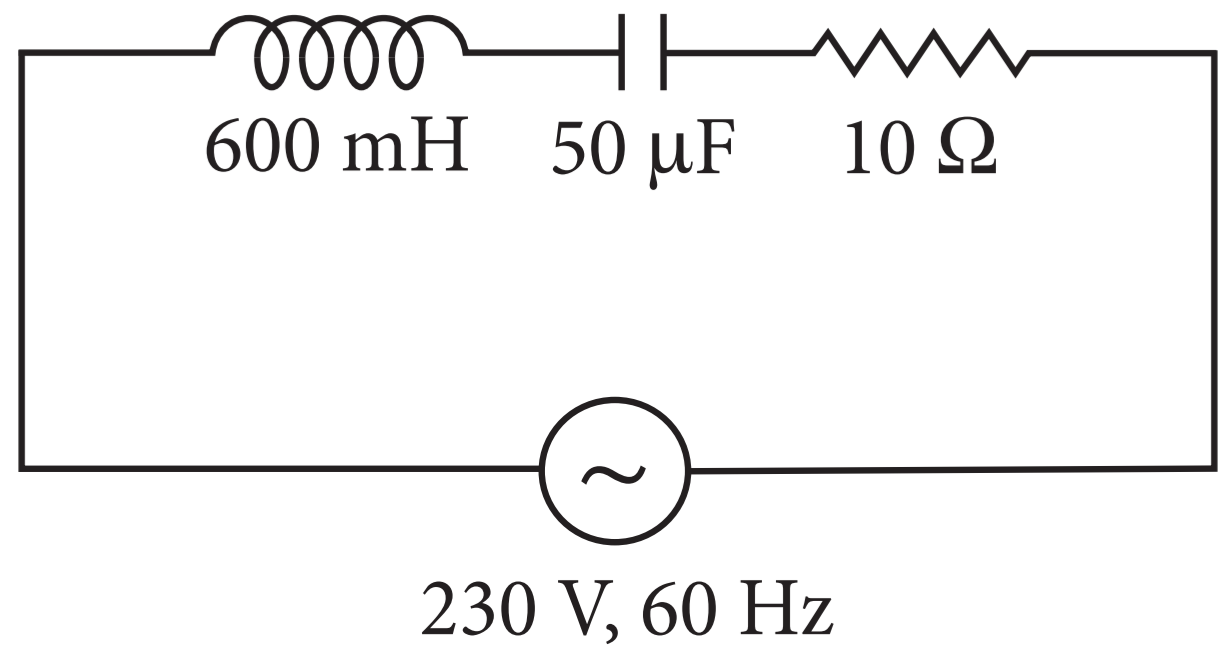
In an a.c. circuit, 600mH inductor and a $15\Omega$ capacitor are connected in series with $10\Omega$ resistance. The a.c. supply to the circuit is 230V, 60Hz.
  1. The average power transferred per cycle to resistance is:
  1. 10.42W
  2. 15.25W
  3. 17.42W
  4. 13.45W
  1. The average power transferred per cycle to capacitor is:
  1. Zero
  2. 10.42W
  3. 17.42W
  4. 15W
  1. The average power transferred per cycle to inductor is:
  1. 25W
  2. 17.42W
  3. 16.52W
  4. Zero
  1. The total power transferred per cycle by all the three circuit elements is:
  1. 17.42W
  2. 10.45W
  3. 12.45W
  4. Zero
  1. The electrical energy spend in running the circuit for one hour is:
  1. 7.5 × 10⁵ Joule
  2. 10 × 103 Joule
  3. 9.4 × 10³ Joule
  4. 6.2 × 10⁴ Joule
In a microwave oven, the food is kept in a plastic container and the microwave is directed towards the food. The food is cooked without melting or igniting the plastic container. Explain.
A magnetic dipole of magnetic moment 0.72A-m2 is placed horizontally with the north pole pointing towards bsouth. Find the position of the neutral point if the horizontal component of the earth's magnetic field is $18\mu\text{T.}$
A silver ball of radius 4.8cm is suspended by a thread in a vacuum chamber. Ultraviolet light of wavelength 200 run is incident on the ball for some time during which a total light energy of 1.0 × 10⁻⁷J falls on the surface. Assuming that on the average one photon out of every ten thousand is able to eject a photoelectron, find the electric potential et the surface of the bell assuming zero potential at infinity. What is the potential at the centre of the bell?
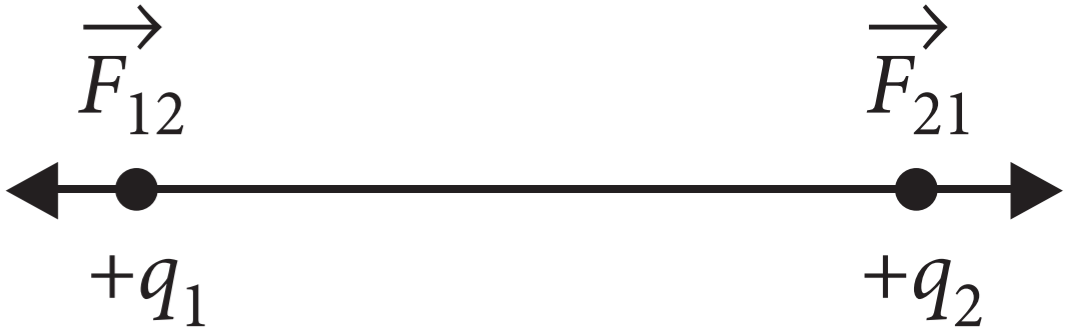
Coulomb's law states that the electrostatic force of attraction or repulsion acting between two stationary point charges is given by:

$\text{F}=\frac{1}{4\pi\in_0}\frac{\text{q}_1\text{q}_2}{\text{r}^2}$

Where F denotes the force between two charges q1 and q2 separated by a distance r in free space, $\in_0$ is a constant known as permittivity of free space. Free space is vacuum and may be taken to be air practically. If free space is replaced by a medium, then $\in_0$ is replaced by $(\in_0\text{k})$ or $(\in_0\in_\text{r})$ where k is known as dielectric constant or relative permittivity.

  1. In coulomb's law, $\text{F}=\text{k}\frac{\text{q}_1\text{q}_2}{\text{r}^2}$ then on which of the following factors does the proportionality constant k depends?
  1. Electrostatic force acting between the two charges.
  2. Nature of the medium between the two charges.
  3. Magnitude of the two charges.
  4. Distance between the two charges.
  1. Dimensional formula for the permittivity constant $\in_0$ of free space is:
  1. [ML-3 T4 A2]
  2. [M-1 L3 T2 A2]
  3. [M-1 L-3 T4 A2]
  4. ML-3 T4 A-2]
  1. The force of repulsion between two charges of 1C each, kept 1m apart in vaccum is:
  1. $\frac{1}{9\times10^9}\text{N}$

  2. 9 × 109N
  3. 9 × 107N
  4. $\frac{1}{9\times10^{12}}\text{N}$

  1. Two identical charges repel each other with a force equal to 10 mgwt when they are 0.6m apart in air.(g = 10m s-2). The value of each charge is:
  1. 2mC
  2. 2 × 10-7mC
  3. 2 nC
  4. $2\mu\text{C}$
  1. Coulomb's law for the force between electric charges most closely resembles with:
  1. Law of conservation of energy.
  2. Newton's law of gravitation.
  3. Newton's 2nd law of motion.
  4. Law of conservation of charge.
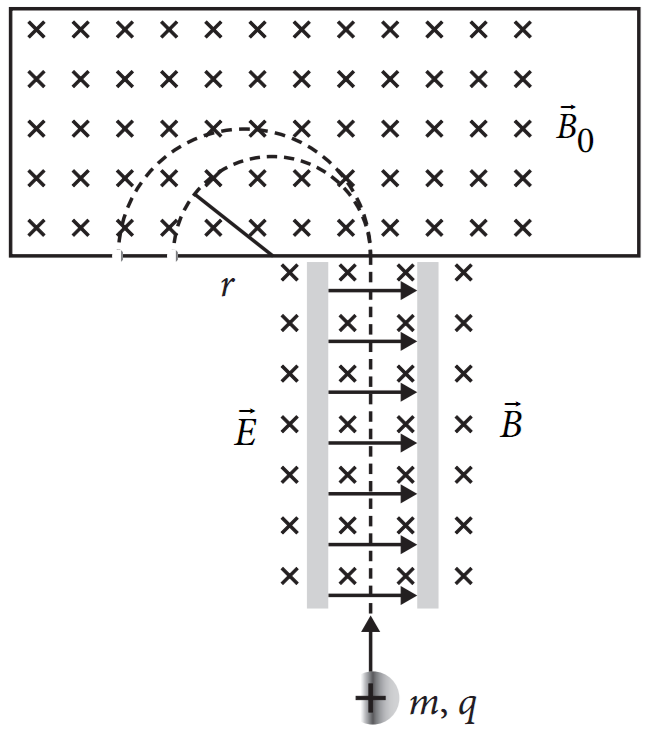
Various methods can be used to measure the mass of an atom. One possibility is through the use of a mass spectrometer. The basic feature of a Banbridge mass spectrometer is illustrated in figure. A particle carrying a charge +q is first sent through a velocity selector and comes out with velocity $\text{v}=\frac{\text{E}}{\text{B}}.$
The applied electric and magnetic fields satisfy the relation E = vB so that the trajectory of the particle is a straight line. Upon entering a region where a second magnetic field $\vec{\text{B}}_0$ pointing into the page has been applied, the particle will move in a circular path with radius rand eventually strike the photographic plate.

  1. In mass spectrometer, the ions are sorted out in which of the following ways?
  1. By accelerating them through electric field.
  2. By accelerating them through magnetic field.
  3. By accelerating them through electric and magnetic field.
  4. By applying a high voltage.
  1. Radius of particle in second magnetic field B0 is:
  1. $\frac{2\text{mv}}{\text{qE}_0}$
  2. $\frac{\text{mv}}{\text{qE}_0}$
  3. $\frac{\text{mv}}{\text{qB}_0}$
  4. $\frac{2\text{mE}_0\text{v}}{\text{qB}_0}$
  1. Which of the following will trace a circular trajectory with largest radius?
  1. Proton
  2. ct-particle
  3. Electron
  4. A particle with charge twice and mass thrice that of electron.
  1.  Mass of the particle in terms q, B0, B, rand E is:
  1. $\frac{\text{qbr}}{\text{E}}$
  2. $\frac{\text{qbr}}{\text{E}}$
  3. $\frac{\text{qbr}}{\text{E}}$
  4. $\frac{\text{qbr}}{\text{E}}$ 
  1. The particle comes out of velocity selector along a straight line, because:
  1. Electric force is less than magnetic force.
  2. Electric force is greater than magnetic force.
  3. Electric and magnetic force balance each other.
  4. Can't say.