MCQ
When current passes through the circuit a compass needle rests in which direction (with respect to the Earth)?
- ASouth - north
- BNorth - south
- CEast - west
- DWest - east
Explanation:
The earth acts like a huge magnet. Thus in the absence of electric current a compass needle always comes to rest in Earths North - south direction.
However, when current passes through the circuit the needle comes to rests in the direction opposite to the magnetic field of Earth i.e. South-North direction.
Generate a complete, print-ready paper with questions like this in minutes — across 16+ boards, with answer keys.
For the photoelectric effect, the maximum kinetic energy  of the emitted photoelectrons is plotted against the frequency n of the incident photons as shown in the figure. The slope of the curve gives
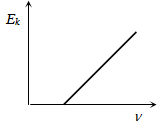
|
(a) Charge of the electron |
|
(b) Work function of the metal |
|
(c) Planck's constant |
|
(d) Ratio of the Planck’s constant to electronic charge |
X-rays can be used to study crystal structure, if the wavelength lies in the range
| (a) 2 Å to 0.1 Å | (b) 10 Å to 5 Å | (c) 50 Å to 10 Å | (d) 100 Å to 50 Å |
P-type semiconductors are made by adding impurity element
|
(a) As |
(b) P |
(c) B |
(d) Bi |
A 100 W bulb B1, and two 60-W bulbs B2 and B3, are connected to a 250 V source, as shown in the figure. Now W1, W2 and W3 are the output powers of the bulbs B1, B2 and B3, respectively. Then
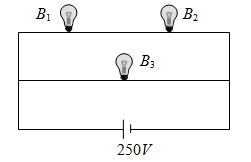
|
(a) |
(b) |
(c) 
|
(d) 
|
Which of the following rays has the maximum frequency
|
(a) Gamma rays |
(b) Blue light |
(c) Infrared rays |
(d) Ultraviolet rays |
In nuclear fission the percentage of mass converted into energy is about
|
(a) 10% |
(b) 0.01% |
(c) 0.1% |
(d) 1% |
In the figure the charge Q is at the centre of the circle. Work done is maximum when another charge is taken from point P to

|
(a) K |
(b) L |
(c) M |
(d) N |

