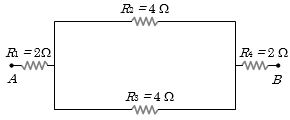
When current supplied by a cell to a circuit is $0.3 \,A$, its terminal potential difference is $0.9 \,V$. When the current supplied becomes $0.25 \,A$, its terminal potential difference becomes $1.0 \,V$. The internal resistance of the cell is ............ $\Omega$
Easy


Download our appand get started for free
Experience the future of education. Simply download our apps or reach out to us for more information. Let's shape the future of learning together!No signup needed.*
Similar Questions
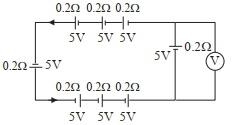
- 1The reading in the ideal voltmeter $(V)$ shown in the given circuit diagram is :View Solution
- 2$n$ identical cells each of $e.m.f.$ $E$ and internal resistance $r$ are connected in series. An external resistance $R$ is connected in series to this combination. The current through $R$ isView Solution
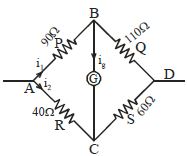
- 3In a Wheatstone bridge, $P = 90\,\Omega $, $Q = 110\,\Omega $ , $R = 40\,\Omega $ and $S = 60\,\Omega $ and a cell of $4\,V\,emf$. Then the potential difference between the diagonal along which a galvanometer is connected is ............. $V$View Solution
- 4In an electrolyte $3.2 \times {10^{18}}$ bivalent positive ions drift to the right per second while $3.6 \times {10^{18}}$ monovalent negative ions drift to the left per second. Then the current isView Solution
- 5$n$ identical bulbs, each designed to draw a power $p$ from a certain voltage supply, are joined in series across that supply. The total power which they will draw isView Solution
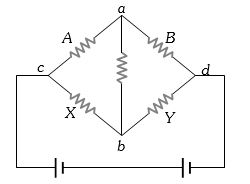
- 6In the Wheatstone's bridge (shown in figure) $X = Y$ and $A > B$. The direction of the current between ab will beView Solution
- 7View SolutionTwo resistors having equal resistances are joined in series and a current is passed through the combination. Neglect any variation in resistance as the temperature changes. In a given time interval
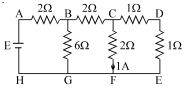
- 8The figure shows a network of resistors and $a$ battery. If $1\,A$ current flowsthrough the branch $CF$, then answer the following questions The current throughView Solution
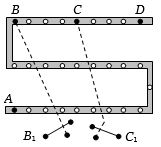
- 9View SolutionFor the post office box arrangement to determine the value of unknown resistance the unknown resistance should be connected between
- 10In the given figure, the equivalent resistance between the points $A$ and $B$ is ............ $\Omega$View Solution