$n$ identical cells each of $e.m.f.$ $E$ and internal resistance $r$ are connected in series. An external resistance $R$ is connected in series to this combination. The current through $R$ is
Medium
Download our app for free and get started
Total $e.m.f. = nE$,
Total resistance $R + nr$
$ \Rightarrow $ $i = \frac{{nE}}{{R + nr}}$

Download our appand get started for free
Experience the future of education. Simply download our apps or reach out to us for more information. Let's shape the future of learning together!No signup needed.*
Similar Questions
- 1View SolutionThe equivalent resistance of resistors connected in series is always
- 2Thomson coefficient of a conductor is $10\,\mu V/K$. The two ends of it are kept at ${50\,^o}C$ and ${60\,^o}C$ respectively. Amount of heat absorbed by the conductor when a charge of $10\,C$ flows through it isView Solution
- 3Say switches $S_1, S_2$ and so on upto $S_6$ are closed, one after other in order (first $S_1$, then $S_2$) at regular intervals of $1$ minute starting from $t = 0$. The graph of current versus time is best represented asView Solution
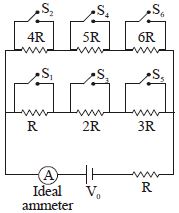
- 4A current of $5\, A$ passes through a copper conductor (resistivity $= 1.7\times10^{-8}\,\Omega \,m$) of radius of cross-section $5\, mm$. Find the mobility of the charges if their drift velocity is $1.1\times10^{-3}\, m/s$ ................ $m^2/Vs$View Solution
- 5When $5\ V$ potential difference is applied across a wire of length $0.1\ m$, the drift speed of electrons is $2.5 \times 10^{-4}$ $ms^{-1}$ . If the electron density in the wire is $8 \times 10^{28}$ $m^{-3}$ the resistivity of the material is close toView Solution
- 6A resistor develops $300 \,J$ of thermal energy in $15 \,s$, when a current of $2\, A$ is passed through it. If the current increases to $3 \,A$, the energy developed in $10\,\,s$ is........$J.$View Solution
- 7View SolutionPotential gradient is defined as
- 8View SolutionSensitivity of potentiometer can be increased by
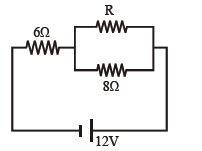
- 9In the circuit shown in figure, the power which is dissipated as heat in the $6\,\Omega$ resistor is $6\,W$. What is the value of resistance $R$ in the circuit?................... $\Omega$View Solution
- 10View SolutionAssertion : Ohm's law is applicable for all conducting elements.
Reason : Ohm's law is a fundamental law