Question
When electric dipole is placed in uniform electric field, its two charges experience equal and opposite forces, which cancel each other and hence net force on electric dipole in uniform electric field is zero. However, these forces are not collinear, so they give rise to some torque on the dipole. Since net force on electric dipole in uniform electric field is zero, so no work is done in moving the electric dipole in uniform electric field. However, some work is done in rotating the dipole against the torque acting on it.
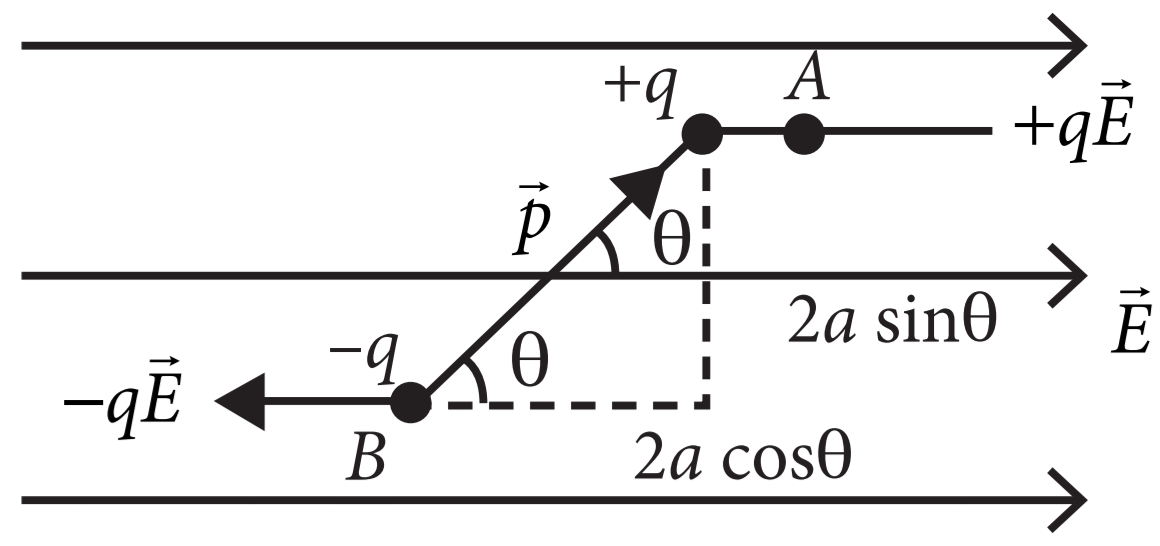
  1. The dipole moment of a dipole in a uniform external field $\vec{\text{E}}$ is $\vec{\text{P}}.$ Then the torque 'i acting on the dipole is:
  1. $\vec{\tau}=\vec{\text{P}}\times\vec{\text{E}}$

  2. $\vec{\tau}=\vec{\text{P}}\cdot\vec{\text{E}}$

  3. $\vec{\tau}=2(\vec{\text{P}}+\vec{\text{E}})$

  4. $\vec{\tau}=(\vec{\text{P}}+\vec{\text{E}})$

  1. An electric dipole consists of two opposite charges, each of magnitude $1.0\mu\text{C}$ separated by a distance of 2.0cm. The dipole is placed in an external field of 105N C-1. The maximum torque on the dipole is:
  1. 0.2 × 10-3Nm
  2. 1 × 10⁻³Nm
  3. 2 × 10-3Nm
  4. 4 × 10⁻³Nm
  1. Torque on a dipole in uniform electric field is minimum when $\theta$ is equal to:
  1. 90º
  2. 180º
  3. Both (a) and (c)
  1. When an electric dipole is held at an angle in a uniform electric field, the net force F and torque t on the dipole are:
  1. $\text{F}=0, \tau=0$

  2. $\text{F}\not=0, \tau\not=0$

  3. $\text{F}=0, \tau\not=0$

  4. $\text{F}\not=0, \tau=0$

  1. An electric dipole of moment pis placed in an electric field of intensity E. The dipole acquires a position such that the axis of the dipole makes an angle $\theta$ with the direction of the field. Assuming that the potential energy of the dipole to be zero when $\theta=90^\circ$ the torque and the potential energy of the dipole will respectively be:
  1. $\text{pE}\sin\theta,-\text{pE}\cos\theta$

  2. $\text{pE}\sin\theta,-2\text{pE}\cos\theta$

  3. $\text{pE}\sin\theta,2\text{pE}\cos\theta$

  4. $\text{pE}\cos\theta,-2\text{pE}\sin\theta$

Answer

  1. (a) $\vec{\tau}=\vec{\text{P}}\times\vec{\text{E}}$

Explanation:

As $\tau=$ either force × perpendicular distance between the two forces.

$=\text{qaE}\sin\theta\text{ or }\tau=\text{PE}\sin\theta$

$(\because\text{qa}=\text{P})$

Or $\vec{\tau}=\vec{\text{P}}\times\vec{\text{E}}$

  1. (c) 2 × 10-3Nm

​​​​​​​​​​​​​​Explanation:

The maximum torque on the dipole in an external electric field is given by

$\tau=\text{pE}=\text{q}(\text{2a})\times\text{E}$

Here, $\text{q}=1\mu\text{C}=10^{-6}\text{C,}$

2a = 2cm = 2 × 10-2m,

E = 105N C-1,

$\tau=?$

$\therefore\tau=10^{-6}\times2\times10^{-2}\times10^5$

$=2\times10^{-3}\text{Nm}$

  1. (d) Both (a) and (c)

​​​​​​​​​​​​​​​​​​​​​​​​​​​​​​​​​​​Explanation:

When $\theta$ is 0 or 180º, the $\tau$ minimum, which means the dipole moment should be parallel to the direction of the uniform electric field.

  1. (c) $\text{F}=0, \tau\not=0$

​​​​​​​​​​​​​​​​​​​​​​​​​​​​​​​​​​​Explanation:

Net force is zero and torque acts on the dipole, trying to align p with E.

  1. (a) $\text{pE}\sin\theta,-\text{pE}\cos\theta$

​​​​​​​​​​​​​​​​​​​​​​​​​​​​​​​​​​​Explanation:

Torque, $\tau=\text{pE}\sin\theta$ and potential energy, $\text{U}=-\text{pE}\cos\theta.$​​​​​​​

Need a full question paper?

Generate a complete, print-ready paper with questions like this in minutes — across 16+ boards, with answer keys.

Start Generating Free

Similar questions

If we allow radiations of a fixed frequency to fall on plate and the accelerating potential difference between the two electrodes is kept fixed, then the photoelectric current is found to increase linearly with the intensity of incident radiation. Here, radiation pressure is $\text{P}=\Big(\frac{1+\text{e}}{\text{C}}\Big)\text{I}$. As, atmosphere pressure at sea level is 105Pa. If the intensity of light of a given wavelength, is increased, there is an increase in the number of photons incident on a given area in a given time. But the energy of each photon remain the same.
  1. The number of photons hitting the cone second
  1. $\frac{\pi\text{R}^2\text{I}}{2\text{E}}$
  2. $\frac{2\pi\text{R}^2\text{I}}{\text{E}}$
  3. $\frac{\pi\text{R}^2\text{I}}{4\text{E}}$
  4. $\frac{\pi\text{R}^2\text{I}}{\text{E}}$
  1. A radiation of energy E falls normally on a perfect reflecting surface. The momentum transferred to the surface is:
  1. $\frac{\text{E}}{\text{c}}$
  2. $\frac{2\text{E}}{\text{c}}$
  3. $\text{Ec}$
  4. $\frac{\text{E}}{\text{c}^2}$
  1. Which one is correct?
  1. $\text{E}^2=\text{p}^2\text{c}^2$
  2. $\text{E}^2=\text{p}^2\text{c}$
  3. $\text{E}^2=\text{p}^2$
  4. $\text{E}^2=\frac{\text{p}^2}{\text{c}^2}$
  1. The incident intensity on a horizontal surface at sea level from the Sun is about 1k Wm-2. Assuming that 50% of this intensity is reflected and 50% is absorbed, determine the radiation pressure on this horizontal surface.
  1. 8.2 × 10⁻² Pa
  2. 5 × 10⁻⁶ Pa
  3. 3 × 10⁻⁵ Pa
  4. 3 × 10⁻⁵ Pa
  1. Find the ratio of radiation pressure to atmospheric pressure P0 about 1 × 10⁵ Pa at sea level.
  1. 5 × 10-11
  2. 4 × 10⁻⁸
  3. 6 × 10-12
  4. 8 × 10-11
What can be said about the centre of mass of a uniform hemisphere without making any calculation? Will its distance from the centre be more than $\frac{\text{r}}{2}$ or less than $\frac{\text{r}}{2}?$
If an automobile engine is overheated, it is cooled by putting water on it. It is advised that the water should be put slowly with engine running. Explain the reason.
Explain diffraction by a single slit and write down the conditions for central maximum, secondary maxima and minima.
A magnetic dipole of magnetic moment $0.72\sqrt{2}\text{ A-m}^2$ -is placed horizontally with the north pole pointing towards east. Find the position of the neutral point if the horizontal component of the earth's magnetic field is $18\mu\text{T.}$
Suppose in an imaginary world the angular momentum is quantized to be even integral multiples of $\frac{\text{h}}{2\pi}$ What is the longest possible wavelength emitted by hydrogen atoms in visible range in such a world according to Bohr's model?
Find the acceleration due to gravity of the moon at a point 1000km above the moon's surface. The mass of the moon is 7.4 × 10²²kg and its radius is 1740km.
50cc of oxygen is collected in an inverted gas jar over water. The atmospheric pressure is 99.4kPa and the room temperature is 27°C. The water level in the jar is same as the level outside. The saturation vapour pressure at 27°C is 3.4kPa. Calculate the number of moles of oxygen collected in the jar.
In tug of war, the team that exerts a larger tangential force on the ground wins. Consider the period in which a team is dragging the opposite team by applying a larger tangential force on the ground. List which of the following works are positive, which are negative and which are zero?
  1. Work by the winning team on the losing team.
  2. Work by the losing team on the winning team.
  3. Work by the ground on the winning team.
  4. Work by the ground on the losing team.
  5. Total external work on the two teams.