Question
If an automobile engine is overheated, it is cooled by putting water on it. It is advised that the water should be put slowly with engine running. Explain the reason.

Answer

In a hot engine the hot parts are expanded because of heat, if cold water is poured suddenly then there will be uneven thermal contraction in the parts. This will result in a stress to develop between the various parts of the engine and may let the engine to crack down.

Need a full question paper?

Generate a complete, print-ready paper with questions like this in minutes — across 16+ boards, with answer keys.
Start Generating Free

Similar questions

The mean free path of electrons in a gas in a discharge tube is inversely proportional to the pressure inside it. The Crookes dark space occupies half the length of the discharge tube when the pressure is 0.02mm of mercury. Estimate the pressure at which the dark space will fill the whole tube.
Explain the difference between nuclear fission and nuclear fusion.
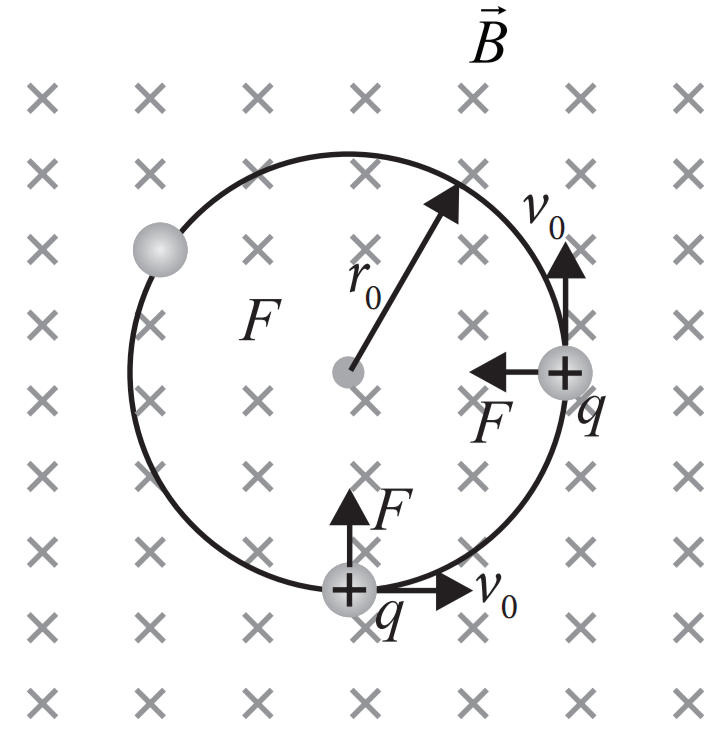
An electron with speed v0 << c moves in a circle of radius r0 in a uniform magnetic field. This electron is able to traverse a circular path as magnetic field is perpendicular to the velocity of the electron. A force acts on the particle perpendicular to both $\vec{\text{v}}_0$ and $\vec{\text{B}},$ This force continuously deflects the particle sideways without changing its speed and the particle will move along a circle perpendicular to the field. The time required for one revolution of the electron is T0.

  1. If the speed of the electron is now doubled to 2v0. The radius of the circle will change to:
  1. 4r0
  2. 2r0
  3. r0
  4. $\frac{\text{r}_0}{2}$

  1. If v0 = 2v0 then the time required for one revolution of the electron will change to:
  1. 4T0
  2. 2T0
  3. T0
  4. $\frac{\text{T}_0}{2}$

  1. A charged particles is projected in a magnetic field $\vec{\text{B}}=(2\hat{\text{i}}+4\hat{\text{j}})\times10^2\text{ T}.$ The acceleration of the particle is found to be $\vec{\text{a}}=(\text{x}\hat{\text{i}}+2\hat{\text{j}})\text{m s}^{-2}$ Find the value of x.
  1. 4ms-2
  2. -4ms-2
  3. -2ms-2
  4. 2ms-2
  1. If the given electron has a velocity not perpendicular to B, then trajectory of the electron is:
  1. Straight line.
  2. Circular.
  3. Helical.
  4. Zig-zag.
  1. If this electron of charge (e) is moving parallel to uniform magnetic field with constant velocity v, the force acting on the electron is:
  1. Bev
  2. $\frac{\text{Be}}{\text{v}}$

  3. $\frac{\text{B}}{\text{ev}}$

  4. Zero
A car starts from rest on a half kilometer long bridge. The coefficient of friction between the tyre and the road is 1.0. Show that one cannot drive through the bridge in less than 10s.
Calculate the orbital period in each of these levels.
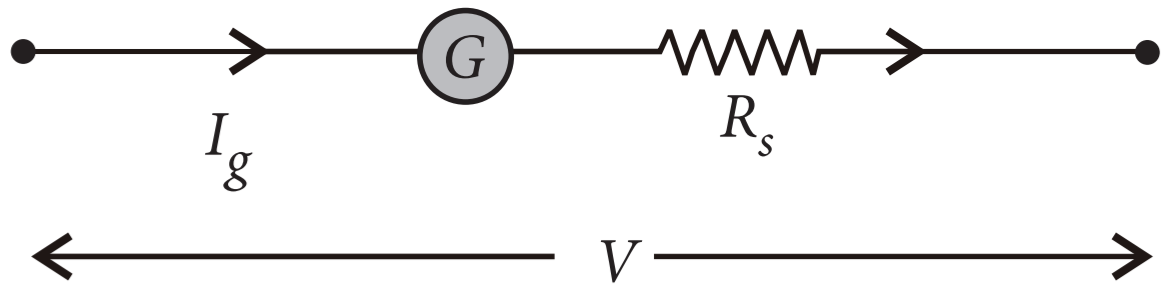
A galvanometer can be converted into voltmeter of given range by connecting a suitable resistance R, in series with the galvanometer, whose value is given by,
$\text{R}_\text{s}=\frac{\text{V}}{\text{I}_\text{g}}-\text{G}$
where Vis the voltage to be measured, lg is the current for full scale deflection of galvanometer and G is the resistance of galvanometer.

Series resistor(R,) increases range of voltmeter and the effective resistance of galvanometer. It also protects the galvanometer from damage due to large current. Voltmeter is a high resistance instrument and it is always connected in parallel with the circuit element across which potential difference is to be measured. An ideal voltmeter has infinite resistance. In order to increase the range of voltmeter n times the value of resistance to be connected in series with galvanometer is Rs = (n - 1)G.
  1. 10mA current can pass through a galvanometer of resistance $25\Omega$ What resistance in series should be connected through it, so that it is converted into a voltmeter of 100V?
  1. $0.975\Omega$
  2. $99.75\Omega$
  3. $975\Omega$
  4. $9975\Omega$
  1. There are 3 voltmeter A, B, C having the same range but their resistance are $15000\Omega,10000\Omega$, and $5000\Omega$ respectively. 'Tile best voltmeter amongst them is the one whose resistance is
  1. $5000\Omega$
  2. $10000\Omega$
  3. $15000\Omega$
  4. all are equally good.
  1. A milliammeter of range 0 to 25mA and resistance of $10\Omega$ is to be converted into a voltmeter with a range of 0 to 25V. 'Tile resistance that should be connected in series will be:
  1. $930\Omega$
  2. $960\Omega$
  3. $990\Omega$
  4. $1010\Omega$
  1. To convert a moving coil galvanometer (MCG) into a voltmeter:
  1. A high resistance R is connected in parallel with MCG.
  2. A low resistance R is connected in parallel with MCG.
  3. A low resistance R is connected in series with MCG.
  4. A high resistance R is connected in series with MCG.
  1. To increase the current sensitivity of a moving coil galvanometer, we should decrease:
  1. Zero.
  2. Low.
  3. High.
  4. Infinity.
(a) A giant refracting telescope at an observatory has an objective lens of focal length 15 m. If an eyepiece of focal length 1.0 cm is used, what is the angular magnification of the telescope?
(b) If this telescope is used to view the moon, what is the diameter of the image of the moon formed by the objective lens? The diameter of the moon is$3.48 \times 10^6$ m , and the radius of lunar orbit is $3.8 \times 10^8 m$.
A prism is a portion of a transparent medium bounded by two plane faces inclined to each other at a suitable angle. A ray of light suffers two refractions on passing through a prism and hence deviates through a certain angle from its original path. The angle of deviation of a prism is, $\delta=(\mu-1)\text{A},$ through which a ray deviates on passing through a thin prism of small refracting angle A.
If $\mu$ is refractive index of the material of the prism, then prism formula is, $\mu=\frac{\frac{\sin(\text{A}\delta_\text{m})}{2}}{\frac{\sin\text{A}}{2}}$
  1. For which colour, angle of deviation is minimum?
  1. Red
  2. Yellow
  3. Violet
  4. Blue
  1. When white light moves th rough vacuum:
  1. All colours have same speed.
  2. Different colours have different speeds.
  3. Violet has more speed than red.
  4. Red has more speed than violet.
  1. The deviation through a prism is maximum when angle of incidence is:
  1. 45º
  2. 70º
  3. 90º
  4. 60c
  1. What is the deviation produced by a prism of angle 6º? (Refractive index of the material of the prism is 1.644).
  1. 3.864º
  2. 4.595º
  3. 7.259º
  4. 1.252º
  1. A ray of light falling at an angle of 50º is refracted through a prism and suffers minimum deviation. If the angle of prism is 60º, then the angle of minimum deviation is:
  1. 45º
  2. 75º
  3. 50º
  4. 40º
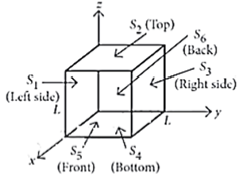
Net electric flux through a cube is the sum of fluxes through its six faces. Consider a cube as shown in figure, having sides of length $L =10.0 cm$. The electric field is uniform, has a magnitude $E =4.00 \times 10^3 NC ^{-1}$ and is parallel to the xy plane at an angle of $37^{\circ}$ measured from the + x -axis towards the + y -axis.
Image
(i) Electric flux passing through surface $S_6$ is
(a) $-24 Nm ^2 C ^{-1}$
(b) $32 Nm ^2 C ^{-1}$
(c) $-32 Nm ^2 C ^{-1}$
(d) $24 Nm ^2 C ^{-1}$

(ii) Electric flux passing through surface $S_1$ is
(a) $-32 Nm ^2 C ^{-1}$
(b) $-24 Nm ^2 C ^{-1}$
(c) $32 Nm ^2 C ^{-1}$
(d) $24 Nm ^2 C ^{-1}$

(iii) The surfaces that have zero flux are
 (a) $S _2$ and $S _4$ (b) $S_3$ and $S_6$ (c) $S _1$ and $S _2$ (d) $S _1$ and $S _3$

(iv) he total net electric flux through all faces of the cube is a) 24 Nm2 C-1 c)-8 Nm2 C-1 b
(a) $24 Nm ^2 C ^{-1}$ (b) $8 Nm ^2 C ^{-1}$ (c) $-8 Nm ^2 C ^{-1}$ (d) zero

OR

The dimensional formula of surface integral $\oint \vec{E} \cdot d \vec{S}$ of an electric field is
(a) $\left[ M ^{-1} L^3 T^{-3} A\right]$
(b) $\left[ M L ^2 T^{-2} A^{-1}\right]$
(c) $\left[ ML ^3 T^{-3} A^{-1}\right]$
(d) $\left[ M L ^{-3} T^{-3} A^{-1}\right]$
By mistake, an eye surgeon puts a concave lens in place of the lens in the eye after a cataract operation. Will the patient be able to see clearly any object placed at any distance?