MCQ
When is the conduction current the same as the displacement current?
- AWhen the source is ac
- BWhen the source is dc
- CWhen the source is either an ac or a dc
- DWhen the source is neither dc nor ac
Explanation:
The conduction current is the same as the displacement current when the source is ac.
Generate a complete, print-ready paper with questions like this in minutes — across 16+ boards, with answer keys.
Light coming from a star is observed to have a wavelength of 3737 Å, while its real wavelength is 3700 Å. The speed of the star relative to the earth is [Speed of light 3  ]
]
|
(a) 3 |
(b) 3 |
(c) 3.7 |
(d) 3.7 |
The work function for tungsten and sodium are 4.5 eV and 2.3 eV respectively. If the threshold wavelength λ for sodium is  , the value of λ for tungsten is
|
(a) 5893 Å |
(b) 10683 Å |
(c) 2791 Å |
(d) 528 Å |
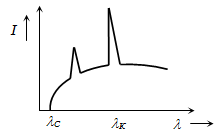
The intensity of X-rays from a Coolidge tube is plotted against wavelength as shown in the figure. The minimum wavelength found is  and the wavelength of the
  line is
  . As the accelerating voltage is increased
|
(a) ( |
(b) ( |
(c) |
(d) |
Three resistances 4Ω each of are connected in the form of an equilateral triangle. The effective resistance between two corners is
|
(a) 8 Ω |
(b) 12 Ω |
(c) |
(d) |
Velocity of light in a medium is 1.5 . Its refractive index will be
|
(a) 8 |
(b) 6 |
(c) 4 |
(d) 2 |
$\text{B}_\text{y},=\text{B}_\text{y}+\frac{\text{vE}_\text{z}}{\text{c}^2}$
$\text{E}_\text{y},=\text{E}_\text{y}+\frac{\text{vB}_\text{z}}{\text{c}^2}$
$\text{B}'_\text{y}=\text{B}_\text{y}+\text{v}\text{E}_\text{z}$
$\text{E}'_\text{y}=\text{E}_\text{y}+\text{vB}_\text{z}$
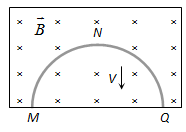
A thin semicircular conducting ring of radius R is falling with its plane vertical in a horizontal magnetic induction B. At the position MNQ, the speed of the ring is V and the potential difference developed across the ring is
|
(a) Zero |
|
(b) Bv |
|
(c) πRBV and Q is at higher potential |
|
(d) 2RBV and Q is at higher potential |


